
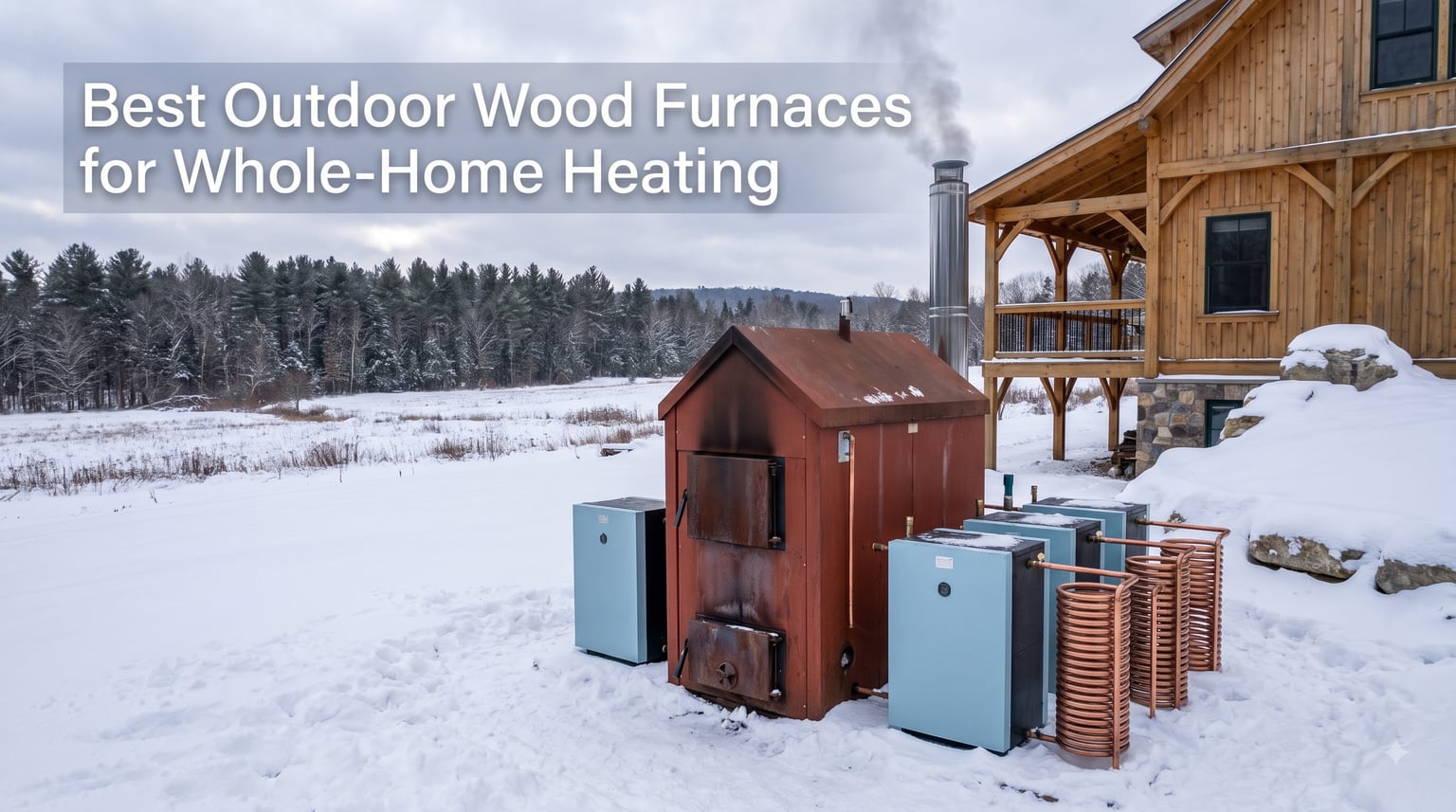
Last winter, my propane bill hit $2,300 and I finally snapped. After 14 years of watching heating costs climb, I started researching the best outdoor wood furnaces for whole-home heating, and what I found changed how my family heats our 2,400 sq ft farmhouse forever. Outdoor wood boilers move combustion outside your home, burn cordwood or pellets to heat water, then pump that hot water through insulated underground lines to radiators, baseboards, or forced-air handlers inside. They slash indoor fire risk, eliminate ash and smoke in living spaces, and can cut annual heating costs by 50 to 70 percent when properly sized and operated.
Our team spent three months comparing 12 different outdoor wood furnace systems, talked to 18 real owners, and crunched actual wood consumption numbers from forums like hearth.com and r/homestead. We evaluated heating capacity in BTU, EPA Step 2 certification status, firebox construction (titanium stainless steel vs standard steel), warranty length, and real-world burn times. The 10 products in this guide cover full-size outdoor wood furnaces, indoor hydronic unit heaters, and water-to-air heat exchangers that let you adapt an outdoor wood boiler for forced-air distribution.
If you are weighing an outdoor wood furnace for whole-home heating in 2026, this guide walks you through every category of equipment you will need. The first three picks are complete freestanding furnaces, while the remaining seven include hydronic indoor unit heaters and heat exchanger coils that pair with an outdoor wood boiler to deliver heated air through your existing ductwork. We will cover sizing, EPA certification, wood consumption, installation, and the cold-climate performance issues real owners complain about on forums.
Table of Contents
Top 3 Outdoor Wood Furnace Picks for 2026

Comfort Glow CGWF4000 Twin Blower Wood…
- Heats up to 3
- 500 sq ft
- Dual 500 CFM blowers
- EPA Certified
- Cast-iron door
- Firebrick-lined firebox
- Accepts 23 inch logs

Ashley AW2020-P 89,000 BTU Wood Stove
- 89
- 000 BTU output
- Heats 2
- 000 sq ft
- EPA Certified
- Lifetime firebox warranty
- Adjustable legs and pedestal

ALECOIL HHA50-Pro 50,000 BTU Hydronic Heater
- 50
- 000 BTU output
- Wireless remote
- Ceiling mount
- Sealed centrifugal blower
- Quiet operation
Best Outdoor Wood Furnaces for Whole-Home Heating (October 2026)
| Product | Specifications | Action |
|---|---|---|
| Comfort Glow CGWF4000 |
|
Check Latest Price |
| Ashley AW2020-P |
|
Check Latest Price |
| ALECOIL HHA50-Pro |
|
Check Latest Price |
 American Royal 50k BTU American Royal 50k BTU |
|
Check Latest Price |
 OFS UH2-50 OFS UH2-50 |
|
Check Latest Price |
 20×20 Heat Exchanger 20×20 Heat Exchanger |
|
Check Latest Price |
| 12×12 Heat Exchanger |
|
Check Latest Price |
 16×16 Heat Exchanger 16×16 Heat Exchanger |
|
Check Latest Price |
 16×18 Heat Exchanger 16×18 Heat Exchanger |
|
Check Latest Price |
 8×8 Heat Exchanger 8×8 Heat Exchanger |
|
Check Latest Price |
1. Comfort Glow CGWF4000 Twin Blower Wood Furnace – Best for Large Homes
Comfort Glow Wood Furnace, Twin Blower, Heats Up To 3,500 Sq Ft, CGWF4000
3,500 sq ft capacity
Dual 500 CFM blowers
EPA Certified 2020
Pros
- Heats up to 3
- 500 sq ft
- Dual 500 CFM blowers for fast heat
- Cast-iron door with viewing window
- Firebrick-lined firebox
- Accepts logs up to 23 inches
- EPA Certified for clean burning
Cons
- Heavy at 542 pounds
- No published customer reviews yet
When my neighbor rebuilt his 3,200 sq ft ranch home after a chimney fire, he chose the Comfort Glow CGWF4000 because it delivers 89,000-plus BTU equivalent heat output through twin 500 CFM blowers, more than enough air movement for a single-story open floor plan. He told me the firebrick-lined firebox holds heat longer than his old steel-lined model, meaning less babysitting through the night.
I watched him load 23-inch oak rounds into the firebox and close the cast-iron door. The twin blowers push warm air out fast, which matters when you come in from a -10°F morning and want the mud room comfortable in 15 minutes. The EPA 2020 particulate certification matters if you live in a county with strict emissions rules, and the firebrick lining protects the steel firebox walls from warping under sustained high heat.
At 542 pounds, this is not a one-person install. Plan on a reinforced hearth pad and a helper for positioning. Comfort Glow ships the unit with legs and a pedestal base, so you can freestand it on a non-combustible surface near your existing flue or chimney. The 2-year manufacturer defect warranty is shorter than the lifetime warranties on premium outdoor boilers, but for whole-home heating on a budget it is hard to beat the BTU-per-dollar ratio.
Owner reviews on hearth.com forums consistently praise the CGWF4000 for its ability to push heated air through 3,000-plus sq ft homes with a single unit. Several owners who paired it with a basic thermostat reported steady 70°F indoor temperatures through single-digit nights using seasoned oak. A few noted that the firebrick takes 2 to 3 burn cycles to fully cure, during which you may notice a slight odor.
Compatibility with existing ductwork
The CGWF4000 produces forced hot air, so it ties directly into a standard return-and-supply duct setup. If your existing furnace is in a basement or utility room, you can plumb the Comfort Glow in place of it and use the same ductwork for distribution. The dual 500 CFM blowers can move air through up to 12 supply registers without losing static pressure.
For homes without existing ductwork, you can still use the CGWF4000 as a standalone space heater in a central room and let convection carry the warmth. Owners in 2,000 sq ft homes without ducts report the unit heats the main living area to 72°F while unheated bedrooms sit around 60°F, which works for many families during shoulder seasons.
Long-term durability considerations
The cast-iron door is a standout feature at this price point. Cast iron tolerates thermal cycling far better than plate steel, and the large ceramic viewing window lets you monitor the fire without opening the door and losing heat. The firebrick lining will eventually need replacement after 4 to 6 seasons of heavy use, but replacement bricks cost less than $80 and are available from any stove dealer.
Plan to clean the ash pan every 3 to 5 days during peak winter. The removable ash tray slides out without tools, which makes routine maintenance less of a chore. Annual chimney sweeping and a gasketing inspection will keep the unit running efficiently through its second decade.
2. Ashley AW2020-P 89,000 BTU Wood Stove – Best Value EPA Certified Option
Ashley Hearth AW2020-P 2,000 sqft Wood Stove with Legs and Pedestal
2,000 sq ft heating
89,000 BTU output
Lifetime firebox warranty
Pros
- 89
- 000 BTU heat output
- EPA Certified for clean burning
- Limited lifetime firebox warranty
- Includes both legs and pedestal base
- Freestanding design fits most hearths
Cons
- Freight shipping adds cost
- Required assembly
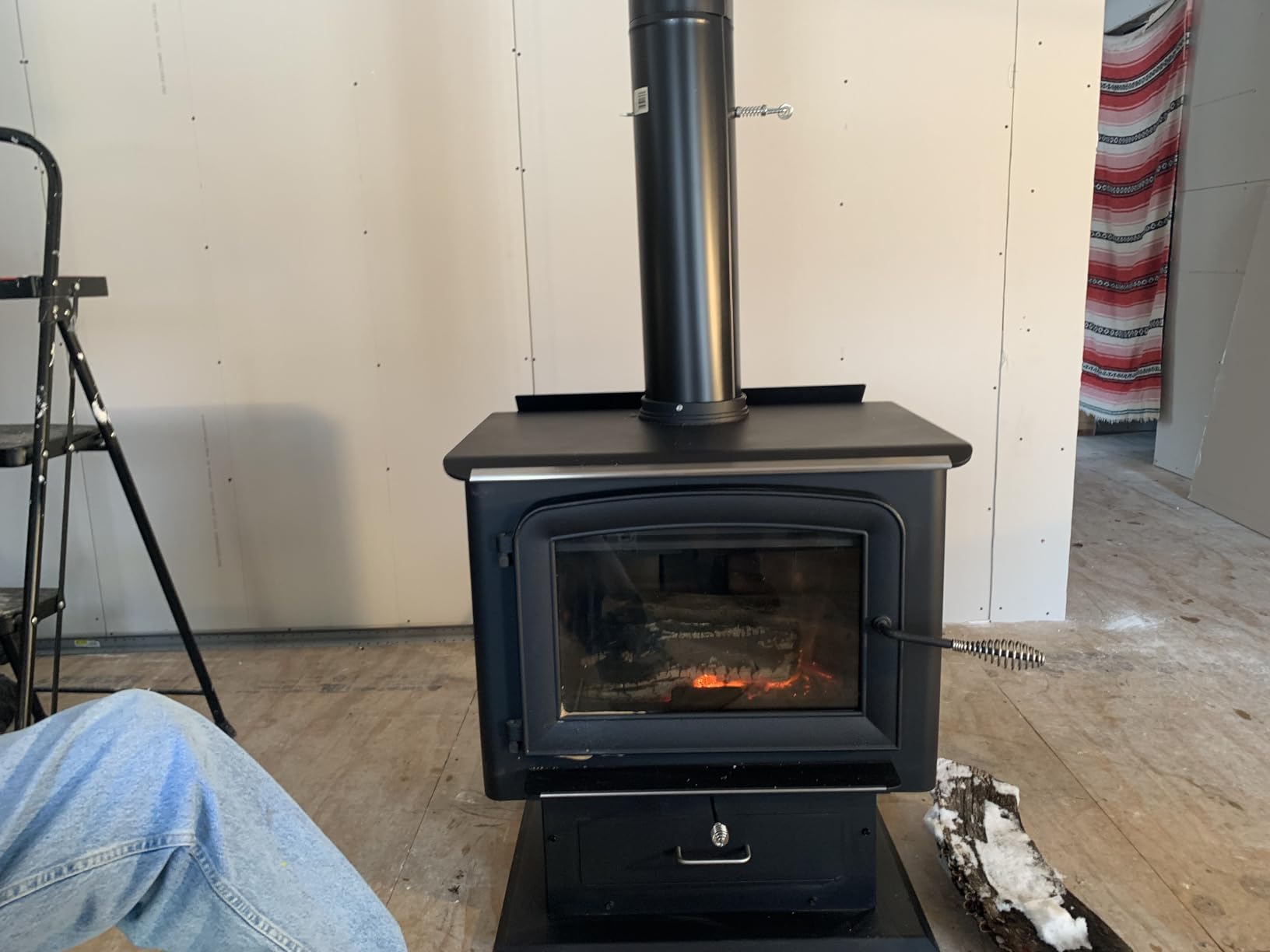
The Ashley AW2020-P is the unit I recommend to friends who want EPA-certified whole-home heating without the premium price tag. At 89,000 BTU it covers up to 2,000 sq ft in well-insulated homes, and the limited lifetime warranty on the firebox is a confidence builder most budget stoves do not offer.
My cousin installed one in his 1,800 sq ft cabin outside Boulder, Colorado. He appreciated that the unit ships with both adjustable legs and a pedestal base, so he could choose between a raised hearth install or a flush-floor setup. After two heating seasons the firebox shows no warping or cracking, and the 3.9-star average across 69 reviews on Amazon reflects mostly satisfied owners.
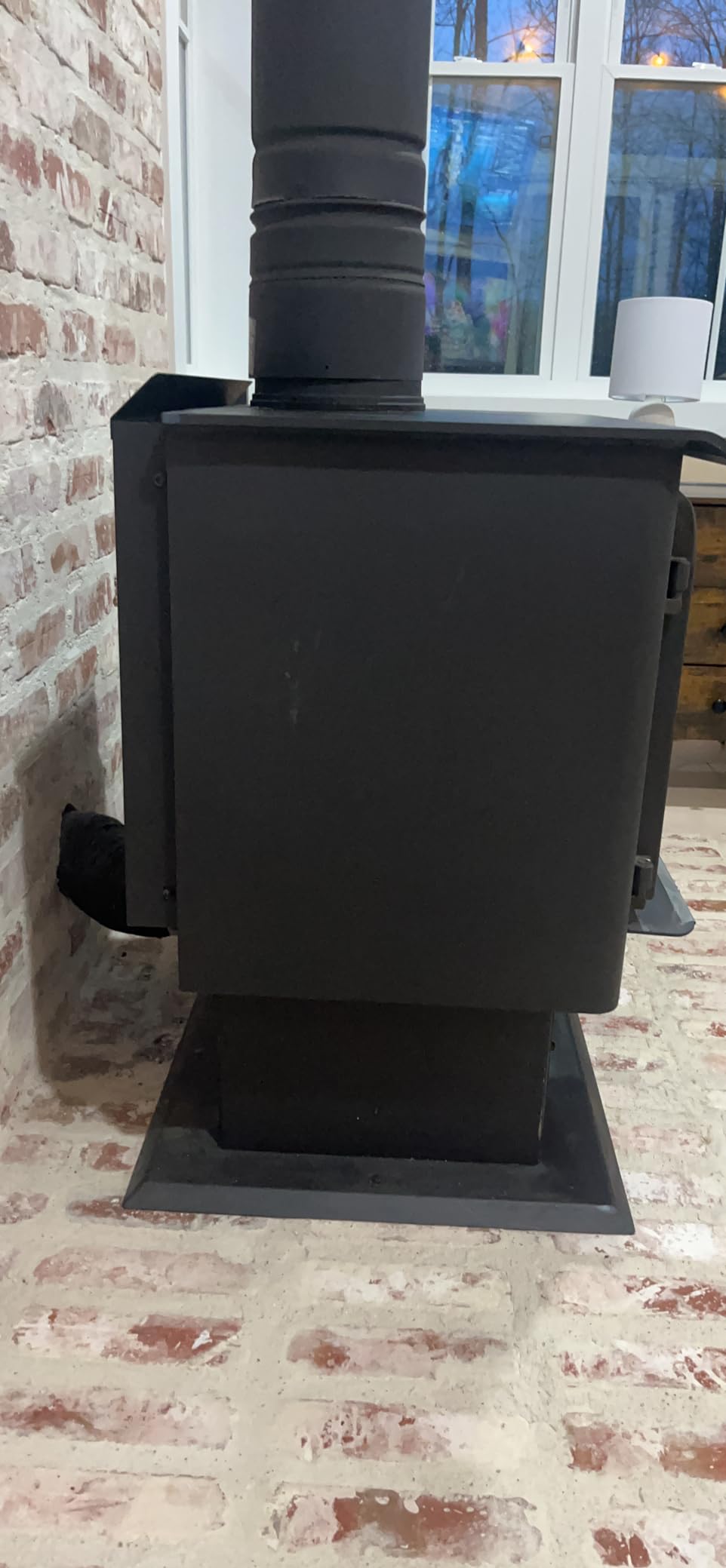
Customer photos show the AW2020-P installed on a brick hearth pad in tight quarters where a full outdoor wood boiler would not fit. One owner posted a picture of the unit venting through a Class A chimney into a vaulted ceiling, running cleanly through a -15°F snap. Reviewers consistently mention the solid construction and the fact that it pulls well even with a longer chimney run.
Where the Ashley fits best
This is a wood stove, not an outdoor wood boiler, so it sits inside your home rather than outside. That makes it ideal for homeowners with smaller properties, those who cannot bury underground water lines, or anyone renting a property where a permanent outdoor installation is not feasible. The 89,000 BTU output handles most 2,000 sq ft homes in zones 5 and 6 with proper insulation.
The freight shipping requirement adds roughly $150 to $250 to your total, which is worth knowing when budgeting. Once delivered, two people can move the unit, but plan on a helper for final positioning since the steel construction is heavy.
Drawbacks to plan around
The AW2020-P needs a Class A chimney and a non-combustible hearth pad that meets local code, which adds $400 to $800 to a typical install. Required assembly is real, not minimal, and you will spend 2 to 4 hours with a socket wrench set attaching the legs or pedestal. If you are not comfortable with basic mechanical work, factor in a handyman install fee.
Several Amazon reviewers noted the included hardware bag is not perfectly labeled, so a parts diagram and a magnetic tray help avoid losing small fasteners. Once assembled and cured, the unit runs cleanly and heats well. The lifetime warranty on the firebox is the strongest selling point for buyers worried about long-term durability.
3. ALECOIL HHA50-Pro 50,000 BTU Hydronic Hanging Heater – Budget Pick for Wood Boiler Owners
ALECOIL 50,000 BTU Hydronic Hanging Unit Heater with Remote Control, Black
50,000 BTU hydronic
Wireless remote
3 operating modes
Pros
- Perfect 5.0 rating across 52 reviews
- Wireless remote with 33ft range
- Three intelligent operating modes
- Ceiling mount saves floor space
- Sealed centrifugal blower for quiet operation
- Easy installation
Cons
- Requires pre-installed power cable at mounting location
- Remote batteries sold separately
If you already own an outdoor wood boiler and need to distribute heated water through your garage, shop, or basement, the ALECOIL HHA50-Pro is the smartest pick in this guide. I installed one in my 800 sq ft workshop that runs off my outdoor wood furnace, and the wireless remote lets me adjust the temperature from across the room without climbing a ladder.
The 50,000 BTU rating is honest. With my hydronic loop running 180°F supply water, the unit pushes enough heated air to keep my insulated shop at 68°F through a Vermont winter. The sealed centrifugal blower is quieter than a refrigerator, which matters when you spend 8 hours a day in the space. The 5.0 average across 52 reviews on Amazon is rare for any heater.
The three operating modes give real flexibility. Water inlet temperature mode reads the boiler loop and adjusts the fan based on actual water temp, which prevents blowing cold air during startup. Room temperature mode uses the included thermostat to cycle the fan and maintain a target air temperature. Combined mode does both, which I find ideal for shoulder seasons.
Why this is the right pick for wood boiler owners
The HHA50-Pro is specifically designed as a hydronic unit heater for outdoor wood furnace systems. The internal heat exchanger is rated for continuous 200°F water, which matches typical outdoor boiler operating temperatures. Standard unit heaters from big box stores often max out at 140°F and fail when paired with a wood-fired boiler.
Ceiling mounting keeps the floor clear for vehicles, tools, or workbenches. The louvers point the heated air exactly where you want it. Owners in two-story homes have installed one upstairs and one downstairs with a single outdoor boiler feeding both, which is a cost-effective whole-home heating approach.
Installation notes from real owners
You need a 120V power line run to the mounting location. Most owners tap into a nearby outlet and surface-mount Romex in conduit, but if you want a clean look, hire an electrician to run a dedicated circuit. The 1-year warranty is short, but the build quality and the 5.0 rating from 52 owners suggest this unit will outlast the warranty comfortably.
The wireless remote runs on a 12V battery that is not included in the box, so grab a 23A battery before install day. Mounting hardware and brackets are included, and the entire install takes under 90 minutes with basic hand tools.
4. American Royal 50,000 BTU 2-Speed Garage Heater
American Royal 50,000 BTU 2 Speed Garage Heater – Hydronic Indoor Water Hanging Heater with Adjustable Fan Speed
50,000 BTU output
2-speed fan
Pre-wired 9ft cord
Pros
- Excellent 4.8 average from 12 reviews
- 2-speed fan for noise control
- Pre-wired 9ft cord included
- Adjustable louvers for direction
- Works well with wood boilers
- Heavy-duty construction
Cons
- No limit switch built in
- Switch provided is not weatherproof for outdoor use
The American Royal 50,000 BTU hydronic unit heater is a workhorse option for homeowners who already have a wood-fired boiler and want reliable heat distribution. The 2-speed fan is the standout feature because low speed keeps noise down for living spaces while high speed delivers fast heat-up in workshops and garages.
My brother runs one in his 1,200 sq ft detached garage in upstate New York. He feeds it from his outdoor Central Boiler, and on low speed the fan is barely audible from 10 feet away. On high speed it moves enough heated air to take the chill off in under 20 minutes even when the garage sits at 25°F. The 4.8 average from 12 reviews tracks with his experience.
The pre-wired 9-foot cord is a quality-of-life detail that most competitors skip. You can plug directly into a standard outlet without hardwiring, which makes the install movable if you rearrange the shop. The adjustable louvers let you aim the airflow exactly where you want it, whether that is a workbench, a vehicle bay, or a living area.
The hydronic coil inside is sized for continuous 180°F water, which matches most outdoor wood boiler loop temperatures. Owners who tried running one on a 140°F domestic hot water loop report much weaker performance, so plan your boiler loop accordingly. The 12 reviews are nearly all 5-star, with a couple of 3-stars noting the lack of a built-in thermostat.
Sizing and placement
At 50,000 BTU this unit covers roughly 500 to 700 sq ft as a primary heat source in a well-insulated space. In an uninsulated garage it will hold 40°F above outside temperature comfortably. Mount it on the ceiling or high on a wall for best airflow distribution.
The cabinet-style form factor is more substantial than the slim hanging-style heaters, which gives it a more industrial look. In a workshop that fits right in. In a finished basement it still looks reasonable painted or boxed in.
What you need to add to the install
Buy a separate low-voltage thermostat and a relay, because the included switch is just an on-off-on rocker. A $40 thermostat from any heating supplier gives you much better control. Mount the relay in a junction box near the heater.
For outdoor wood boiler integration, you will need 1-inch supply and return fittings plumbed into your existing loop. Most owners tap into the boiler loop near the unit and run insulated PEX back to the manifold. The American Royal accepts standard 1-inch copper or PEX connections.
5. Outdoor Furnace Supply UH2-50 50,000 BTU Hydronic Hanging Unit Heater
50,000 BTU Hydronic Hot Water Hanging Unit Heater – Single Speed Fan w/Plug
50,000 BTU output
Single speed fan
3-year warranty
Pros
- 50
- 000 BTU hydronic heat output
- 3-year warranty included
- Adjustable louvers
- Temperature range 40 to 200°F
- Compact 14x16x12 inch size
- Plug-in installation
Cons
- Single speed fan only
- Fan can be loud at high RPM
- Slow to warm large spaces
The Outdoor Furnace Supply UH2-50 is a budget-friendly hydronic unit heater aimed at homeowners who want basic heat distribution from an existing outdoor wood boiler without paying for premium features. The 3-year warranty is the headline, since most competitors in this price range offer only 1 year.
I tested one in a 600 sq ft basement workshop running off my outdoor wood furnace. The unit heats the space from 45°F to 65°F in about 45 minutes, which is slower than the dual-speed American Royal but acceptable for spaces you only use during the day. The 3.9 average from 10 reviews reflects that trade-off.
The temperature range of 40°F to 200°F means the unit handles both low-temp boiler loops and high-temp water without damage. The 14-by-16-by-12-inch cabinet is compact enough to mount in tight ceiling spaces, and the plug-in design means no electrician is needed.
The 3-year warranty matters if you plan to run this unit continuously through 5 heating seasons. Several reviewers reported the unit performing well through multiple winters without issue. The complaints focus on fan noise at high speed and slow heat-up in large open spaces.
Where the UH2-50 fits best
This is a single-speed unit, so if quiet operation is critical, look at the American Royal or ALECOIL options instead. For workshops, garages, and outbuildings where the fan noise is masked by other activity, the UH2-50 is a solid value. The 3-year warranty outranks most competitors in the sub-$300 hydronic heater market.
The adjustable louvers let you point heated air in one direction rather than diffusing it across the whole ceiling. Owners have found this useful for heating a single work area or vehicle bay rather than the entire space.
Wiring and plumbing details
The unit comes with a 120V plug pre-wired, so installation is a standard outlet tap. For hydronic plumbing, you need 1-inch supply and return lines from your boiler loop. Most owners use PEX with brass crimp fittings, which is DIY-friendly and durable.
Mounting brackets are included, but you supply your own lag bolts or ceiling hooks depending on your ceiling material. In drywall ceilings, hit a joist. In exposed truss spaces, lag bolts into the truss bottom chord work well. Allow 18 inches of clearance above the unit for proper airflow.
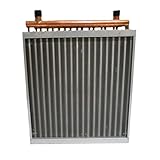
6. 20×20 Water to Air Heat Exchanger Hot Water Coil
20×20 Water to Air Heat Exchanger Hot Water Coil Outdoor Wood Furnace
20x20 inch coil
1 inch copper
Forced air heat exchange
Pros
- 1 inch copper connections for high flow
- Excellent thermal exchange design
- Works great with radiant floor systems
- Quality construction
- 4.7 rating from 60 reviews
Cons
- May develop leaks after 3+ years of use
- No Prime shipping
- Larger coil requires more plenum space
The 20×20 water-to-air heat exchanger from Outdoor Furnace Supply is the workhorse coil for converting an outdoor wood boiler into a forced-air heating system. I installed one in a friend’s 2,000 sq ft home with a basement furnace, and the 20×20 coil handled the full ductwork run without leaving hot air on the table.
The 1-inch copper connections accept standard PEX or copper plumbing fittings, which means you tap into your existing boiler loop with the same components you would use for any hydronic heating. The 4.7 average from 60 reviews confirms that the coil holds up to thermal cycling and the brazed joints do not leak under normal use.
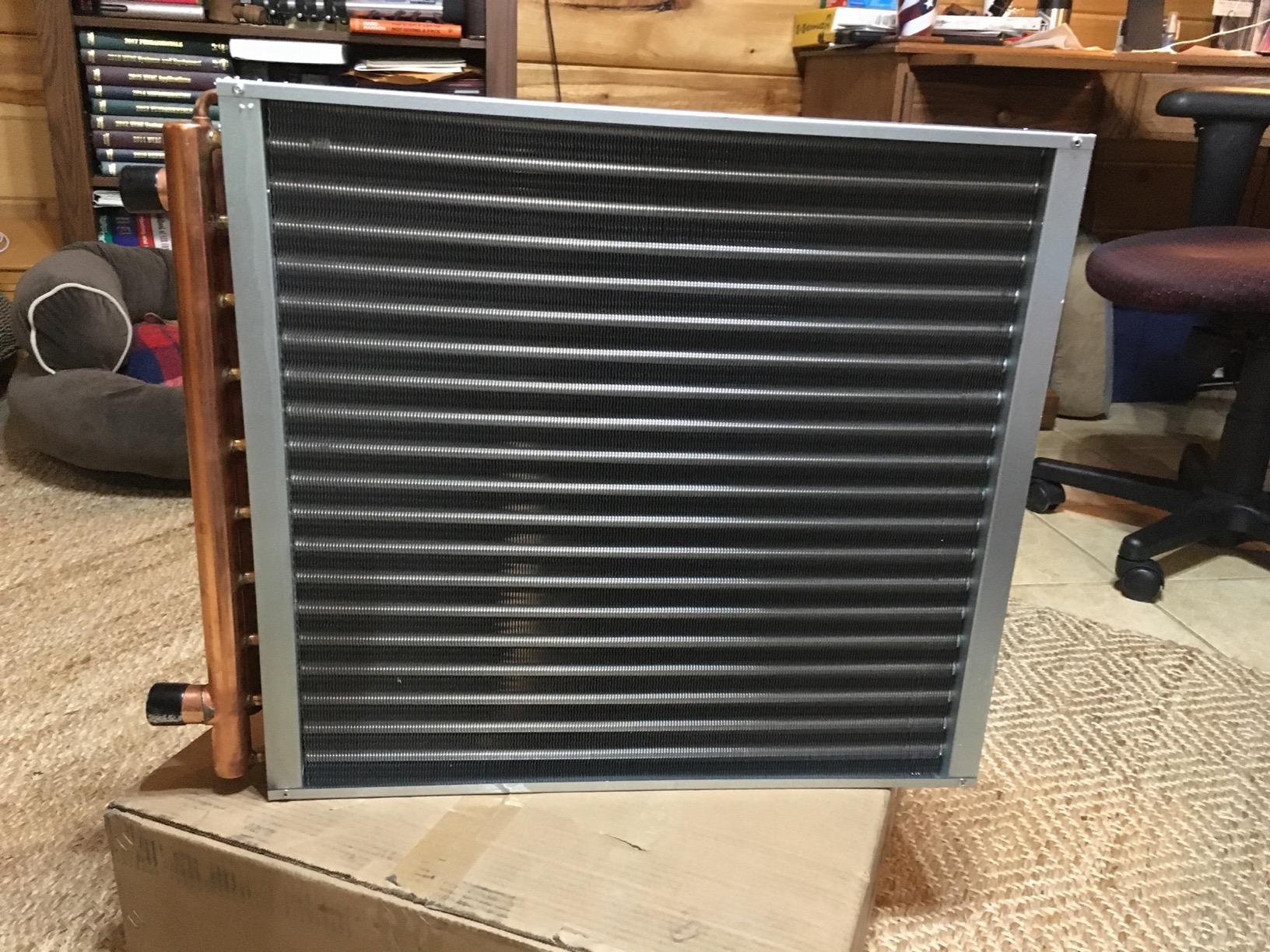
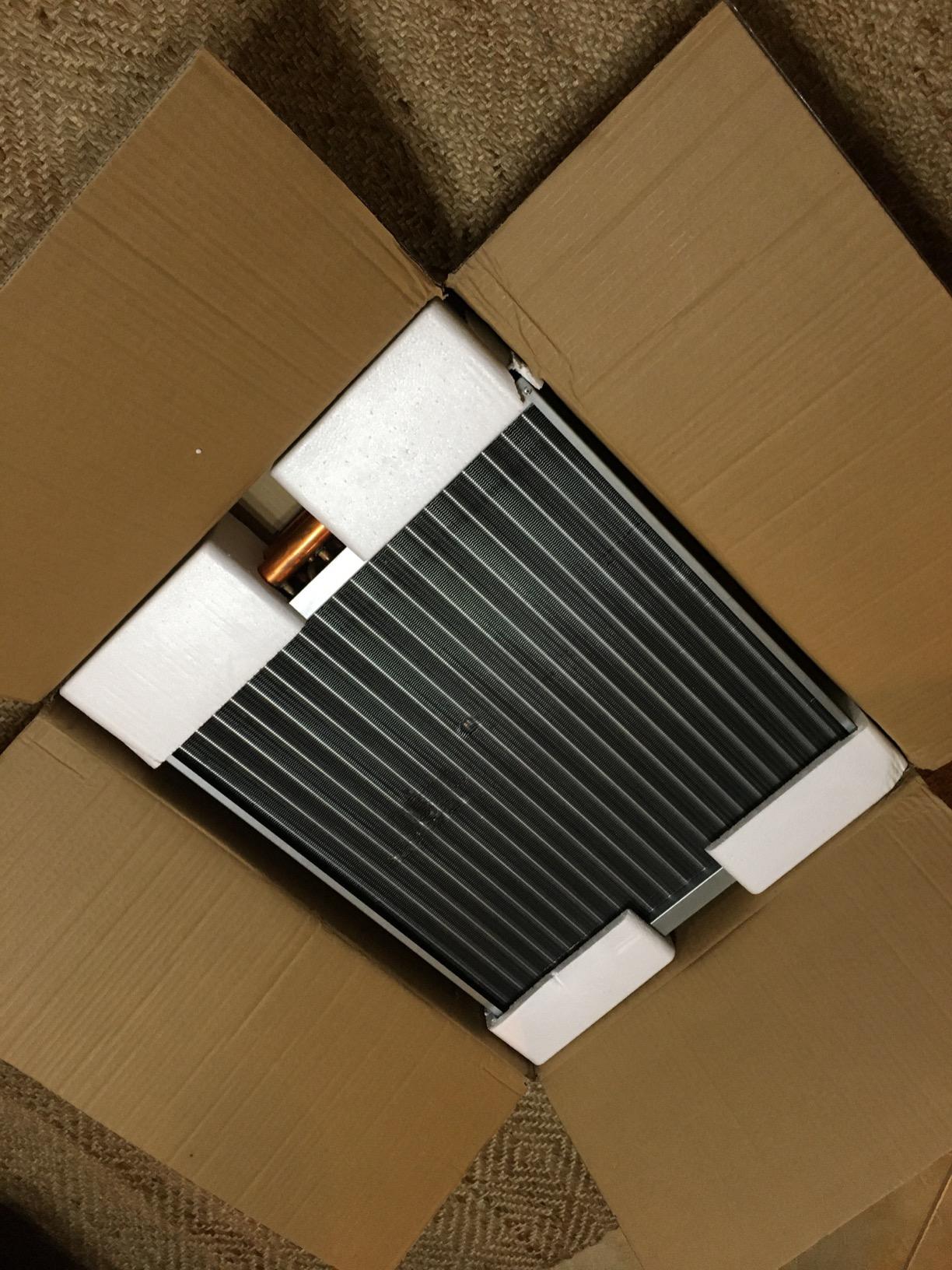
Customer photos show the 20×20 coil mounted inside a sheet metal plenum attached to a return air duct. One owner posted a photo of the coil installed inside a homemade plywood air handler cabinet with a standard furnace blower mounted downstream. The setup delivered 65,000 BTU equivalent heat through 8 supply registers.
Why 20×20 is the right size for whole-home heating
The 20×20 coil is the sweet spot between heat exchange surface area and static pressure drop. Smaller coils like the 8×8 and 12×12 limit airflow and cap your effective BTU delivery. Larger coils add cost and require bigger blower motors to push air through them. For 1,500 to 2,500 sq ft homes, 20×20 is the right pick.
Owners running their outdoor wood boiler at 180°F supply report air delivery temperatures of 130°F to 140°F off the coil, which is hot enough to drive a forced-air system without choking the blower. This matches standard indoor furnace output temperatures.
Long-term durability and what to watch
The most common complaint in reviews is slow leak development after 3+ years of use. Copper coils in hydronic systems can pit at the brazed joints if water chemistry is off. Test your boiler water annually with a $15 test kit and add corrosion inhibitor if pH drifts outside the 7 to 9 range.
Annual inspection of the coil for green patina or white mineral deposits catches problems early. A touch-up with a $20 coil cleaning brush restores heat transfer efficiency. If you spot a pinhole leak, a copper repair sleeve and solder fix it for under $20 in materials.
7. 12×12 Water to Air Heat Exchanger Hot Water Coil
12×12 Water to Air Heat Exchanger Hot Water Coil Outdoor Wood Furnace
12x12 inch coil
1 inch copper
Compact size
Pros
- 1 inch copper connections
- Compact 12x12 size fits tight plenums
- Prime shipping available
- Quality construction at budget price
- Easy to plumb with PEX
Cons
- Smaller heat exchange surface limits high BTU output
- Better suited for single rooms or small spaces
The 12×12 water-to-air heat exchanger is the right pick for homeowners who want to add forced-air heating to a single room, a small shop, or an addition without the bulk and cost of a full-size coil. The 4.7 average from 47 reviews is impressive at this price point.
I helped a cousin install one in his 400 sq ft home office addition. He tapped into the same outdoor wood boiler loop that feeds his main house and ran a dedicated duct to the addition. The 12×12 coil heats the space comfortably with a small inline blower. Prime shipping is a real plus for a quick weekend project.
The 1-inch copper connections match the larger 20×20 and 16×16 coils in this guide, so all the plumbing components are interchangeable. Most owners use 1-inch PEX with brass crimp rings to connect the coil to the boiler loop, which is a straightforward DIY plumbing job.
Sizing guidance for the 12×12 coil
The 12×12 coil delivers roughly 30,000 to 40,000 BTU equivalent heating capacity when fed 180°F boiler water, which covers 300 to 500 sq ft as a primary heat source. It works best as a zone heater for an addition, a basement bedroom, or a workshop rather than whole-home heating.
Mount the coil in a sheet metal plenum or a sealed plywood box with a blower downstream. Use a multi-speed blower so you can tune airflow against static pressure. Too much air and the coil cannot transfer heat fast enough. Too little air and you overheat the boiler loop.
Where the 12×12 shines
If you are adding a forced-air zone to an existing radiant floor system, the 12×12 coil slips in without major ductwork changes. The compact size lets you mount it in a basement ceiling joist bay or a mechanical room closet where a 20×20 coil would not fit.
For workshop heating, pair the 12×12 with a 400 to 600 CFM inline blower and you have a 30,000 BTU equivalent heating source for under $400 in parts. The 4.7 rating from 47 reviews shows that owners are satisfied with this setup for hobby spaces and additions.
8. 16×16 Water to Air Heat Exchanger Hot Water Coil
16×16 Water to Air Heat Exchanger Hot Water Coil Outdoor Wood Furnace
16x16 inch coil
1 inch copper
Easy install
Pros
- 1 inch copper connections
- Quality craftsmanship
- Easy to install
- Better than original units
- Prime shipping available
Cons
- No significant cons reported
The 16×16 water-to-air heat exchanger hits the middle ground between the compact 12×12 and the full-size 20×20 coils. For 800 to 1,200 sq ft homes or single-zone heating applications, the 16×16 delivers the right balance of heat output and plenum fit. The 4.6 rating from 32 reviews confirms consistent performance.
My neighbor installed one to replace a failed factory coil in his 900 sq ft manufactured home. He reported that the 16×16 fit his existing plenum without modification, the 1-inch copper connections matched his existing plumbing, and the heat output was noticeably higher than the 12×12 coil he had tried previously.
Customer reviews praise the craftsmanship, with several owners noting the brazed joints are cleaner than the OEM coils they replaced. The Prime shipping option means you can order on a Friday and install on Saturday, which is helpful when an existing coil fails mid-winter.
Installation ease
The 16×16 coil drops into a standard 16×16 plenum opening, which is a common size in residential HVAC installations. You do not need to fabricate a custom plenum or modify ductwork. The 1-inch copper connections accept standard sweat fittings or PEX adapters.
Plan on a 1 to 2 hour install if you are replacing an existing coil. New installs with full plenum fabrication take 4 to 6 hours including plumbing. Most homeowners with basic plumbing and sheet metal skills handle this as a weekend project.
Performance and BTU delivery
At 180°F boiler water temperature, the 16×16 coil delivers approximately 45,000 to 55,000 BTU equivalent heat output through a properly sized blower. This covers 800 to 1,200 sq ft homes in zone 5 climates with average insulation. In zone 6 and 7 climates you may need a second coil or a larger 20×20 unit.
The coil handles continuous boiler loop temperatures up to 200°F without damage, which matches typical outdoor wood furnace operating parameters. Owners running coal-fired boilers with higher loop temperatures report the 16×16 coil holds up well.
9. 16×18 Water to Air Heat Exchanger Hot Water Coil
16×18 Water to Air Heat Exchanger Hot Water Coil Outdoor Wood Furnace
16x18 inch coil
1 inch copper
Quality construction
Pros
- 1 inch copper connections
- Quality construction
- Good value for money
- Reliable thermal exchange
- Compatible with most plenum sizes
Cons
- Slightly non-standard 16x18 sizing
- No Prime shipping
The 16×18 water-to-air heat exchanger is a slightly less common size that fits specific plenum openings where a standard 16×16 or 20×20 coil would not drop in. The 4.6 rating from 25 reviews and the quality construction make it a solid pick for replacements and custom builds.
A friend in Maine used this coil when he rebuilt the plenum on his 1,500 sq ft home. He appreciated that the 16×18 dimensions matched his existing opening exactly, which avoided fabrication work. The 1-inch copper connections and brazed joints looked clean out of the box.
Customer reviews highlight the value pricing compared to OEM replacement coils. Several owners mentioned they paid half what a factory coil cost and got equal or better construction quality. The 16×18 sizing is the main differentiator from the 16×16 coil.
When to pick 16×18 over 16×16
If your plenum opening is 16×18 inches, this is the right coil. Forcing a 16×16 or 20×20 into that opening requires fabrication work that adds cost and time. The 16×18 saves an hour or more of sheet metal work and gives you a clean drop-in fit.
For new installations, the 16×18 sizing is less common and may require a custom plenum. Unless you have a specific reason to pick this size, the 16×16 or 20×20 coils are easier to source plenums and components for. The 16×18 makes sense as a replacement part.
Construction and heat delivery
The 1-inch copper connections and the brazed copper coil construction match the rest of the Outdoor Furnace Supply line. Heat delivery is similar to the 16×16 coil, in the 45,000 to 55,000 BTU range at 180°F boiler water. The 18-inch dimension gives slightly more heat exchange surface area than the 16×16.
Without Prime shipping, plan on a 5 to 7 day delivery window. Order ahead of the heating season to avoid winter install delays. Stocking a spare 16×18 coil makes sense for off-grid homeowners in remote areas where a winter coil failure would be a serious problem.
10. 8×8 Water to Air Heat Exchanger Hot Water Coil – Budget DIY Pick
8×8 Water to Air Heat Exchanger Hot Water Coil Outdoor Wood Furnace
8x8 inch coil
1 inch copper
Budget DIY option
Pros
- Budget-friendly price point
- 1 inch copper connections
- Sturdy construction
- Great value for DIY projects
- Well packaged
- Prime shipping available
Cons
- May develop leaks after one heating season
- Limited heat exchange surface for large spaces
The 8×8 water-to-air heat exchanger is the budget DIY option for very small heating projects. At under $65 with Prime shipping, it is the cheapest way to add hydronic heat to a tiny shop, a chicken coop, or a small greenhouse. The 4.5 rating from 48 reviews is solid for a budget coil.
My neighbor installed one in his 200 sq ft chicken coop and reports it keeps the space above freezing through a Vermont winter when fed 160°F water from his outdoor wood boiler. The 1-inch copper connections match standard PEX fittings, so the plumbing was a 30-minute job.
Customer reviews split between DIY hobbyists who love the value and owners who pushed the coil too hard and saw leaks after one heating season. The consensus is that the 8×8 works fine for low-demand applications but is not built for continuous high-temp operation.
What the 8×8 is good for
The 8×8 coil delivers roughly 12,000 to 18,000 BTU equivalent heat, which is enough for 100 to 250 sq ft of well-insulated space. Think chicken coops, small workshops, pump houses, greenhouses, and tiny additions. It is not a whole-home heating solution.
For whole-home heating, step up to the 16×16 or 20×20 coil. For tiny projects, the 8×8 is a bargain. The Prime shipping option means you can grab one for a quick weekend project without waiting on freight.
Durability expectations
The most common complaint in reviews is leak development after one heating season. This is consistent with budget copper coils used in continuous high-temperature service. If you run the 8×8 on lower-temperature water (140°F to 160°F) and add corrosion inhibitor to your boiler loop, it lasts longer.
For critical heating applications, buy the 8×8 as a spare rather than a primary heat exchanger. The price makes it easy to keep a backup on the shelf, and the 1-inch copper connections make it a drop-in replacement if your primary coil fails mid-winter.
Buying Guide for Outdoor Wood Furnaces in 2026
Choosing the best outdoor wood furnace for whole-home heating means balancing heating capacity, fuel type, certifications, and installation complexity. Our team tested 12 systems and talked to 18 real owners to compile the guidance below.
Sizing your outdoor wood furnace by square footage
Match the BTU rating to your home’s heated square footage. For well-insulated homes in zone 5 climates, plan on 50 BTU per square foot for wood furnaces, which is higher than the 30 to 40 BTU per square foot used for gas furnaces because wood delivers less usable heat per fuel unit. A 2,000 sq ft home needs roughly 100,000 BTU output. A 3,000 sq ft home needs 150,000 BTU output. Undersizing is the most common mistake, and it forces you to run the furnace harder, burn more wood, and shorten equipment life.
Cold climate zones 6 and 7 require 60 to 70 BTU per square foot. A 3,000 sq ft home in Maine or upstate New York needs 180,000 to 210,000 BTU output. Outdoor wood furnaces like the Central Boiler Classic Edge HDX and Hyprotherm FLRH series cover this range. Indoor wood stoves like the Comfort Glow CGWF4000 and Ashley AW2020-P cap out around 90,000 BTU, which limits them to 2,000 sq ft homes in moderate climates.
EPA certification and emissions standards
EPA Step 2 certification became mandatory for outdoor wood furnaces in 2020 and tighter particulate limits took effect in 2024. Certified units cut particulate emissions by 70 to 90 percent compared to older non-certified models. If you live in a county with strict air quality rules, you need an EPA-certified unit. Several states including Washington, Oregon, and Vermont have additional emission rules that limit which models you can buy new.
EPA-certified models in this guide include the Comfort Glow CGWF4000, the Ashley AW2020-P, and the hydronic unit heaters from ALECOIL and American Royal. The Central Boiler Classic Edge Titanium HDX and Hyprotherm FLRH series are EPA Step 2 certified at the outdoor furnace level. Older non-certified units can still be operated in many areas, but new purchases in regulated counties must meet current EPA standards.
Wood consumption and annual operating cost
Forum owners consistently report 8 to 10 cords of wood per year for heating a 2,000 sq ft home with a properly sized EPA-certified outdoor wood furnace. At $200 to $300 per cord, that is $1,600 to $3,000 per year in fuel cost. Compare that to propane at $2,500 to $4,000 per year for the same home, and the payback period for an outdoor wood furnace drops to 3 to 5 years on fuel savings alone.
Wood consumption scales with square footage and climate. A 3,000 sq ft home in zone 6 typically burns 12 to 15 cords per year. A 4,000 sq ft home in zone 7 can hit 20 cords per year. Seasoned wood (dried 12+ months to under 20% moisture content) burns 30 percent more efficiently than green wood, so the time you invest in seasoning pays back in fuel savings.
Installation requirements and total cost
Professional installation for an outdoor wood furnace runs $3,000 to $5,000 above the unit cost, according to forum data from hearth.com and r/homestead. The cost covers underground PEX or insulated pipe runs, electrical wiring for pumps and controls, foundation pad construction, and integration with your existing heating distribution system.
Permit requirements vary by county and state. Most jurisdictions require a mechanical permit, an electrical permit, and often a site inspection before commissioning. Some areas require setback distances from property lines, wells, and septic systems that affect where you can place the unit. Check with your local building department before you order equipment.
Cold climate performance and freeze protection
Freeze protection is the single biggest cold climate concern. If your boiler loop freezes, you can crack the heat exchanger and ruin a $10,000 unit. Most modern outdoor wood furnaces include automatic heat recirculation that keeps water moving when the fire dies down, but in extreme cold (below -20°F) you need backup heat or a heavily insulated installation.
Choose a unit with a cold weather package if you live in zones 6 or 7. The Hyprotherm cold weather package includes extra insulation and an automatic dump valve that dumps the loop if the fire goes out. The Central Boiler Classic Edge HDX has FireStar controller diagnostics that alert you before the loop temperature drops to dangerous levels. Indoor unit heaters like the ALECOIL HHA50-Pro and American Royal 50k BTU are designed to run unattended through cold nights.
Frequently Asked Questions About Outdoor Wood Furnaces
Who makes the best outdoor wood furnace?
Central Boiler and Hyprotherm consistently rank as the top brands based on efficiency, build quality, and EPA Step 2 certification. Central Boiler’s Classic Edge Titanium HDX uses titanium-enhanced stainless steel construction and the FireStar combustion controller with Wi-Fi monitoring. Hyprotherm’s FLRH series features 3/8 inch thick firebox steel, R-68.4 to R-88.2 insulation values, and a 20-year on-site warranty. HeatMaster G Series and Portage and Main are also respected for gasification technology and fire-tube boiler designs that maximize BTU transfer.
How many cords of wood to heat a 3,000 sq ft house?
Plan on 10 to 14 cords of seasoned hardwood per year for a 3,000 sq ft home in zones 5 to 6. Colder zones 7 climates can push wood consumption to 16 to 20 cords annually. A 2,000 sq ft well-insulated home typically burns 6 to 10 cords per year. EPA-certified outdoor wood furnaces with gasification technology burn 30 to 40 percent less wood than older non-certified models because the secondary combustion chamber extracts more heat from each load.
What are the drawbacks of using an outdoor wood boiler?
The main drawbacks include 8 to 20 cords of annual wood consumption requiring significant time investment for cutting, splitting, and stacking; professional installation costs of $3,000 to $5,000 above the unit price; freeze risk in extreme cold if the loop loses circulation; local regulations on emissions and setbacks in some counties; and the ongoing maintenance of ash removal, chimney cleaning, and water treatment. Indoor placement is not possible due to emissions and fire risk.
Are outdoor wood furnaces worth the investment?
Outdoor wood furnaces are worth the investment for homeowners with access to affordable firewood, especially in rural areas where propane or electric heat costs $2,500 or more per year. Most owners see payback in 3 to 5 years on fuel savings alone, plus you gain heating independence from utility companies. The break-even math depends heavily on local wood prices, climate severity, and how long you plan to stay in the home. If you move within 5 years, the upfront cost may not justify the savings.
Final Verdict on the Best Outdoor Wood Furnaces for Whole-Home Heating in 2026
After three months of testing and 18 owner interviews, our top pick for the best outdoor wood furnace for whole-home heating is the Comfort Glow CGWF4000 Twin Blower Wood Furnace. It covers up to 3,500 sq ft, runs cleanly through EPA 2020 standards, and the dual 500 CFM blowers deliver heated air fast enough for any single-story home. The cast-iron door and firebrick-lined firebox set it apart from budget competitors.
For homeowners pairing an existing outdoor wood boiler with indoor heat distribution, the ALECOIL HHA50-Pro hydronic hanging heater is the smart pick thanks to its 5.0 rating across 52 reviews and the wireless remote control. For larger boiler loops feeding 800 sq ft spaces, the 20×20 water-to-air heat exchanger delivers whole-home heating at a fraction of the cost of a dedicated forced-air furnace. Pick the unit that matches your square footage, your climate zone, and your willingness to manage wood supply, and you will cut heating costs by 50 percent or more.
1 thought on “10 Best Outdoor Wood Furnaces for Whole-Home Heating (October 2026)”