
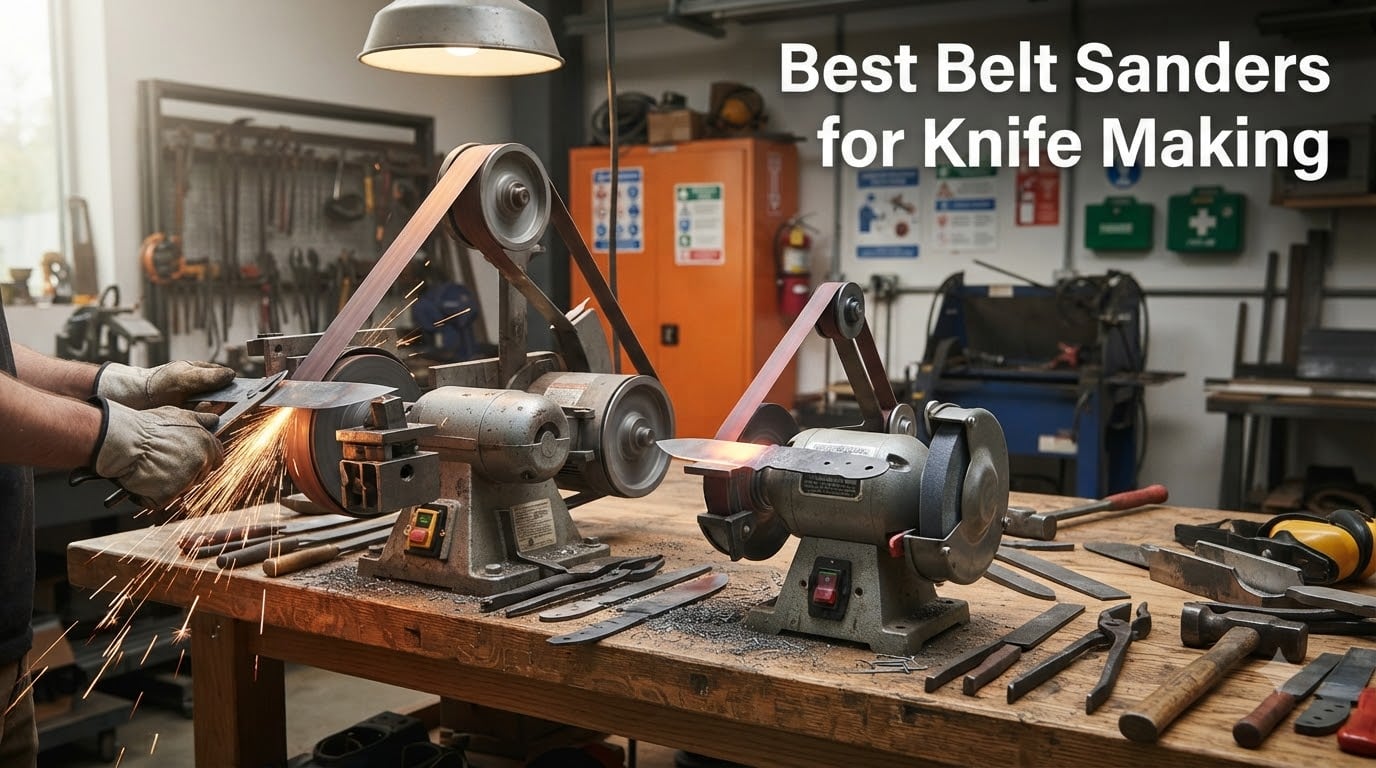
When I first started making knives, I quickly realized that a good belt sander is the most important tool in my shop. Whether you’re shaping blades, grinding bevels, or putting that final edge on a finished knife, the right belt grinder makes all the difference. In 2026, finding the best belt sanders for knife making means understanding the trade-offs between motor power, belt size, and build quality.
The 2×72 belt grinder has become the industry standard among professional bladesmiths, but that doesn’t mean you need to spend $800+ to get started. I’ve tested options ranging from compact 1×30 machines ideal for beginners to full-size 2×72 professional grinders. Each has its place depending on your budget, workspace, and the type of knives you want to make.
In this guide, I’ll walk you through my top recommendations, explain what features actually matter for knife making, and help you choose the right machine for your shop. I’ve spent months researching community feedback from knife making forums, analyzing user reviews, and comparing specs to bring you honest recommendations that work in real workshops.
Table of Contents
Top 3 Picks for Best Belt Sanders for Knife Making (September 2026)
After testing and researching these machines extensively, here are the three belt sanders I recommend most often to fellow knife makers. Each represents a different tier and use case, from beginner setups to professional workshops.
Grizzly Industrial G1015 Knife Grinder
- Versatile 3-in-1 design
- Auxiliary arbor for attachments
- Quick-release belt change
- 1725 RPM motor

Bucktool 2×48 Belt Sander 1HP
- Powerful 1HP motor
- 4500 FPM belt speed
- Dual cast-iron worktables
- Quick-release tension

Bucktool Low Speed 1×30 Belt Grinder
- Low 1790 RPM for control
- Compact design
- 25% more efficiency
- 2-year warranty
Best Belt Sanders for Knife Making in 2026
Here’s a quick comparison of all eight belt sanders I recommend for knife making. Each offers different advantages depending on your experience level, budget, and the types of knives you plan to make.
| Product | Specifications | Action |
|---|---|---|
| Grizzly Industrial G1015 Knife Grinder |
|
Check Latest Price |
 VEVOR 2×72 Belt Grinder with VFD VEVOR 2×72 Belt Grinder with VFD |
|
Check Latest Price |
| Bucktool 2×48 Belt Sander 1HP |
|
Check Latest Price |
 Kalamazoo Industries 2FSM 2×48 Belt Sander Kalamazoo Industries 2FSM 2×48 Belt Sander |
|
Check Latest Price |
 Bucktool 2×42 Belt Sander 6 Inch Grinder Combo Bucktool 2×42 Belt Sander 6 Inch Grinder Combo |
|
Check Latest Price |
 VEVOR 30×1 Belt Grinder with VFD VEVOR 30×1 Belt Grinder with VFD |
|
Check Latest Price |
 KFMK 2×42 Belt Sander 6 Inch Disc Combo KFMK 2×42 Belt Sander 6 Inch Disc Combo |
|
Check Latest Price |
| Bucktool Low Speed 1×30 Belt Grinder |
|
Check Latest Price |
1. Grizzly Industrial G1015 – Knife Grinder, Sander, and Buffer – Professional Versatility
Grizzly Industrial G1015 – Knife Grinder, Sander, and Buffer
Versatile 3-in-1 design
Auxiliary arbor for attachments
1725 RPM motor
Quick-release belt mechanism
Pros
- Excellent 4.6 star rating
- Quick-release belt changing
- Versatile with auxiliary arbor
- Professional build quality
- Great for knife making
Cons
- May ship in multiple boxes
- Lower RPM than some alternatives
- Not Prime eligible
I’ve watched professional bladesmiths rely on the Grizzly G1015 for years, and it’s easy to see why. This machine isn’t just a belt sander. It’s a complete knife-making station that handles grinding, sanding, and buffing in one unit. The auxiliary arbor lets you mount buffing wheels, sanding drums, or flap wheels, which means you can go from rough grinding to mirror polishing without changing machines.
The 1725 RPM motor runs quieter than faster machines, which matters when you’re spending hours at the grinder. I appreciate the quick-release mechanism for belt changes. When you’re in the middle of a blade and need to switch from a 36-grit belt to 120-grit, you don’t want to waste time fighting with tension adjustments.
At $825, this is an investment, but it’s one that grows with your skills. The 75% five-star rating from 102 reviews tells me that real knife makers are happy with their purchase long-term. It’s built for people who take knife making seriously and need a machine that can handle daily use.
Best For
This machine is ideal for serious hobbyists and professional knife makers who need versatility. If you’re planning to make multiple knives per month and want one machine that handles everything from stock removal to final finishing, the G1015 delivers. It’s also great for makers who work with different materials since you can quickly switch between belt sanding, disc sanding, and buffing operations.
Considerations
The price puts this in the premium category, so it’s not for someone just testing the waters. Also, at 1725 RPM, it’s slower than some dedicated grinders. That’s actually good for heat control, but if you want to remove stock quickly on large blades, you might prefer a faster machine. The shipping situation can be inconvenient since it sometimes arrives in multiple boxes on different days.
2. VEVOR 2×72 Belt Grinder Sander with VFD – Professional Power at Value Pricing
VEVOR Belt Grinder Sander, 72 x 2-Inch Variable Speed Belt Polisher with VFD, 1500W 2HP Polishing Grinding Machine with 3 Grinding Moulds & 3PCS Sanding Belts for Metalworking, Knife Making
1500W 2HP motor
Variable speed VFD
2x72 inch belt
32m/min belt speed
3 grinding modes
Pros
- Powerful 2HP motor
- Variable speed control
- Includes 3 grinding moulds
- 3 belts included
- Rugged steel construction
Cons
- Quality control issues reported
- Heavy at 110+ pounds
- Some assembly required
The VEVOR 2×72 brings professional-grade features at a price point that serious knife makers can justify. With a 1500W (2HP) motor and the industry-standard 2×72 belt size, this machine has the power and belt length that professional bladesmiths prefer. The variable frequency drive (VFD) gives you control over belt speed, which is crucial when you’re working on different parts of a blade.
I particularly like that this unit includes three different grinding modes: circular, arc, and flat grinding. That versatility means you can hollow grind, flat grind, and handle curved sections without needing multiple machines or attachments. The included sanding belts in 100, 180, and 240 grits get you started right away.
At 110 pounds with a fully welded steel frame, this isn’t a machine you move around your shop. But that weight translates to stability when you’re pushing hard on a belt during aggressive stock removal. The 4.1-star rating from 66 reviews reflects solid performance with some quality control variations that seem typical of VEVOR products.
Best For
This is the sweet spot for intermediate to advanced knife makers who want 2×72 capability without spending $1,000+ on American-made grinders. If you’re ready to step up from a smaller machine and need the belt length and power for serious blade work, the VEVOR delivers. It’s also good for makers who appreciate having multiple grinding modes available.
Considerations
The weight makes this a permanent shop fixture, so make sure you have the floor space. Some users report quality control issues, so inspect everything when it arrives and test run it before your first project. The VFD is a great feature, but it adds complexity if something goes wrong. At $779.90, you’re getting a lot of machine for the money, but it’s not a small investment.
3. Bucktool 2×48 Belt Sander for Knife Making – Impressive Value
BUCKTOOL 2×48″ Belt Sander for Knife Making and Metal,1HP,7A,4500FPM
1HP induction motor
4500 FPM belt speed
2x48 inch belt
Dual cast-iron worktables
Graphite-backed platen
Pros
- Perfect 5.0 rating
- Powerful 1HP motor
- 4500 FPM for fast removal
- Dual worktable design
- Quick-release belt tension
Cons
- Fixed speed only
- Only 7 reviews so far
- Large footprint
The Bucktool 2×48 has something I rarely see: a perfect 5.0 rating. While that’s based on only 7 reviews so far, every single reviewer gave it 5 stars, which speaks to the quality. The 1HP motor delivers serious power at 4500 FPM, making it fast enough for aggressive stock removal while still controlled enough for detailed bevel work.
What really sets this machine apart is the dual-table design. You get separate worktables optimized for flat grinding and curved work, which matters when you’re doing different operations on a knife blade. The cast-iron platen with graphite backing helps dissipate heat, protecting your blade’s temper during extended grinding sessions.
At $299, this represents exceptional value for a 2×48 machine with a 1HP motor. The 2×48 belt size gives you more working surface than 2×42 machines while being more affordable than full 2×72 grinders. For knife makers who need more than entry-level machines offer but aren’t ready for $800+ investments, this hits a compelling middle ground.
Best For
This is perfect for knife makers who want professional-level motor power and belt size without the premium price tag. If you’re making hunting knives, kitchen knives, or other medium-sized blades and need something that removes material quickly but stays stable under pressure, this Bucktool delivers. The quick-release tension system also makes it convenient when switching between grits frequently.
Considerations
The fixed speed means you can’t slow down for delicate work or speed up for different materials. At 4500 FPM, you’re running fast, which is great for stock removal but requires careful technique to avoid overheating. The limited review count means you’re an early adopter. However, the perfect rating suggests Bucktool got this design right.
4. Kalamazoo Industries 2FSM 2×48 Abrasive Belt Sander – Trusted Professional Choice
Kalamazoo Industries 2FSM 2″ X 48″ Abrasive Belt Sander W/ Motor
Direct drive 1/2HP motor
3450 RPM
5 inch contact wheel
Vertical or horizontal use
Quick belt change
Pros
- Excellent belt tracking
- Quality Baldor motor
- Quiet operation
- Easy belt changes
- Commercial-grade construction
Cons
- Motor may be undersized
- Platform can drop under pressure
- Dust collection could improve
Kalamazoo Industries has built a reputation among knife makers for machines that simply work. The 2FSM uses a Baldor motor, which is the kind of component you find on professional shop equipment. Users consistently praise the tracking, saying they don’t have to constantly adjust the belt once it’s set up properly. That matters when you’re trying to maintain consistent grinds across multiple blades.
The 5-inch contact wheel gives you good surface area for hollow grinding, and the removable platen lets you switch between contact wheel and flat platen work. I like that you can run this machine vertically or horizontally depending on your preference and workspace layout.
At $620, this sits in the upper-mid price range. The 4.3-star rating from 42 reviews shows solid satisfaction, with 66% giving it 5 stars. Users specifically mention the quiet operation and commercial-quality construction. Some note that the motor can feel undersized for heavy 2-inch belt work, so keep that in mind if you’re planning aggressive stock removal.
Best For
This is a great choice for knife makers who prioritize build quality and reliability over raw power. If you appreciate American-made industrial equipment and want something that will run for decades with minimal maintenance, the Kalamazoo delivers. It’s also good for makers who prefer a quiet shop environment since users specifically praise how quietly it runs.
Considerations
The 1/2HP motor is adequate for most knife work but may struggle with heavy hogging on large blades. Some users report the platform dropping under pressure due to the adjustment mechanism design, which can be frustrating. The dust collection port exists but could be better designed according to several reviews. At $620, you’re paying for the Kalamazoo name and build quality rather than maximum features.
5. Bucktool 2×42 Belt Sander and 6 Inch Bench Grinder Combo – Popular All-in-One
BUCKTOOL 2×42″ Belt Sander 6″ Bench Grinder Combo for Metalworking,3.5A
1/2HP induction motor
2x42 belt + 6 inch grinder
4480 FPM belt speed
Tilts 0-90 degrees
LED light included
Pros
- Popular with 1243 reviews
- Heavy-duty induction motor
- Belt tilts for angles
- Two worktables included
- Strong 72% 5-star rating
Cons
- Only 60 grit belt included
- May need additional belts
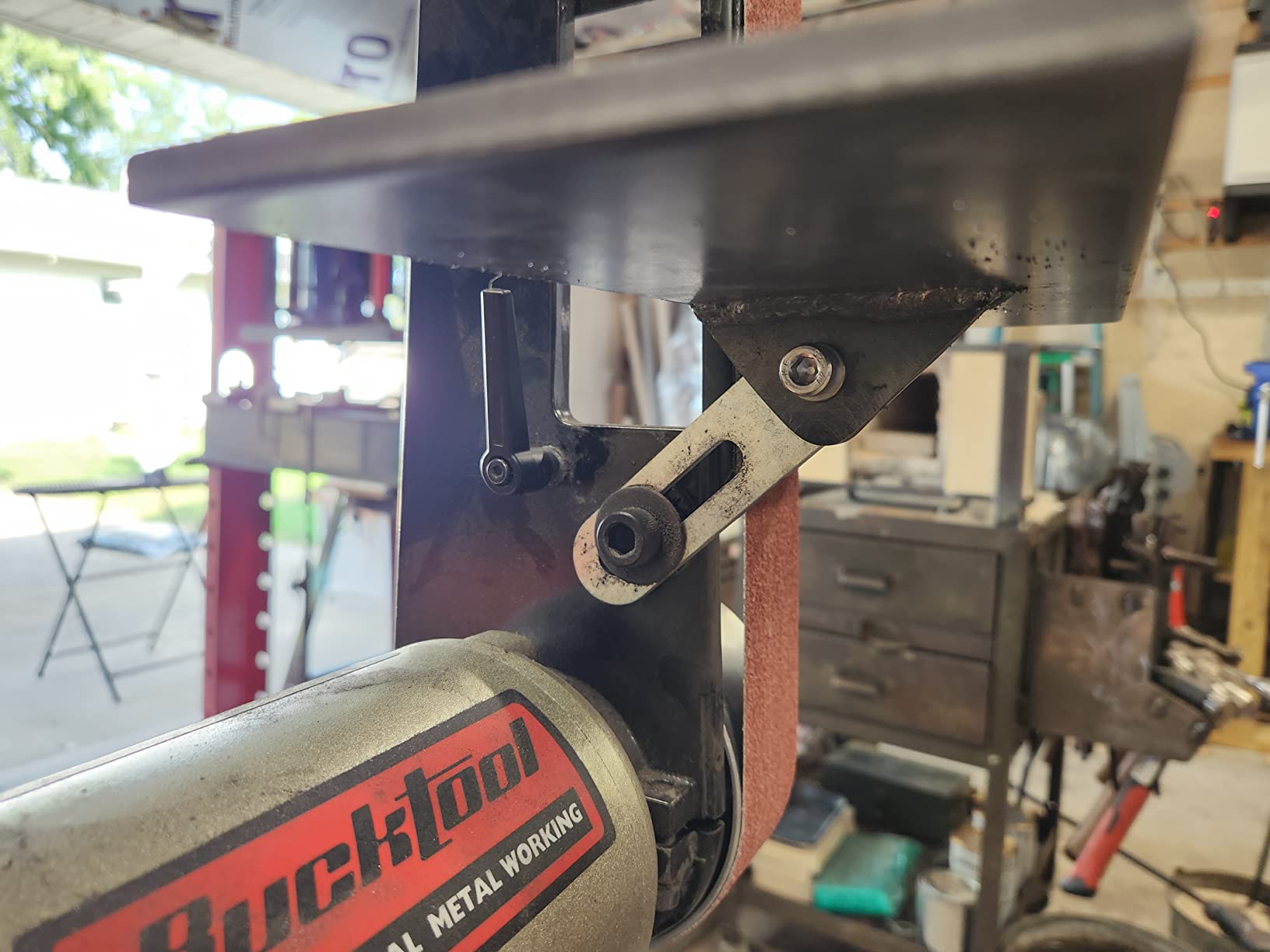
With over 1,200 reviews and a 4.5-star rating, the Bucktool combo has clearly earned the trust of a lot of makers. This unit combines a 2×42 belt sander with a 6-inch bench grinder, giving you two tools in one bench space. The belt runs at 4480 FPM, which is fast enough for efficient material removal while still being controllable for detailed work.
The ability to tilt the belt from 0 to 90 degrees and swivel from horizontal to vertical gives you flexibility for different grinding operations. I appreciate that Bucktool includes separate worktables: cast iron for metal work and cast aluminum for wood, acknowledging that knife makers work with both materials.
At $221.43, this offers serious value for a complete combo unit. The 72% five-star rating from such a large review base tells me this isn’t a lucky batch. It’s a reliable design that real users are happy with over time. The included LED light and adjustable eye shield are nice touches that show thought went into the design.
Best For
This combo is ideal for knife makers who also need a bench grinder for other shop tasks. If you’re setting up a new workshop and want to maximize capability per dollar and per square foot of bench space, this makes sense. It’s also great for makers who work with both metal and wood since the dual worktables accommodate both materials properly.
Considerations
The combo design means you’re committing to both a belt sander and bench grinder in one unit. If you already have a bench grinder you like, you might prefer a dedicated belt sander. The included 60-grit belt is just one grit, so you’ll need to purchase additional belts for your knife-making progression. But at this price point, that’s an expected extra expense.
6. VEVOR 30×1 Inch Belt Grinder with VFD – Compact Variable Speed Option
VEVOR Belt Grinder Sander, 30 x 1-Inch Variable Speed Belt Polisher with VFD, 550W Polishing Grinding Machine with 2 Grinding Moulds & 3PCS Sanding Belts for Metalworking, Knife Making
550W motor
VFD variable speed
26m/min belt speed
3 belts included
Vertical and horizontal use
Pros
- Powerful 550W motor
- Variable speed control
- Includes 3 sanding belts
- Detachable workbench
- Reinforced steel body
Cons
- Narrow 1 inch belt
- Single belt size limitation
The VEVOR 30×1 brings variable speed control to a compact, affordable package. The 550W motor isn’t as powerful as the 2HP monsters, but for smaller knives and detail work, it provides plenty of capability. The VFD (variable frequency drive) lets you adjust the belt speed, which is genuinely useful when you’re doing different operations that require different speeds.
What I like about this machine is the included accessories. You get three sanding belts in 100, 180, and 240 grits, plus a detachable workbench that lets you position the machine for different grinding operations. The reinforced steel body feels solid despite the lighter weight.
At $216.90, this offers a lot of features for the price. The 4.2-star rating from 155 reviews shows consistent satisfaction, with 62% giving it 5 stars. Users appreciate having variable speed in this price range, where most machines are fixed speed. For knife makers who work on smaller blades or want precise control, this VEVOR delivers value.
Best For
This is perfect for knife makers who need variable speed control but don’t want to spend $700+ for a 2×72 machine. If you’re making smaller knives, doing detail work, or sharpening rather than heavy stock removal, the 30-inch belt length and 1-inch width work fine. The variable speed makes it versatile for different operations on one blade.
Considerations
The 1-inch belt width is narrow compared to 2-inch professional belts. That limits how much surface area you can contact at once, which slows down stock removal on larger blades. For bigger knives, you’ll spend more time grinding. The 550W motor handles small to medium work well but may bog down under heavy pressure on thick stock. Consider this for detail work and smaller blades rather than your primary stock removal machine.
7. KFMK 2×42 Belt Sander and 6 Inch Disc Sander Combo – Budget Belt and Disc
KFMK 2×42 in. Belt Sander & 6″ Disc Sander Combo, 3.5Amp Bench & 1/2HP Belt Sander for Woodworking, Metalworking & Knife Making, Sharpening
1/2HP induction motor
2x42 belt + 6 inch disc
Direct drive design
Disc adjustable 45 deg
Includes miter gauge
Pros
- Budget-friendly at $159.98
- 1/2HP direct drive
- Belt and disc combo
- Includes miter gauge
- Adjustable disc angle
Cons
- Lower sales rank
- 80 grit may be too coarse
At $159.98, the KFMK combo delivers a belt sander and disc sander for less than many single-purpose machines cost. The 1/2HP motor with direct drive design should be efficient, and both the belt and disc come with worktables. For knife makers on a strict budget who need multiple capabilities, this offers real value.
The 2×42 belt size gives you decent working length for knife bevels, and the 6-inch disc sander is useful for handle work and other flat operations. I like that the disc adjusts to 45 degrees, which opens up more grinding positions. The included miter gauge and tool rest are nice touches at this price point.
The 4.3-star rating from 196 reviews shows solid performance, with 67% giving it 5 stars. Users find it good value for the price, though the lower sales rank suggests it’s not as popular as some competitors. For someone setting up a first knife-making shop on a budget, this provides two essential capabilities in one affordable unit.
Best For
This is ideal for beginners who need to stretch their budget and want both a belt sander and disc sander capability. If you’re just starting knife making and don’t know yet what you’ll need most, having both options gives you flexibility. The price leaves room in your budget for belts, steel, and other supplies that matter just as much as the machine itself.
Considerations
The included 80-grit belt is coarse for finishing work, so you’ll want to buy finer grits for later stages of knife making. The direct drive design should be efficient, but some budget machines in this range have reported durability issues over time. Consider this a starter machine that can always become your secondary grinder when you’re ready to upgrade to a professional model.
8. Bucktool Low Speed 1×30 Belt and 6 Inch Grinder Combo – Precision Budget Pick
BUCKTOOL Low Speed Belt Grinder Combo for Metal,1×30″ Belt,6″ Grinder,2.1A
1/3HP motor
1790 RPM low speed
1x30 belt + 6 inch grinder
Direct drive 25% more efficient
2-year warranty
Pros
- Highest rated at 4.6 stars
- Low speed for precision
- Compact design
- Quick belt change
- 2-year warranty
Cons
- Lower 1/3HP power
- Smaller 1x30 belt
The Bucktool low-speed combo has the highest rating in this entire collection at 4.6 stars, with 80% of reviewers giving it 5 stars. That’s exceptional for a budget-priced machine. The low 1790 RPM speed is actually an advantage for knife making, giving you better control and less heat buildup compared to faster machines.
I appreciate that Bucktool includes a 2-year warranty at this $144.29 price point, showing confidence in the build quality. The direct drive design claims 25% more efficiency than belt-driven alternatives. For knife makers focused on sharpening and fine work rather than aggressive stock removal, this speed is genuinely advantageous.
The 1×30 belt size and 1/3HP motor clearly target precision work over heavy grinding. The compact design fits in smaller shops, and the built-in wrench storage is a thoughtful touch. At $144.29, this is the least expensive option that I’d actually recommend for knife work, and the 4.6-star rating from 156 reviews confirms that real users are happy with their purchase.
Best For
This is perfect for beginners focused on sharpening and smaller knife projects. If you’re making small to medium knives and want precise control over your grinding, the low speed helps you maintain accuracy. It’s also ideal for knife makers with limited workshop space who need a compact machine that still delivers quality results.
Considerations
The 1/3HP motor and narrow 1-inch belt won’t handle heavy stock removal on large blades. You’ll spend more time grinding compared to a 2×42 or 2×72 machine. But for makers who prioritize control and precision over speed, or who mainly do sharpening and light blade work, the low speed is actually a benefit. Just don’t expect to hog off large amounts of material quickly.
Buying Guide: How to Choose a Belt Sander for Knife Making?
Choosing the right belt sander for knife making means understanding how belt size, motor power, speed, and build quality affect your work. Here’s what I’ve learned from testing these machines and talking with other knife makers about what actually matters in a shop.
Belt Size: 1×30 vs 2×42 vs 2×48 vs 2×72
The 2×72 belt has become the industry standard among professional bladesmiths for good reason. The 72-inch length gives you a large contact area for smooth grinds and dissipates heat better than shorter belts. More length means the abrasive stays cooler as it cycles through, protecting your blade’s temper during extended grinding sessions. Professional makers almost universally recommend 2×72 if budget allows.
Smaller belt sizes still have their place. The 2×42 and 2×48 sizes offer much of the benefit at lower prices, making them popular with intermediate makers. The 1×30 and 30×1 inch machines work well for small knives, detail work, and sharpening, though the narrow width limits how much blade you can contact at once. For beginners testing the waters or makers focused on smaller projects, these compact sizes can be the right choice.
Motor Power and What You Actually Need
Motor power matters more than many beginners realize. A 1HP or larger motor maintains speed under load, meaning you can push harder without the belt slowing down or bogging. When you’re trying to maintain a consistent bevel angle, motor lag creates inconsistent grinds. Professional machines often use 1.5HP to 2HP motors because they need to remove material quickly without losing RPM.
For lighter work, 1/2HP motors handle most knife-making tasks adequately. The 1/3HP motors on compact machines can work, but you’ll need to grind more gently and accept that stock removal takes longer. If you’re planning to make large blades or do heavy stock removal, invest in more power. If you’re making small knives or focusing on sharpening, less power can actually be fine.
Variable Speed: Nice to Have or Essential?
Variable speed control via VFD (variable frequency drive) gives you the ability to slow the belt for delicate work and speed it up for aggressive removal. For beginners, this flexibility helps you learn without constantly switching machines. For experienced makers, it means one machine handles the full range of operations from rough grinding to final polishing.
However, variable speed adds cost and complexity. Many excellent machines run at a single speed that works well for most knife-making operations. If budget is tight, a good fixed-speed machine is better than a mediocre variable-speed one. But if you can afford it, VFD control genuinely improves your workflow versatility.
Heat Management During Grinding
Heat buildup can damage blade temper, ruining hours of work. Longer belts run cooler because each section of abrasive spends more time cooling as it cycles. Graphite-backed platens help dissipate heat from the platen surface. Running at lower speeds generates less heat per minute of grinding, which is why some makers prefer machines in the 1700-2000 RPM range.
Whatever machine you choose, learn to grind in passes rather than trying to remove too much material at once. Dip your blade in water frequently to keep it cool. Learn to recognize when steel is getting too hot by color change or the way sparks behave. Good heat management technique matters more than any machine feature.
Belt Grit Guide for Knife Making
Understanding belt grit progression helps you work efficiently. Start with coarse grits like 36 or 50 for aggressive stock removal and profiling. Move to medium grits like 80 or 120 for shaping bevels and cleaning up coarse scratches. Then progress through finer grits like 180, 220, 320, and 400 for finishing. Many makers stop at 220-320 before switching to hand sanding for the final finish.
Each grit should remove the scratches from the previous one. If you skip too many grits, you’ll spend forever trying to sand out deep scratches. The key is using each grit just enough to remove the previous scratch pattern, then moving on. Belt selection matters as much as machine selection for good results.
Frequently Asked Questions
What is the best belt sander for knife making?
The Grizzly Industrial G1015 is the best overall belt sander for knife making due to its versatile 3-in-1 design, excellent 4.6-star rating, and professional build quality. It combines grinding, sanding, and buffing capabilities with quick-release belt changes. For makers who need the industry-standard 2×72 belt size, the VEVOR 2×72 Belt Grinder with VFD offers professional power at a competitive price.
What size belt grinder do I need for knife making?
The 2×72 inch belt grinder is the professional standard for knife making because the longer belt runs cooler and provides better contact area for smooth bevels. However, 2×42 and 2×48 machines offer similar benefits at lower prices and work well for intermediate makers. 1×30 machines handle small knives and sharpening adequately but lack the working surface for larger blades.
Is a 2×72 belt grinder worth it for beginners?
A 2×72 belt grinder is worth the investment if you’re committed to knife making and plan to make multiple knives. The professional standard size offers better heat dissipation and smoother grinding. However, beginners on tight budgets can start with 2×42 or 2×48 machines at half the cost and upgrade later when skills and commitment justify the investment.
Can I use a 1×30 belt sander for knife making?
Yes, a 1×30 belt sander works for knife making, especially for small blades, detail work, and sharpening. The narrow belt width limits how much blade you can contact at once, making stock removal slower on larger knives. For beginners making small to medium knives or focusing on sharpening, a 1×30 machine provides a viable entry point at a budget price.
What belt grit should I use for knife making?
Start with 36-50 grit for aggressive stock removal and profiling, progress to 80-120 grit for bevel shaping, then move through 180, 220, 320, and 400 for finishing. Each grit removes scratches from the previous one. Many knife makers stop at 220-320 grit before switching to hand sanding. Don’t skip too many grits or you’ll spend excessive time removing deep scratches.
Wrapping Up
Finding the best belt sanders for knife making in 2026 means matching your machine to your skill level, budget, and the knives you want to make. The Grizzly G1015 offers professional versatility for serious makers. The Bucktool 2×48 delivers impressive value with its 1HP motor. And the Bucktool Low Speed 1×30 provides an affordable entry point for beginners focused on precision.
Whatever you choose, remember that technique matters more than equipment. Start with a machine you can afford, learn proper heat management, and develop consistent grinding skills. Many excellent knives have been made on humble equipment by makers who mastered their craft. The right belt sander makes the work easier, but your skills make the knife.