
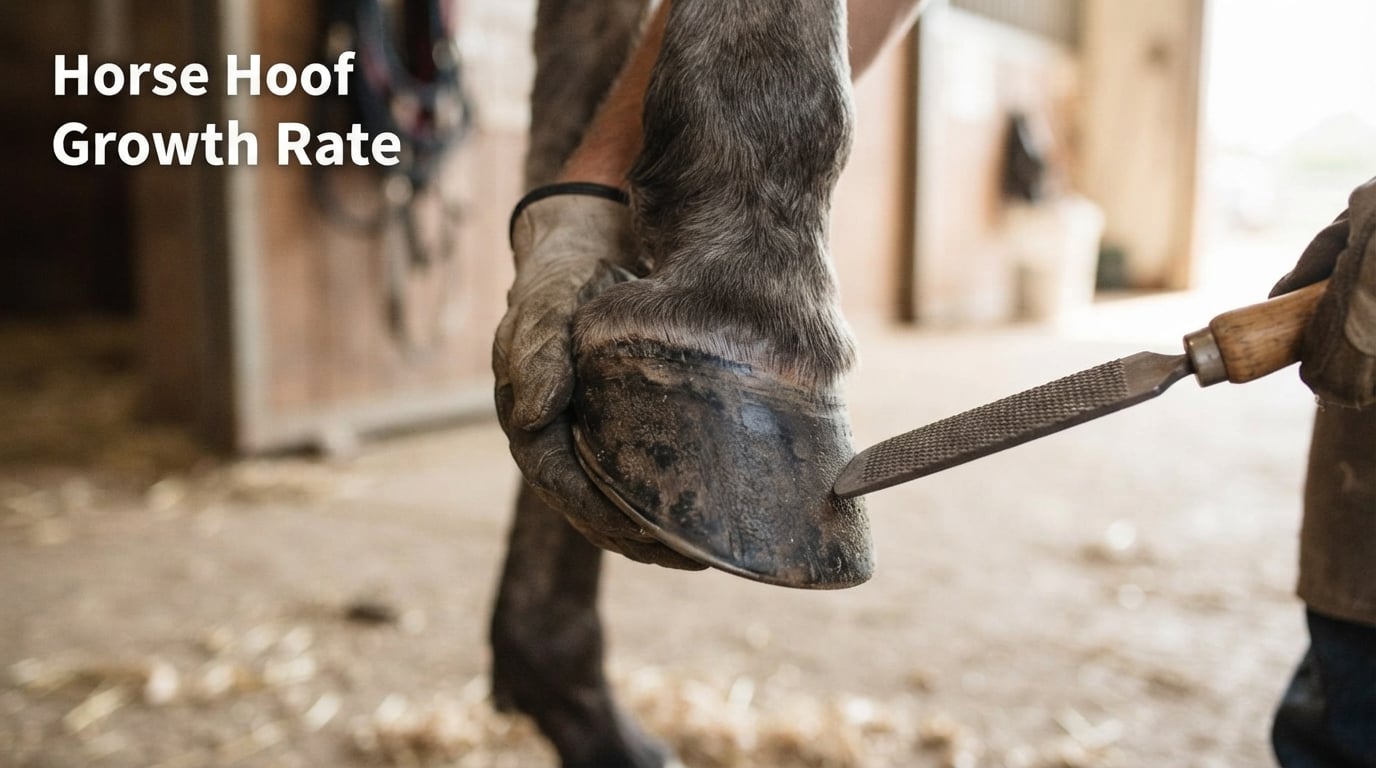
A healthy horse’s hoof grows at a rate of 1/4 to 3/8 inch per month, which works out to roughly 6 to 10 millimeters. At that pace, a complete hoof wall replacement takes 9 to 12 months from coronary band to ground. Understanding this horse hoof growth rate is the difference between realistic expectations and constant frustration, especially when you are waiting out a crack, watching an abscess heal, or evaluating whether a hoof supplement is actually working.
I have spent years around horses and farriers, and one thing I hear constantly from new owners is surprise at how slowly hooves change. A wall that looks rough today will look the same in two weeks.
The hoof you see at the toe right now started growing near the coronary band almost a year ago. That timeline is the foundation of every decision you make about trimming, shoeing, and nutrition.
This guide covers the measurements, the anatomy, the factors that speed growth up or slow it down, and the practical implications for trim schedules and recovery timelines. Whether you are a first-time owner or a longtime rider, knowing the numbers helps you have better conversations with your farrier and vet.
Table of Contents
How Fast Does a Horse’s Hoof Grow Each Month?
The honest answer is that it depends on the horse, but the consensus range is 1/4 to 3/8 inch per month for a healthy adult horse. Cornell University’s equine extension service cites 1/4 to 3/8 inch per month as the expected average.
The American Farriers Association publishes rates of 0.24 to 0.4 inches per month at the toe. Peer-reviewed research puts the daily rate at 0.19 to 0.28 mm per day, which translates to roughly 5.7 to 8.4 mm per month.
To put a few numbers on the board:
- Daily growth: 0.2 to 0.3 mm per day (about 6 to 9 mm per month)
- Monthly growth: 1/4 to 3/8 inch (6 to 10 mm)
- Yearly growth: Roughly 3 inches of new hoof wall
- Full replacement cycle: 9 to 12 months from coronary band to ground surface at the toe
The rate is not flat across the hoof. Heels typically grow faster than toes, and hind hooves often grow slightly faster than fronts. We will cover those details in a moment, because most articles skip them.
Where Does Hoof Growth Start? The Coronary Band Explained
Every bit of new hoof wall you see came from one place: the coronary band. This is the soft, slightly rounded junction where the hair meets the hoof, and it houses the coronium corium, a highly vascular layer of tissue that produces keratin and pushes new horn cells slowly downward.
Here is the basic flow:
- The coronium corium generates new horn cells at the coronary band.
- These cells keratinize (harden) and form horn tubules.
- The horn tubules slide downward in a continuous conveyor, sort of like a lava lamp in slow motion.
- By the time the material reaches the ground, it has traveled 3 to 4 inches in 9 to 12 months.
This is why damage at the coronary band can take a full year to grow out. A cut, a bruise, or an inflammatory event at the coronary band leaves a mark on the wall that travels down with the new growth, eventually disappearing at the toe.
Farriers and vets sometimes call these marks “stress lines” or “event lines,” and they are essentially a written diary of what the horse experienced months ago. The coronary band also has a sister structure called the laminar corium, which lines the inside of the hoof wall and bonds the wall to the coffin bone. Damage to this layer is what causes founder and laminitis, but the growth mechanism itself remains the same: new horn starts at the top and walks its way down.
How Long Does It Take for a Full Hoof to Grow Back?
A complete hoof wall replacement, from the coronary band to the toe, takes 9 to 12 months in a typical adult horse. The heel and quarters replace faster, often in 4 to 6 months, because the distance from the coronary band to the ground is shorter there. The toe takes longer because the wall is taller.
Some real-world numbers to anchor this:
- Toe replacement: 9 to 12 months
- Quarter replacement: 6 to 8 months
- Heel replacement: 4 to 6 months
This timeline matters for three common scenarios. First, if your horse pulls a shoe and tears off some hoof wall, you should expect a full cosmetic recovery to take most of a year. Second, after a serious abscess that drains out the coronary band, the hole or crack at the coronet will travel down the wall for the next 9 to 12 months.
Third, if you start a new supplement or management change, give it at least 6 to 9 months before judging the new growth at the toe. Owners who switch supplements at 30 days and see no difference are usually judging the wrong part of the hoof.
What Affects Horse Hoof Growth Rate?
Four big factors move the needle: season, age, nutrition, and exercise. Smaller factors include moisture, breed, genetics, and overall health. Let’s go through each one.
Season and Climate
Hooves grow faster in spring and summer and slower in winter. University extension data shows that a horse’s hoof growth rate increases noticeably in spring, partly because of photoperiod (longer daylight hours), partly because of warmer temperatures, and partly because pasture quality improves.
Winter growth can drop by 20% or more compared to summer peak growth in some horses.
A common pattern I see in our own barn: the spring reset. Owners who kept their horses on a 7-week trim cycle through winter often find they need a 5-week cycle in May and June. If your trimmer does not adjust, you will start to see flares and chips.
Age
Young horses grow hoof faster than older horses. Foals and weanlings can grow hoof at rates exceeding 3/8 inch per month, sometimes 1/2 inch per month during growth spurts. Mature adults sit in the 1/4 to 3/8 inch range.
Senior horses (over 20) often slow to 1/8 to 1/4 inch per month, especially when combined with reduced circulation or Cushing’s disease.
Nutrition
Nutrition does not dramatically change the speed of growth, but it changes the quality of growth. Biotin, methionine, zinc, copper, and selenium are the headline nutrients. A 2018 systematic review found that biotin supplementation at 15 to 20 mg per day improves hoof wall integrity in horses with poor-quality horn, but it does not necessarily speed growth.
Owners who see “no change” after 60 days usually have good growth already; the supplement was already doing its job quietly.
This is also the most common source of owner frustration in forum discussions. People buy a $70 hoof supplement, expect visible changes in a month, and switch to a different brand. Real visible changes at the toe can take 6 to 9 months because that is how long new growth takes to reach the ground.
Exercise and Blood Flow
Movement pumps blood through the hoof. The hoof is a hydraulic structure, and circulation is what brings nutrients to the coronary band. Horses on stall rest for a long time often show dull, slow-growing horn.
Horses that spend 8 to 12 hours a day moving on pasture generally grow stronger, healthier walls. This is also why wild horses in good habitat maintain solid hooves without trimming.
Moisture and Environment
Hooves that are constantly wet and dry cycle (wet morning dew, dry afternoon, wet again) tend to crack and lose integrity. Hooves that stay in a stable moisture range hold nails better and resist bruising.
The growth rate itself is not directly affected by moisture, but the integrity of the wall is, which means wet-dry cycling can cause the wall to break off faster than it grows.
Heel vs Toe: Why Parts of the Hoof Grow at Different Speeds
Heels grow faster than toes. This is a real biological difference, not just an impression. The heel tubules are shorter, so they reach the ground sooner, and the coronium corium at the heel area tends to be more active.
In practical terms, a hoof that goes 6 weeks between trims will show more heel growth than toe growth, which is exactly why farriers trim the heel less aggressively than the toe during a maintenance cycle.
The takeaway: if you are trying to grow out a toe crack, do not panic if the heel looks overgrown 8 weeks later. The heel growth is normal, and the toe growth is just on a longer journey.
Front vs Hind Hoof Growth Differences
Hind hooves typically grow slightly faster than front hooves, and the difference is meaningful enough that some farriers schedule hind and front trims on different cycles. Hind hooves carry more weight on the inside of the foot and tend to grow a bit more wall thickness.
Front hooves handle more of the horse’s actual weight and tend to be larger, more rounded, and slightly slower in growth.
This is more than trivia. If you are tracking a quarter crack on a front foot, expect it to grow out a bit slower than the same crack on a hind foot. If your trimmer is working on a horse with mismatched hoof shapes between front and back, that asymmetry is biologically normal, not a trimming error.
Reading Hoof Growth Rings as a Health Diary
One of the most overlooked skills in horse care is reading the hoof wall. The hoof wall is a record. Every stress event from the past 9 to 12 months is written in the rings, and a careful eye can read them like tree rings.
Here is what different ring patterns usually mean:
- Single horizontal ridge: Often a one-time event 3 to 6 months ago, such as a fever, an abscess, a foot trim, or a change in feed.
- Multiple parallel ridges: Indicates repeated stress cycles, often from seasonal changes, dietary shifts, or recurring abscesses.
- Wide, smooth ridge (founder ring): Classic indicator of a laminitic event. The wide part is the rapid growth phase after the laminar inflammation.
- Narrow, compressed ring: Often a period of systemic illness or high stress when growth slowed.
- Divergent rings between heel and toe: Suggests uneven loading, possibly from pain elsewhere in the limb or a chronic imbalance.
The skill of reading these takes practice, but it is one of the most rewarding tools in hoof care. A farrier or trimmer who walks up to your horse and immediately reads the wall is doing exactly this.
Hoof Trim Schedule: How Often Should You Trim?
Most horses do well on a 5 to 7 week trim cycle. Faster-growing horses in summer may need a 4-week cycle. Slower-growing horses in winter can stretch to 8 to 10 weeks.
The farrier-and-horse-owner forum consensus is that trim schedules should flex with the season, not stay locked at one interval year-round.
A sensible schedule looks like this:
- Spring and summer: Every 5 to 6 weeks, sometimes 4 weeks for horses with rapid growth or weak walls.
- Fall and winter: Every 6 to 8 weeks, sometimes 10 to 12 weeks for senior horses or low-activity pasture horses.
- Rehab cases (abscess, laminitis, founder): Every 4 to 5 weeks under veterinary guidance, often with radiographs to track progress.
Waiting too long between trims causes the toe to flare, the heel to collapse, and the wall to chip. Trimming too often wastes money and can sometimes short-change the wall if it is being rasped before new growth has matured.
Practical Takeaways for Owners
If you remember only five things from this guide, make them these:
- Horse hoof growth rate is 1/4 to 3/8 inch per month for a healthy adult, faster in young horses, slower in seniors.
- Full hoof replacement takes 9 to 12 months, so any change in care needs 6 to 9 months to show at the toe.
- Heels grow faster than toes, and hinds grow slightly faster than fronts. Both are normal.
- Supplements change quality, not speed. Biotin and zinc improve wall integrity, but they do not grow a faster hoof.
- Trim cycles should flex with the season. Summer is shorter, winter is longer.
Hoof care is a patience game. The hoof you are looking at today was forming months ago, and the hoof you will see in 6 months is being built right now at the coronary band. That is the timeline you are working with, every time you make a management decision.
Frequently Asked Questions
How much does a healthy horse’s hoof grow each month?
A healthy adult horse’s hoof grows 1/4 to 3/8 inch per month, which is roughly 6 to 10 millimeters. Foals and young horses can grow faster, sometimes closer to 1/2 inch per month, while senior horses may slow to 1/8 to 1/4 inch per month. Heels grow faster than toes, and hind hooves grow slightly faster than fronts.
How to make a horse’s hoof grow fast?
Hoof growth is a biological process that cannot be rushed dramatically, but it can be supported. Key factors include balanced nutrition with biotin, zinc, copper, and methionine; consistent exercise to maintain blood flow; steady turnout on varied terrain; a regular trim cycle of 5 to 7 weeks; and avoiding wet-dry cycling that cracks the wall. Note that supplements improve hoof quality, not necessarily speed, and any change takes 6 to 9 months to show at the toe.
What does healthy hoof growth look like?
Healthy hoof growth shows as a smooth, evenly textured wall that grows from the coronary band downward without ridges, cracks, or flares. New growth at the coronary band should appear smooth, slightly shiny, and tightly connected to the old wall, with no separation or inflammation. The wall should be cool to the touch, free of rings or signs of bruising, and the heel should grow at a slightly faster pace than the toe.
Do hooves grow faster in the summer?
Yes, hooves grow faster in spring and summer and slower in winter. Day length, temperature, and pasture quality all contribute to the seasonal pattern. Horses on a 7-week trim cycle in winter often need a 5-week cycle in summer to keep up with growth. The seasonal swing can be 20% or more in some horses, so adjust trim schedules accordingly.
The Bottom Line on Horse Hoof Growth Rate
The horse hoof growth rate of 1/4 to 3/8 inch per month is consistent across healthy adult horses, and the 9 to 12 month full replacement timeline is your real planning horizon. Adjust your expectations for trim cycles by season, judge supplements by what shows up at the toe after 6 months, and remember that the wall you are looking at today was assembled months ago at the coronary band.
If you are working through a hoof issue right now, talk with your farrier about whether the wall you are seeing is current growth or old growth, and ask them to walk you through the rings on the wall. They will know exactly what the past year of your horse’s life looked like, written in keratin.