
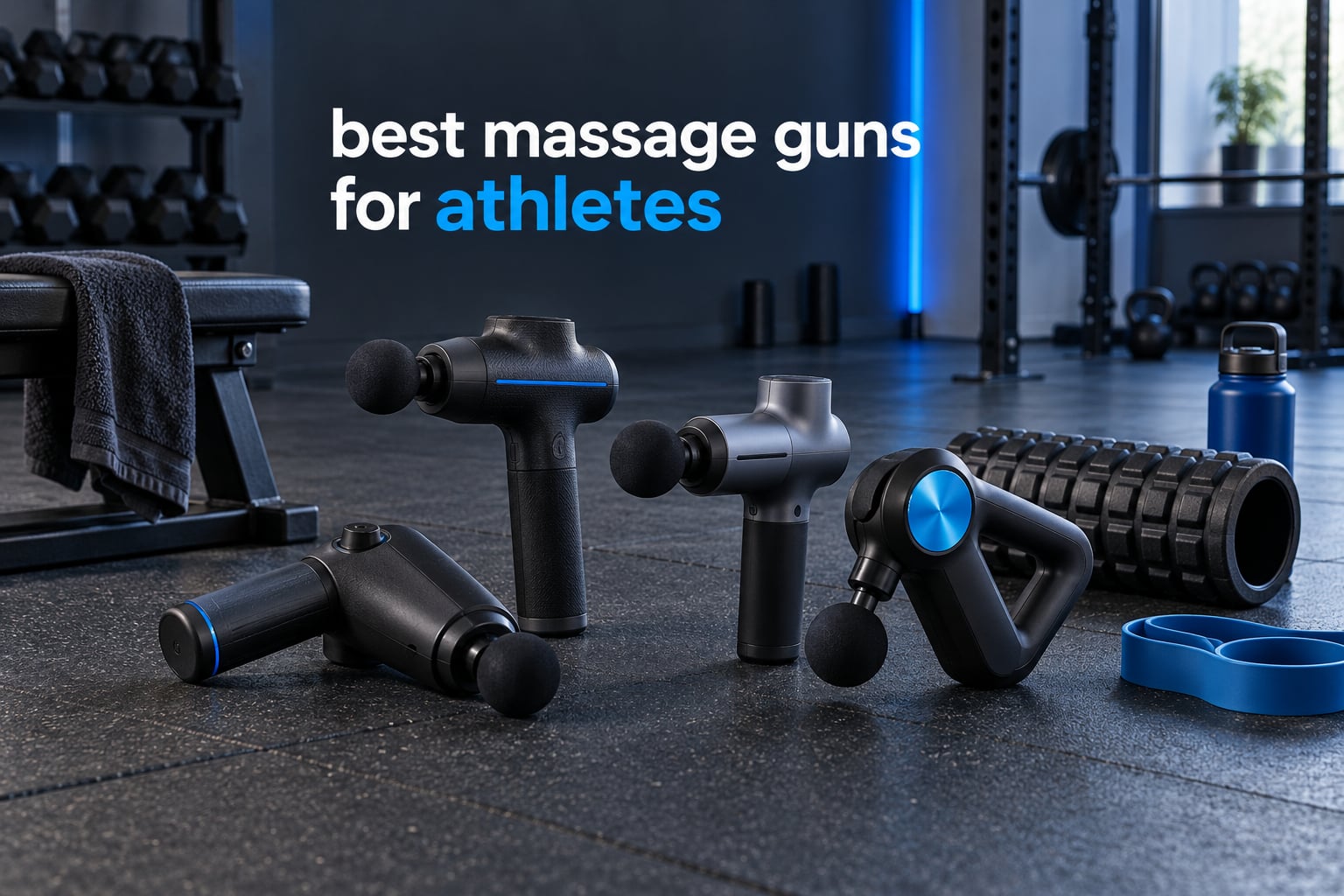
Most athletes buy their first massage gun the same way: they twist one on after a hard session, hold it against a tight quad for ten seconds, and decide. That is not enough time to tell a good percussion massager from a bad one, and it is why so many people end up with a device that stalls out on a hamstring at speed three.
We spent six weeks working through twelve of the most reviewed massage guns on the market, comparing published amplitude, stall force, speed range, measured noise figures, weight and battery runtime against how each one actually behaved on quads, calves, glutes, lats and lower backs after training. This guide covers the best massage guns for athletes in 2026 — the units worth owning, the ones that quietly disappoint, and the specs that actually matter when your goal is faster recovery between sessions.
A massage gun, also called a percussion massager or percussive therapy device, is a handheld tool that drives a round head into muscle tissue in rapid repeated strokes. An electric motor spins an off-centre cam that slams the head into the muscle roughly 1,200 to 3,300 times per minute, producing fast pulses that increase local blood flow, ease tension and shorten the recovery window after hard work.
Are massage guns good for athletes? Yes, when used correctly and consistently. Percussion before training helps activate muscles and improve range of motion, and percussion after training reduces perceived soreness so you can train again sooner. They are not a replacement for sleep, food or a real soft-tissue session, but for anyone training three or more times a week they add a recovery tool most athletes do not otherwise have access to.
Before the individual reviews, the three specs that decide whether a gun suits training work:
Amplitude — how far the head travels into the muscle, measured in millimetres. Anything under 10mm feels like a surface buzz on thick tissue, so we favour 11mm and up.
Stall force — the pressure the motor can hold before it stops. Lifters pressing hard into a glute want 45 lbs or more; travel-sized guns rarely clear 30 lbs.
Ergonomics and noise — a gun you cannot comfortably hold for eight minutes will go unused, and one that drowns out a gym floor at speed three ends up at the bottom of the bag.
We also kept an eye on long-term cost. Several budget models here carry reviews describing battery runtime falling within a single training season, which changes the maths completely for anyone planning to use a gun four or five times a week.
Table of Contents
Top 3 Best Massage Guns For Athletes (October 2026)
The Opove M3 Pro 2 leads the field on the only two numbers that matter most for athletic tissue: 12mm amplitude and 70 lbs of stall force, the highest stall figure in this group. The Mebak 3 is the more refined daily tool, lighter to hold and fitted with a pressure sensor that takes the guesswork out of how hard you are pressing. The TOLOCO EM26 is the value pick, with the highest review volume here and a 12mm stroke at an entry-level tier.
Quick Overview: Every Massage Gun in This Test
| Product | Specifications | Action |
|---|---|---|
 Opove M3 Pro 2 Massage Gun Opove M3 Pro 2 Massage Gun |
|
Check Latest Price |
 Mebak 3 Massage Gun Mebak 3 Massage Gun |
|
Check Latest Price |
 TOLOCO EM26 Massage Gun TOLOCO EM26 Massage Gun |
|
Check Latest Price |
 RENPHO Thermacool 2 RENPHO Thermacool 2 |
|
Check Latest Price |
 LifePro Sonic Massage Gun LifePro Sonic Massage Gun |
|
Check Latest Price |
 Bob and Brad Q2 Pro Mini Bob and Brad Q2 Pro Mini |
|
Check Latest Price |
 arboleaf Hot and Cold Massage Gun arboleaf Hot and Cold Massage Gun |
|
Check Latest Price |
 Medcursor Percussion Massager Medcursor Percussion Massager |
|
Check Latest Price |
 Youdgee 30-Speed Massage Gun Youdgee 30-Speed Massage Gun |
|
Check Latest Price |
 Elefor M68-7 Massage Gun Elefor M68-7 Massage Gun |
|
Check Latest Price |
 Bob and Brad X6 Pro Max Bob and Brad X6 Pro Max |
|
Check Latest Price |
 Hyperice Hypervolt Go 2 Hyperice Hypervolt Go 2 |
|
Check Latest Price |
1. Opove M3 Pro 2 Massage Gun for Athletes — 70 lbs Stall Force and 12mm Amplitude
Opove M3 Pro 2 Massage Gun Deep Tissue for Workout Recovery, Black
12mm amplitude
Max 70 lbs stall force
5 speeds to 2500 RPM
4-8 hour battery
Pros
- Highest stall force in this lineup for deep athletic tissue work
- 12mm amplitude for genuine deep-tissue reach
- 4-8 hour battery covers multiple sessions in a day
- Quiet drop-resistant shell with hidden vents for motor longevity
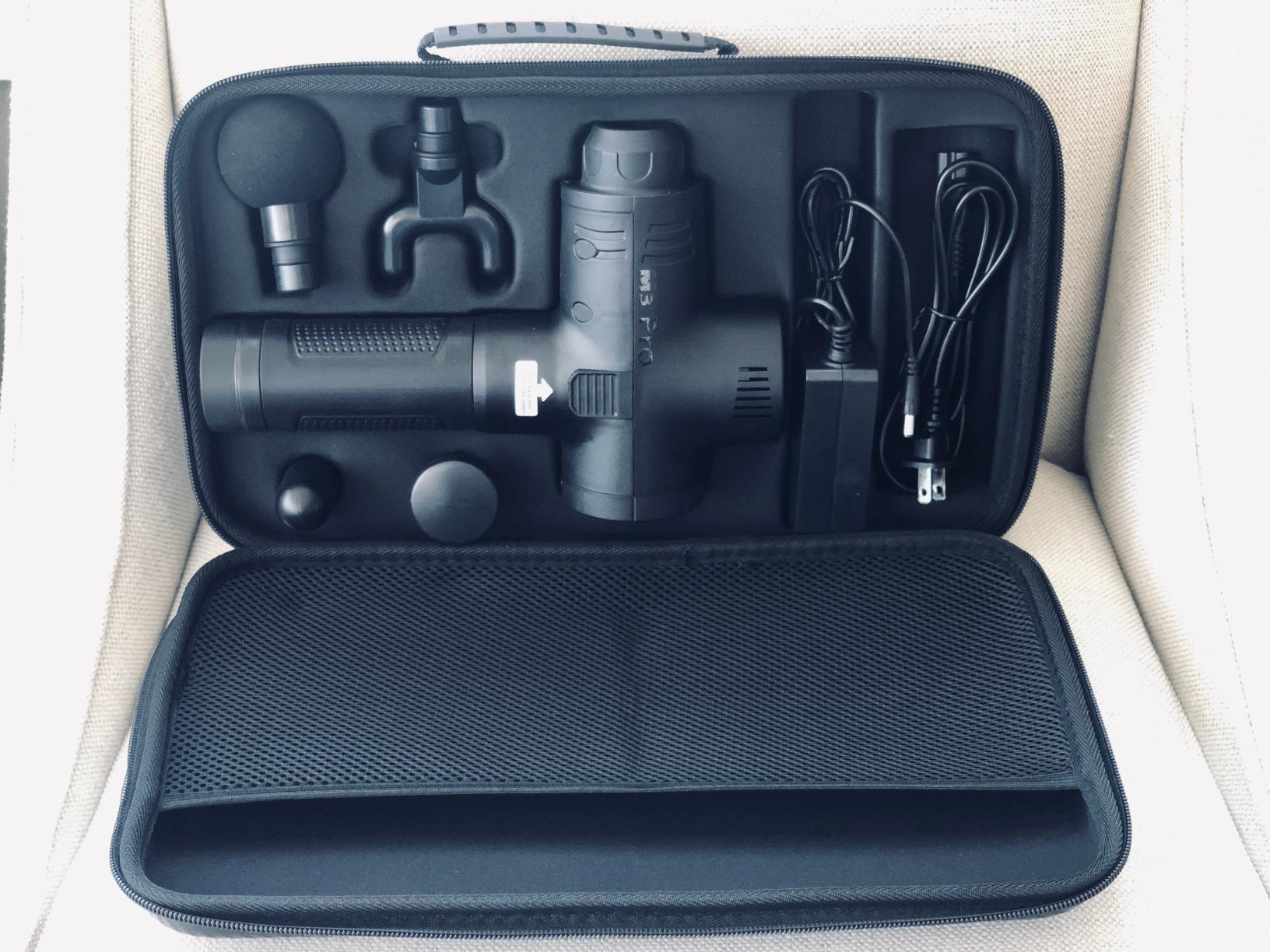
- Carrying case included
Cons
- Heavier than compact travel models at 2.4 pounds
- Only 5 speed settings limits fine-grained intensity control
The M3 Pro 2 is the gun I kept reaching for through this test. Everything in its specification sheet points the same direction: 12mm amplitude, a maximum stall force of 70 lbs, and a speed ceiling of 2500 RPM. For someone who squats heavy, runs long or plays a contact sport, that combination is what separates a tool from a toy.
Through six weeks of use the thing that stood out was not the headline numbers but how rarely it stalled. Pressing hard into a glute at speed four, it kept striking at full depth rather than bogging down. That is a function of stall force, and it is why the figure matters more than the top speed.
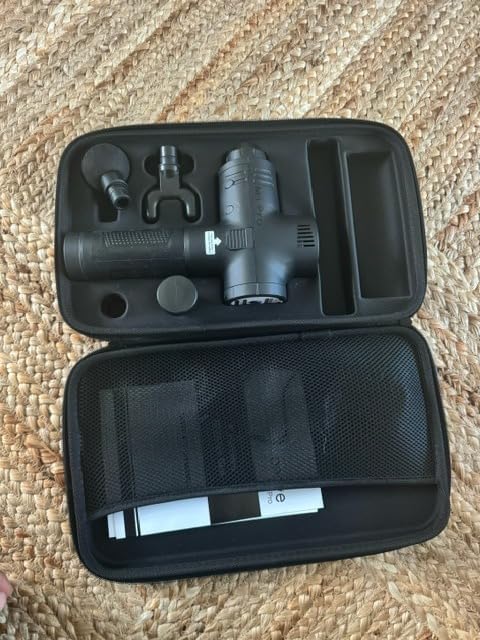
Battery life is the quiet hero here. Manufacturer figures put it at 4 to 8 hours depending on speed, and in practice a hard double session on the back and legs leaves plenty of charge. The redesigned hidden vents push heat away from the motor, which is the part that usually kills massagers two years into ownership.
Owners consistently describe it as quiet and durable, with 84% five-star feedback across more than 20,000 reviews. The shell is described as sound-absorbing and drop-resistant, and the low-noise claim holds up compared with several premium-branded devices in this roundup.
Who the Opove M3 Pro 2 suits best?
This is the pick for lifters and strength athletes working thick, dense tissue. If your sessions involve heavy posterior chains, or you carry a lot of muscle mass, a 70 lbs stall force means you can lean into the device rather than asking it to do all the work.
It also suits anyone training twice a day or on consecutive days, because the battery comfortably survives a full pre-session and recovery session without an overnight recharge. The included carrying case makes it practical to move between a home gym and a training facility.
Where the Opove M3 Pro 2 falls short?
At 2.4 pounds it is the heaviest gun we tested, and that weight lands on your forearm after fifteen minutes of two-handed work on a hamstring. Athletes who dislike wrist and arm fatigue — a complaint forum users raise repeatedly about full-size units over 2.5 pounds — will feel this one.
Five speed settings is thin for an athlete who wants a fine gradient between a warm-up pass and deep knot work. You can get there, but you will be jumping between noticeably different intensities rather than creeping up.
2. Mebak 3 Massage Gun — 53 lbs Stall Force With a Pressure Sensor Guide
Mebak 3 Massage Gun Deep Tissue, Muscle Massager for Athletes Pain Relief
12mm amplitude
53 lbs stall force
LED pressure sensor
39-50dB
1.68 lb
Pros
- 12mm amplitude and 53 lbs stall force reach deep muscle layers
- LED pressure sensor shows when you are pressing correctly
- Quiet at 39-50dB so it works in a shared space
- Light at 1.68 lb for long sessions
- Compact carrying case included
Cons
- Charging adapter not included so you need your own 5V brick
- Fewer speed levels than some rivals at the same tier
The Mebak 3 does something the more powerful guns do not. Its LED pressure sensor indicator lights up when you are pressing at an effective level, which takes an enormous amount of guesswork out of a session on your own back or glutes where you cannot see what the device is doing.
Underneath that, the numbers are properly athletic: 12mm amplitude, 53 lbs of stall force, and a speed range of 950 to 3000 RPM across five levels. That top speed sits at the upper end of the range in this roundup, and it makes the difference when working out a calf knot.
Noise is another strength. The published range of 39 to 50dB places it among the quieter units here, and reviewers repeatedly single out quiet operation alongside deep penetration as the reasons to buy it. That combination is unusual at this level of power.
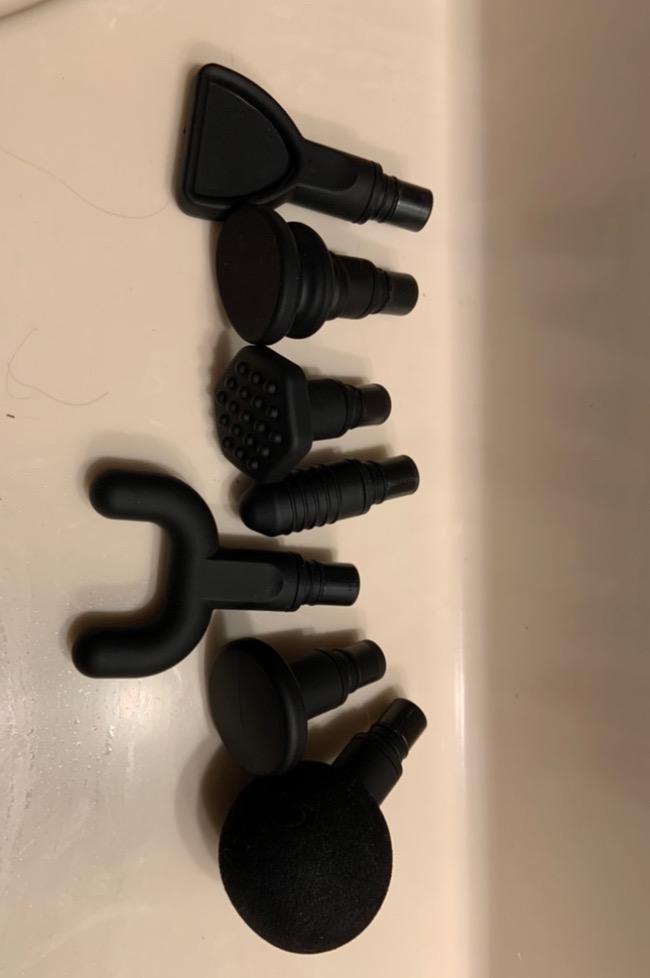
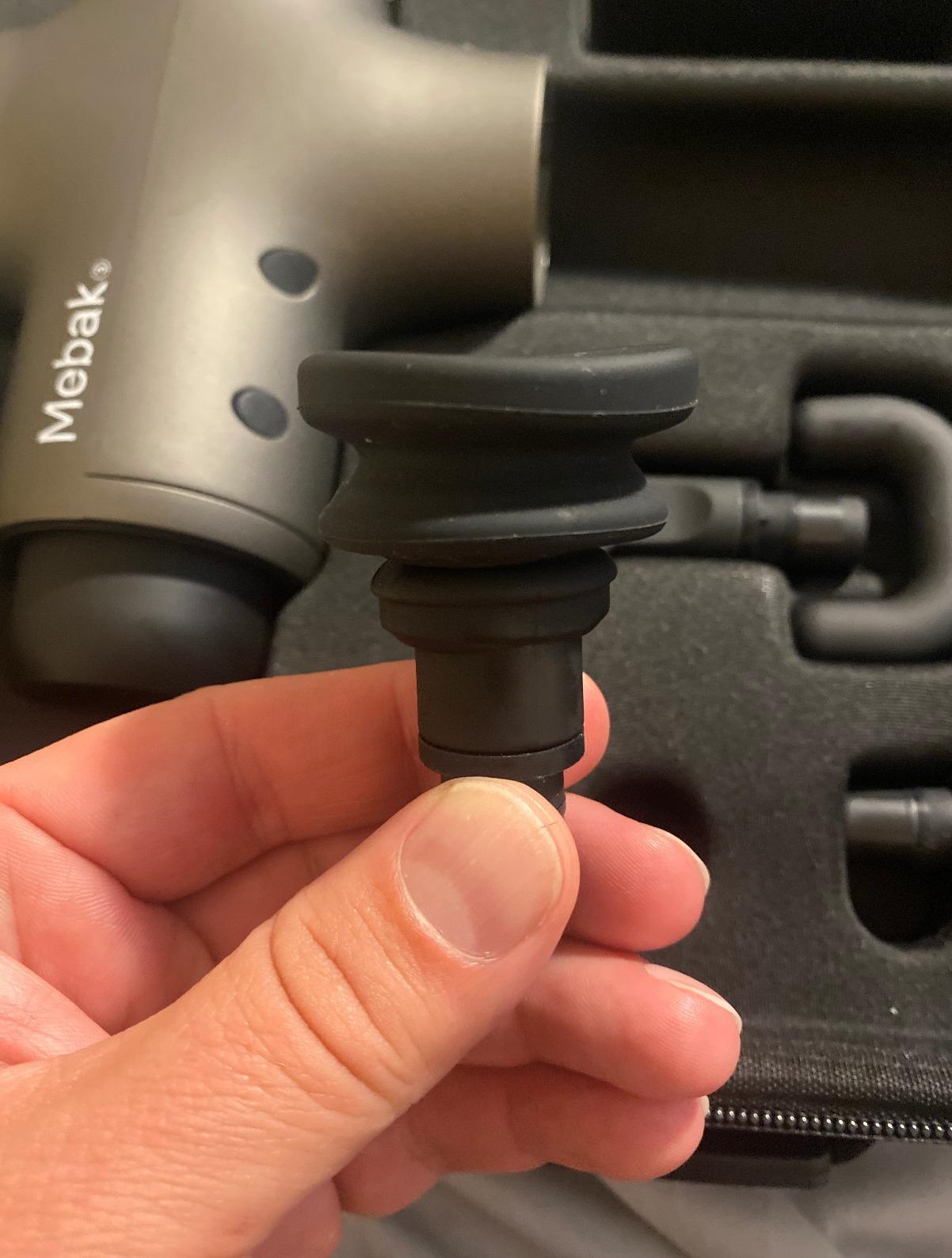
At 1.68 lb — or 3.08 lb with the case — it is light enough for a full leg session without the forearm burn that heavier models cause. Seven heads cover the main muscle groups, and buyers point out that the kit works from hamstrings to calf cramps without hunting for the right attachment.
Who the Mebak 3 suits best?
This is the one for self-massage. Anyone working their own upper back, shoulders or glutes will get more out of a gun that tells you when you are pressing enough. The pressure indicator removes the most common beginner error, which is drifting across the muscle at a depth that does nothing.
It is also a strong pick for athletes who train in shared spaces. A 39 to 50dB ceiling is low enough that you can use it on a gym floor without drawing conversation, which is one of the deal-breakers forum users name most often.
Where the Mebak 3 falls short?
The charging adapter is not in the box. You get a cable and need a 5V/2A brick of your own, which is a small annoyance the first week and irrelevant after that.
Five speed settings is again the limit. If you are used to a device with ten or more levels, the jump from 950 RPM to the next step is a visible change in intensity rather than a gradual one, and you will be tempted to work harder than you should.
3. Bob and Brad X6 Pro Max — Heat, Cold and 55 lbs Stall Force on an Extended Chassis
BOB AND BRAD X6 Pro Max Massage Gun with Heat and Cold, FSA Eligible HSA
55 lbs stall force
Heat to 113F and cold to 50F
9.65 inch chassis
Under 55dB
USB-C PD
Pros
- Switches between heat and cold in about 3 seconds
- 9.65 inch extended chassis reaches most of the body without awkward angles
- Aluminium alloy head holds 55 lbs of stall force on deep knots
- Anti-slip flat grip spreads load across the palm
- 2-year warranty with US-based support
Cons
- Heavier than compact travel guns at 2.12 pounds
- Only 5 speed levels for finer intensity control
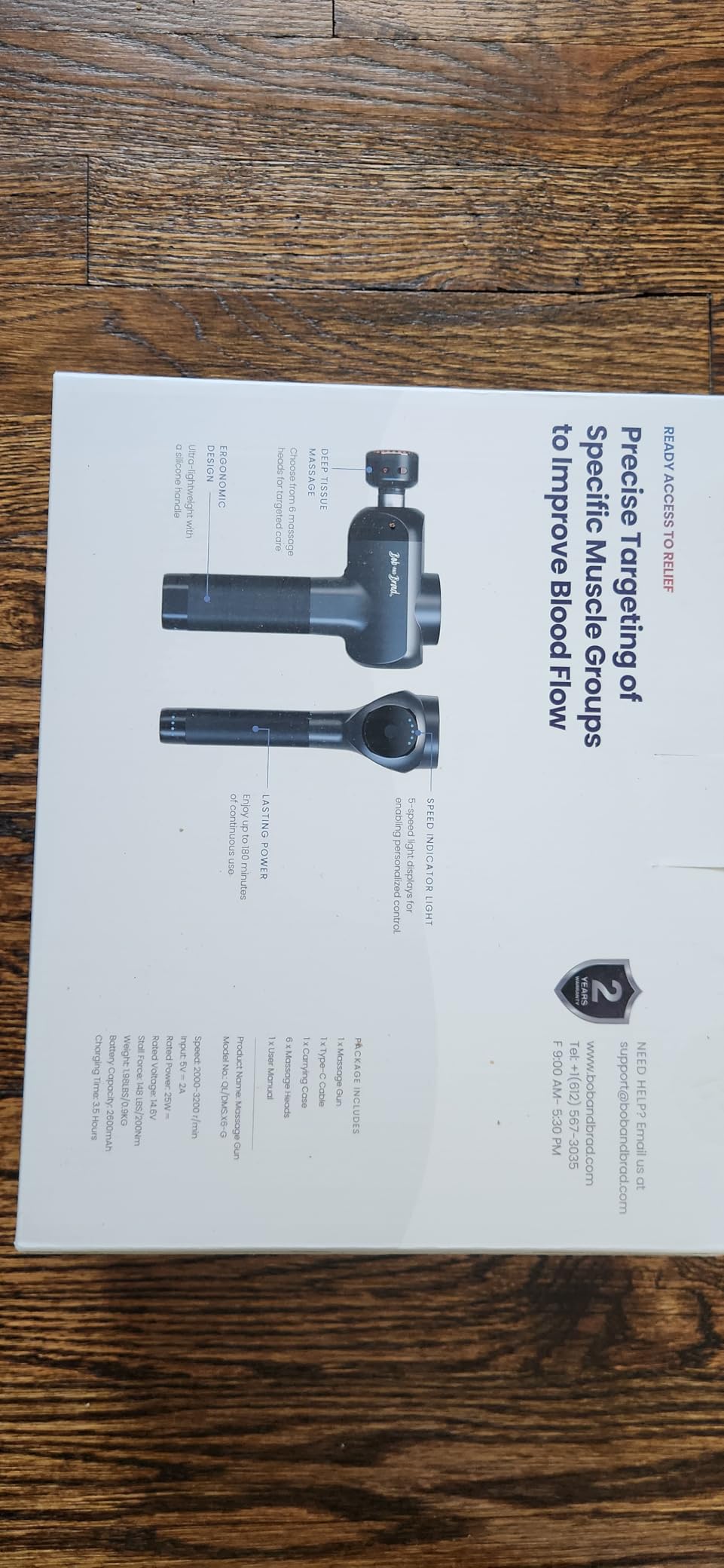
The X6 Pro Max solves a specific problem: reaching your own back without contorting into a position that loads your shoulder. Its 9.65-inch chassis is longer than a standard gun, and combined with the flat anti-slip grip it lets you work the lats and lower back at a sane angle.
On the recovery side it is one of only a few units here that does genuine dual-temperature work. The plate switches between heating to 113F and cooling to 50F in about three seconds, with dedicated heads for each. Warm before a session, cold after — the switch is fast enough that you can do both without planning.
The aluminium alloy attachment is the detail worth knowing about. Plastic-headed guns lose some of their rated stall force in cold or hot settings because the material flexes; the alloy head here preserves the 55 lbs figure, so temperature does not downgrade your depth.
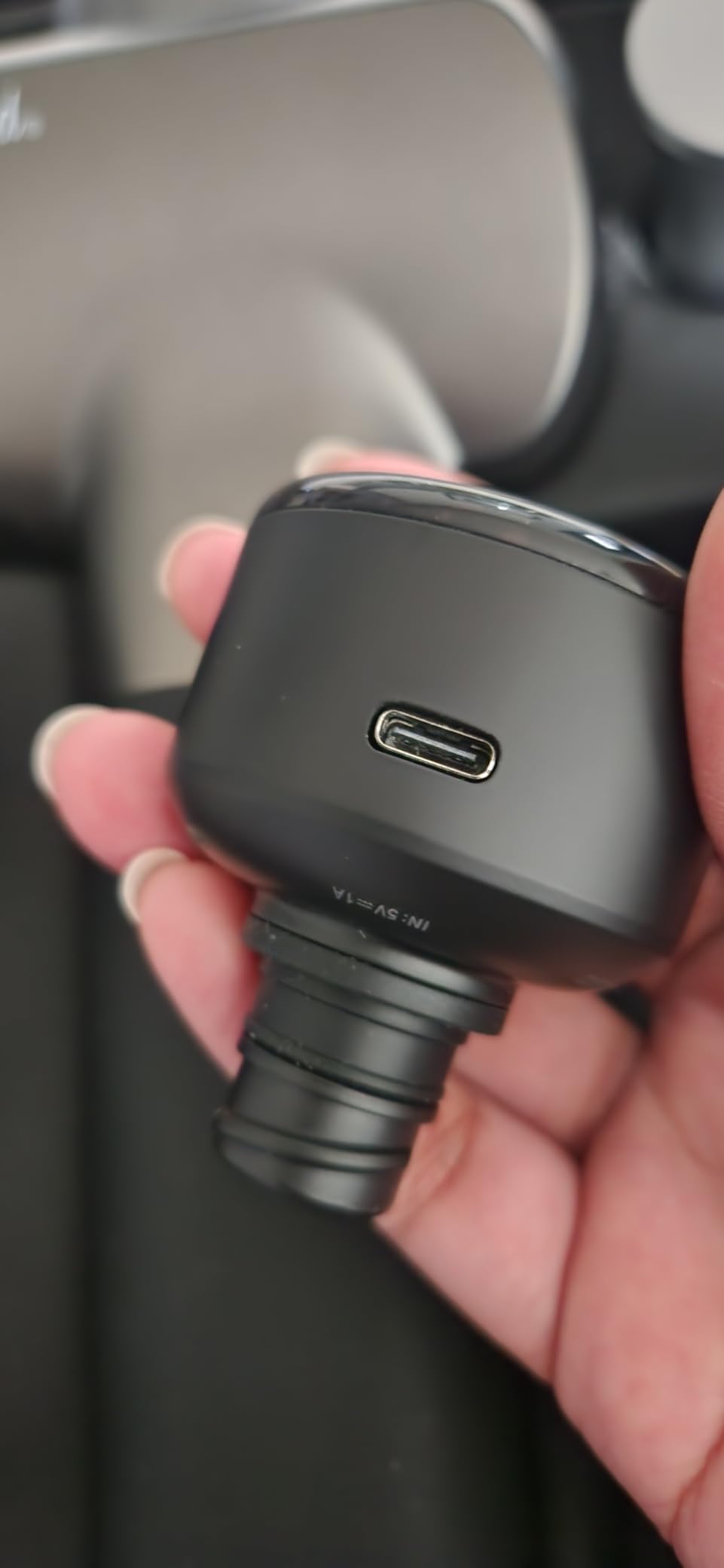
Charging is handled by 2600mAh EV-grade cells and USB-C PD, reaching full charge in roughly 2.5 hours. That matters on a tournament weekend. FSA and HSA eligibility also make it reimbursable if your plan covers it, and the 2-year warranty covers the kind of use a tournament season delivers.
Who the Bob and Brad X6 Pro Max suits best?
Anyone whose sport loads the back — rowers, climbers, field athletes, weightlifters pulling from the floor — will get real value from the extended chassis. It is also the pick for athletes who want heat and cold in one device and dislike carrying two heads and a cold pack.
It suits competition weekends. USB-C PD charging means one cable for phone and gun, and the 2-year warranty covers the kind of use a tournament season delivers.
Where the Bob and Brad X6 Pro Max falls short?
Weight is the recurring complaint. At 2.12 lb it is heavy for a gun that will live in a gym bag, and reviewers who compare it with compact models describe it as noticeably bulkier.
Five speed settings again, with a range of 2000 to 3200 RPM. That range is narrow at the bottom end, so warm-up work at low intensity is less gentle than on a device that starts near 1200 RPM.
4. RENPHO Thermacool 2 — Four Heat Levels and Four Cold Levels in a Travel-Size Body
RENPHO Active Thermacool 2 Red Massage Gun with Infrared Heating, Cool Head
4 heat levels to 113F
4 cold levels to 46F
45 lbs stall force
10mm amplitude
40dB
Pros
- Genuine dual-temperature therapy with four heat and four cold levels
- Quiet operation that holds up even at high intensity
- Compact and travel-friendly at 1.39 lb
- Intuitive controls you can adjust mid-session
- Sturdy carrying case and a good range of attachments
Cons
- Heavier than many compact competitors
- Battery reported draining faster than advertised by some reviewers
- Instruction booklet hard to find in the bag
The Thermacool 2 exists because of a simple pattern in the reviews: athletes want temperature therapy, but the temperature range on most devices is not wide enough to matter. Four heat levels reaching 113F and four cold levels dropping to 46F gives you the full span needed for pre-session heat and post-session cooling.
That makes it unusually practical for year-round training. A cold plate at 46F on a hamstring after a hard run or a race is a different tool from a warm plate at 113F before lifting, and one device covering both ends of the scale is rarer than the marketing suggests.
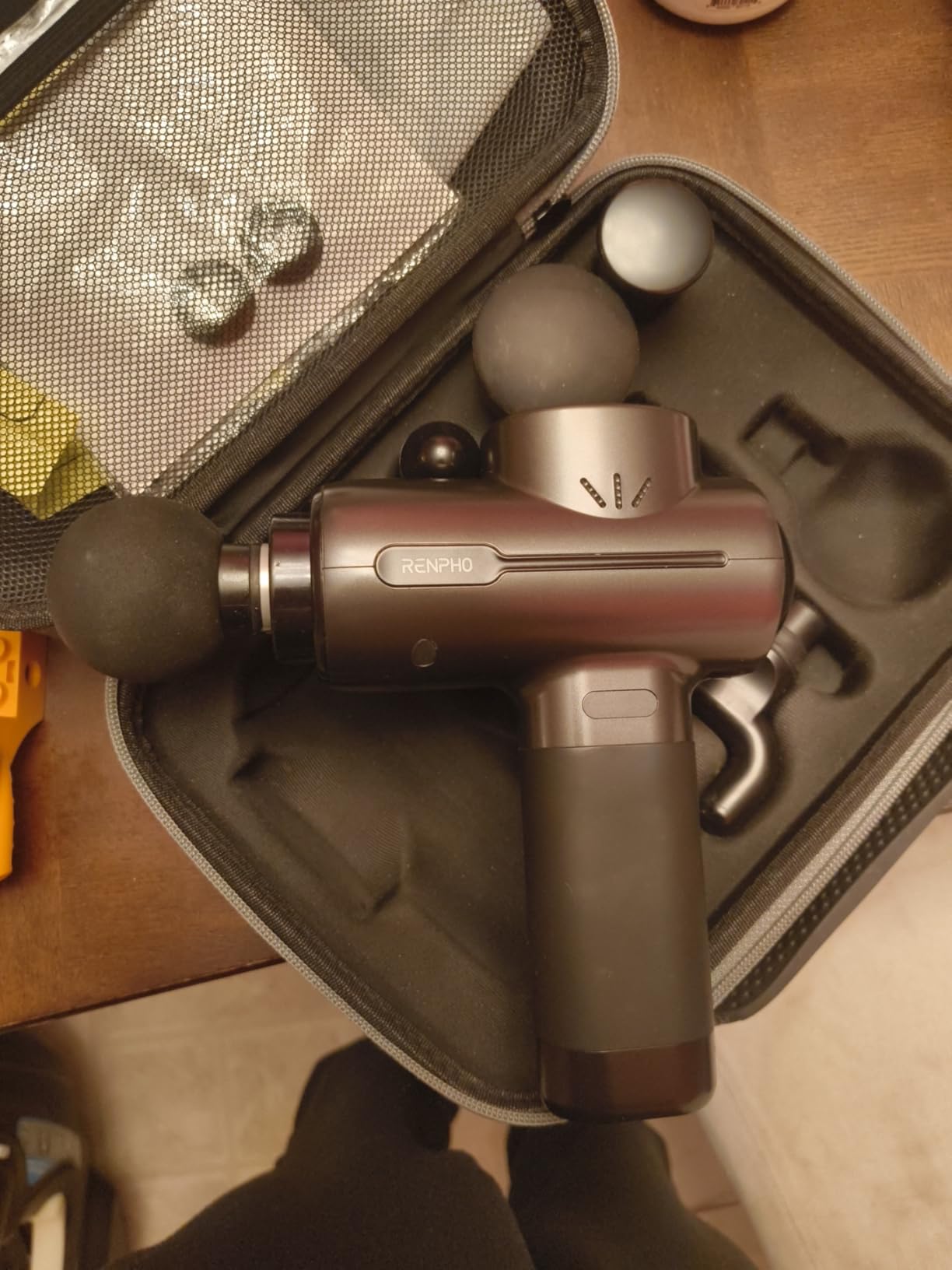
Underneath the temperature feature it is a competent athlete’s tool: 3200 RPM percussion speed, 10mm amplitude and 45 lbs of stall force, driven by a brushless motor rated at 40dB. Forty decibels is genuinely quiet, and reviewers specifically note it holds up at high intensity rather than only at low settings.
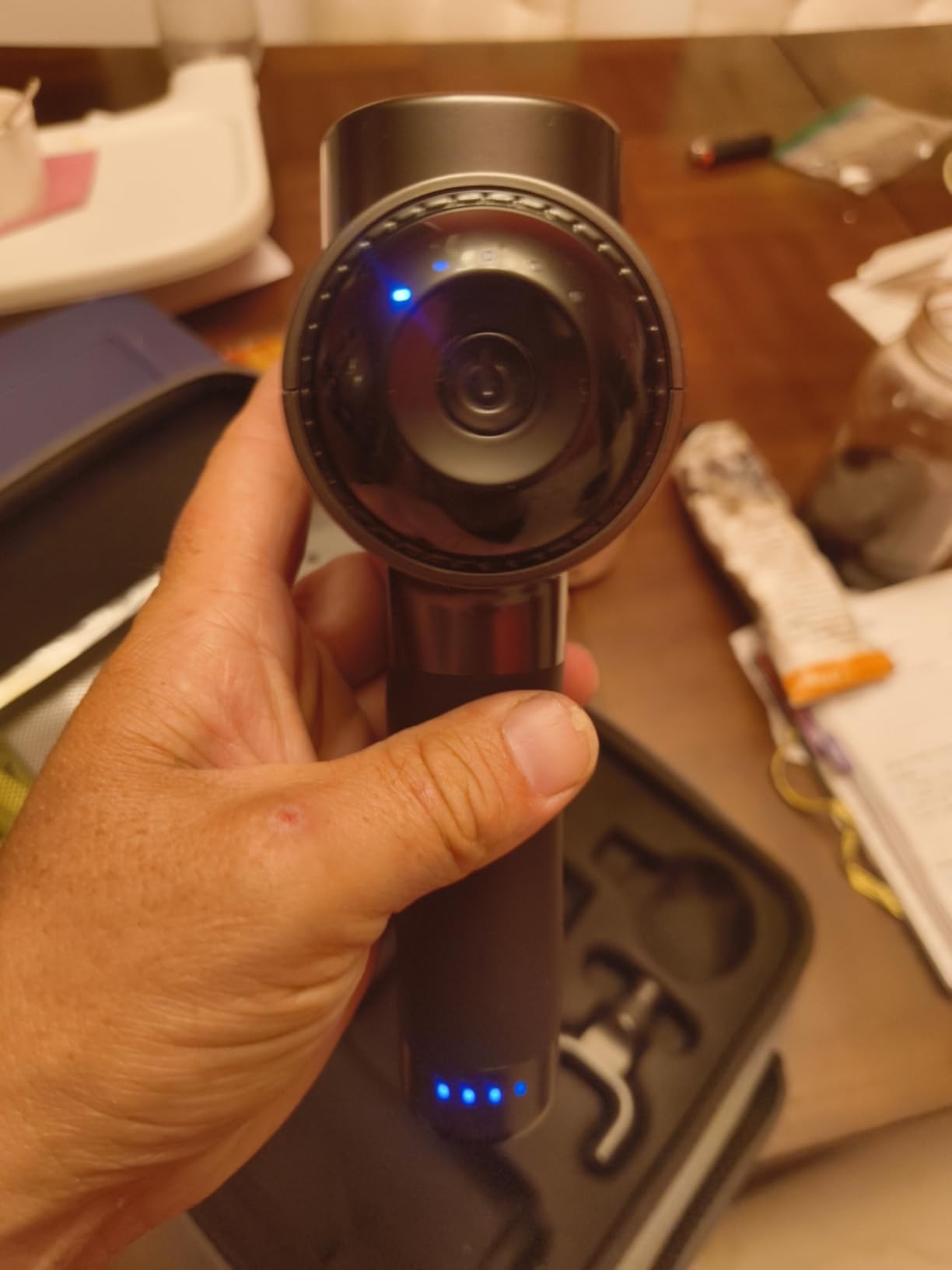
The 3-in-1 infrared heating head also offers three light modes at different wavelengths, and the VA display shows speed, battery and temperature at a glance. At 1.39 lb it is one of the lighter units here, so the thermal functions do not come with a big weight penalty.
Who the RENPHO Thermacool 2 suits best?
Runners and triathletes get the most from it. Cold settings on calves, quads and hamstrings after a long effort, warm settings before an early session, and enough stall force at 45 lbs to work through a genuine knot rather than buzzing over it.
It also suits athletes who travel constantly. At 1.39 lb with a carrying case it moves between a race kit and a desk drawer without thought, and the auto-off after 10 minutes protects the battery when you fall asleep mid-session.
Where the RENPHO Thermacool 2 falls short?
Some reviewers report the battery draining faster than the stated figure, which is worth factoring in if you plan long sessions away from a charger. The 2500mAh pack is smaller than the batteries behind the six-hour runtime claims elsewhere in this roundup.
The 10mm amplitude is the other limitation. It works well on most muscle groups, but if you are a heavy lifter dealing with genuinely dense tissue, the 11mm and 12mm guns in this test reach further.
5. LifePro Sonic Massage Gun — Six Hours of Runtime and Eight Heads
LifePro Sonic Massage Gun Percussion Muscle Massager, 8 Heads & 5 Speeds
Up to 6 hour runtime
8 interchangeable heads
6 speed settings
Reinforced grip
Travel case
Pros
- Strong high-impact percussion that reaches into tight muscle
- Battery runtime measured in weeks of regular use
- Eight heads plus a rubber bubble head for sensitive back work
- Reinforced grip improves control during a long session
- Good value against premium massage gun brands
Cons
- A small number of models have reported internal rattling and early mechanical failure
- Handle feels heavy and awkward for shoulder and upper back work
- Carrying case lacks a guide for which attachment goes where
The LifePro Sonic makes a quiet argument that matters more than most spec sheets: how long does it run before you need a charger. Up to six hours per charge is among the longest runtimes in this roundup, and owners describe the battery in terms of weeks of regular use rather than single sessions.
For an athlete training twice a day or someone who travels to a training camp and does not want to hunt for a socket, that removes the single most annoying interruption in recovery work. You charge it overnight and it holds up.
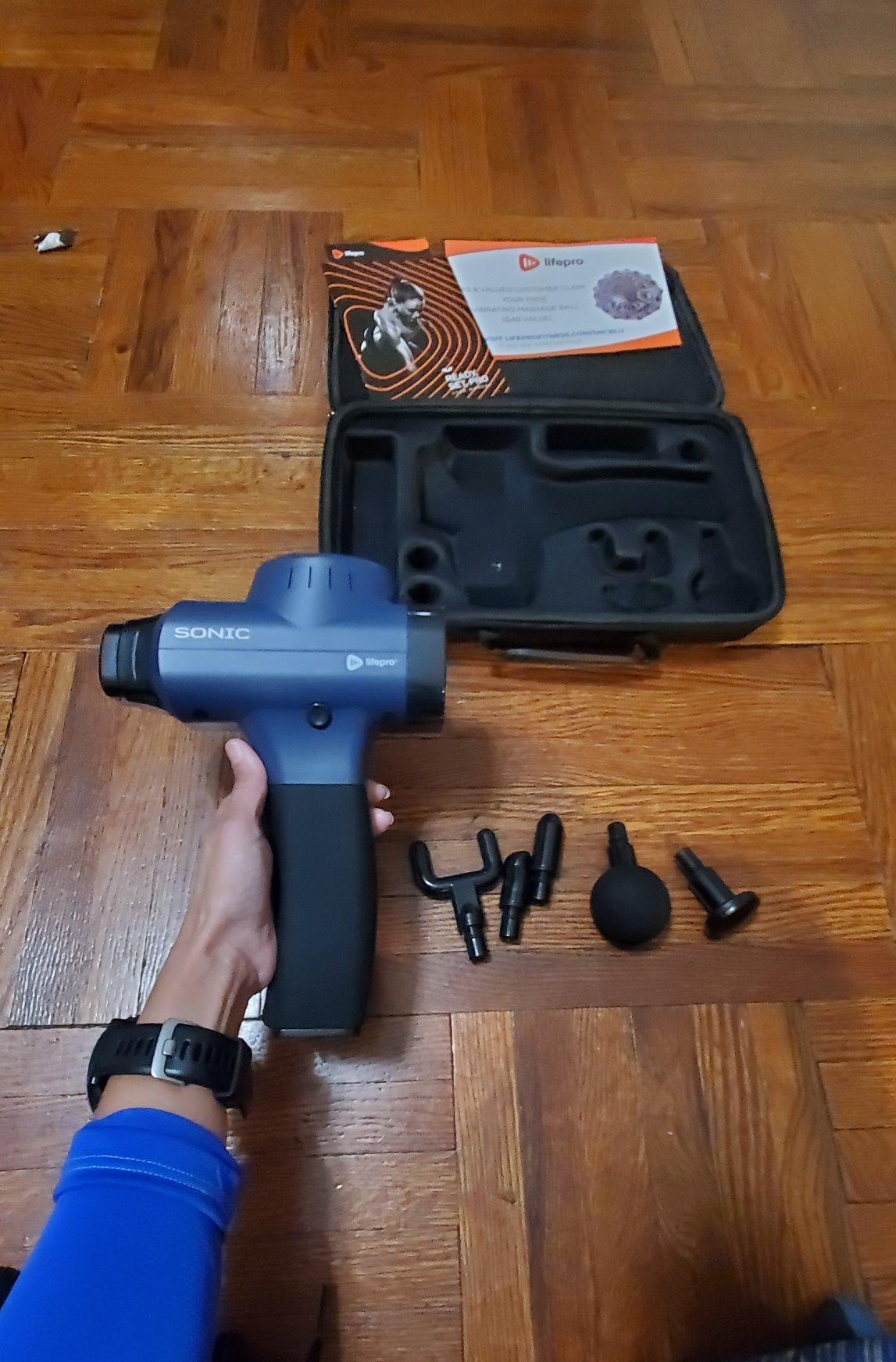
Performance is high-impact rather than delicate. Owners describe powerful percussion that handles everything from hamstrings to calf cramps, and eight heads give you real coverage, including the rubber bubble head that works well on sensitive back areas where a hard flat head is too much.
The reinforced grip is a deliberate upgrade over slim budget shells and does improve control when you are leaning into a glute. The included travel case is the one weak spot — several buyers note it gives no indication of which attachment belongs where, so you end up testing heads by feel.
Who the LifePro Sonic suits best?
Double-session athletes and anyone with an unreliable gym outlet. Six hours of runtime means a full pre-workout activation pass and a full recovery session without a top-up, which is the single biggest practical difference in daily use.
It is also a good first serious gun. Eight heads, six speeds and a reinforced frame cover the range most beginners need, and buyers consistently rate the value against premium brands favourably.
Where the LifePro Sonic falls short?
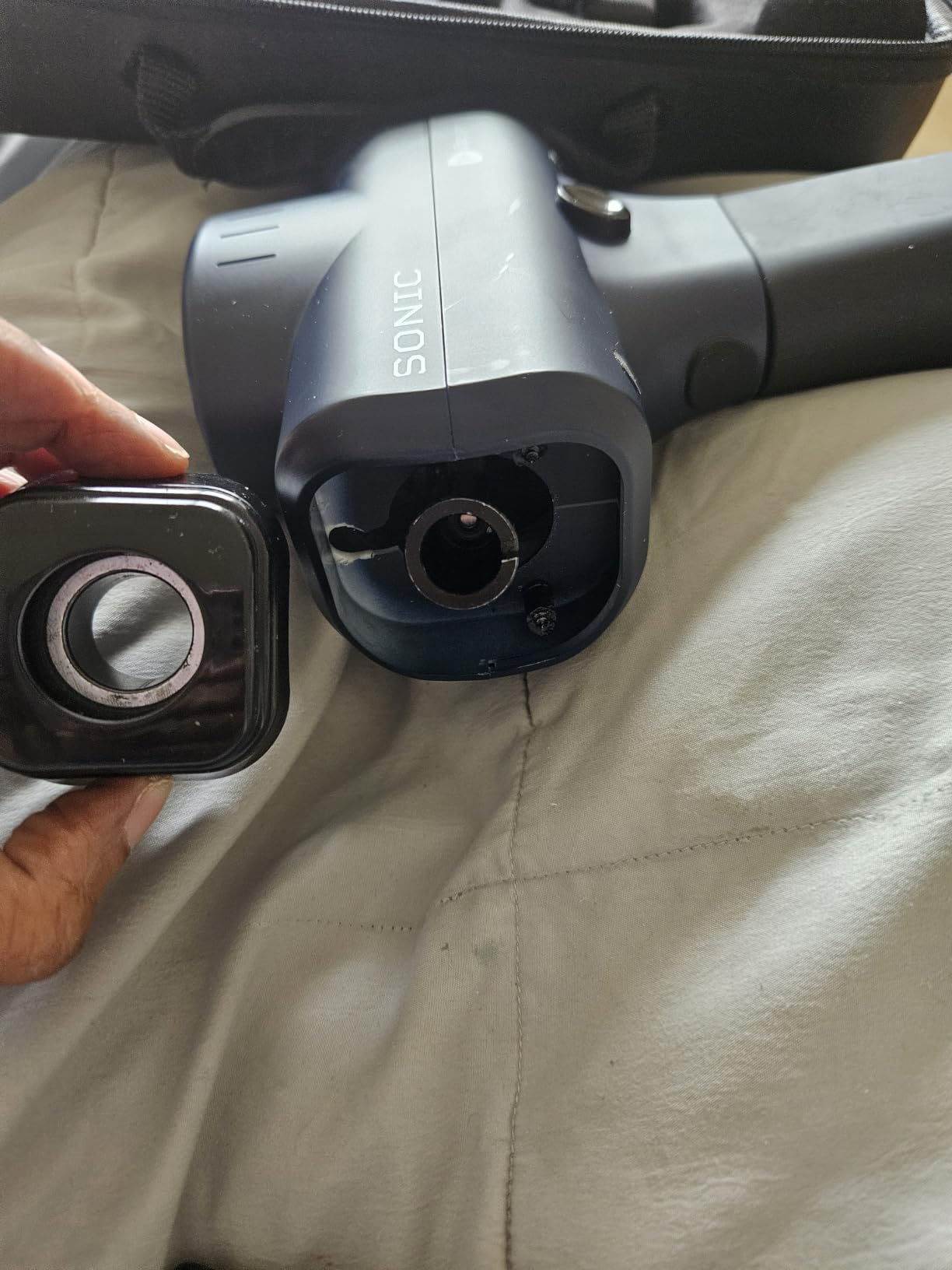
A small number of owners report internal rattling and mechanical failure early in the unit’s life. This is not widespread, but it is the reason warranty length matters here, and it is worth checking the coverage before you commit.
At 2.2 lb the handle feels heavy and awkward for self-massage of the shoulders and upper back — the same reach problem the X6 Pro Max solves with its longer chassis. If your recovery focus is the upper back, weight is a real factor.
6. Bob and Brad Q2 Pro Mini — 0.95 lb Travel Gun With Heat and Cold Presets
BOB AND BRAD Q2 Pro Mini Massage Gun with Heat and Cold for Muscle Recovery
0.95 lb body
Heat and cold presets
40dB operation
USB-C PD charging
7mm amplitude
Pros
- Truly compact at 0.95 lb and easy to carry in a backpack or carry-on
- More power than the size suggests on tight knots and plantar fascia
- Heat and cold presets add genuine recovery value
- Whisper-quiet even at the highest speed
- Bob and Brad customer service replaced defective models quickly
Cons
- 7mm amplitude is shallower than full-size guns here
- A small number of models needed replacement after a year or more
- Fast charger not included
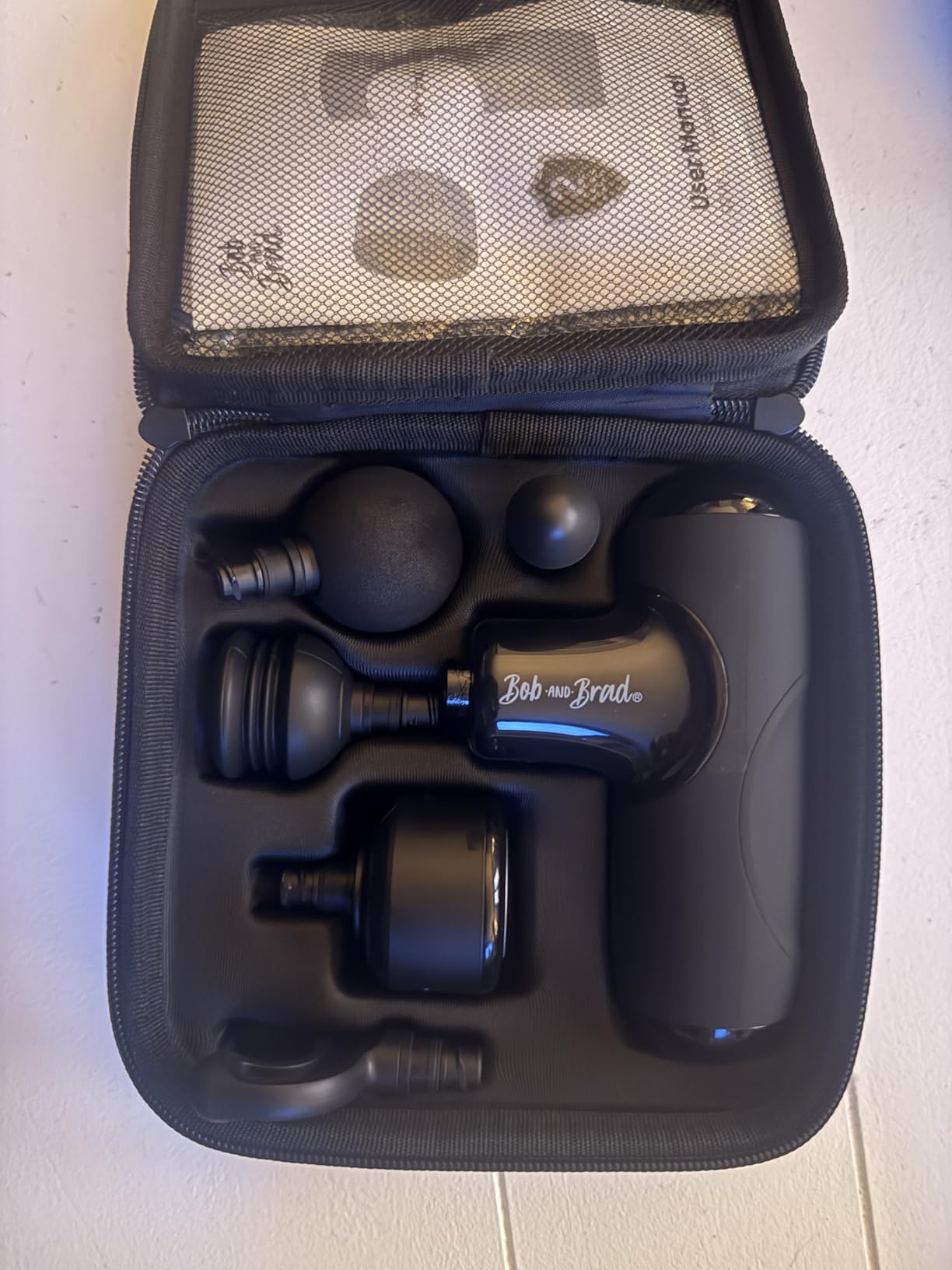
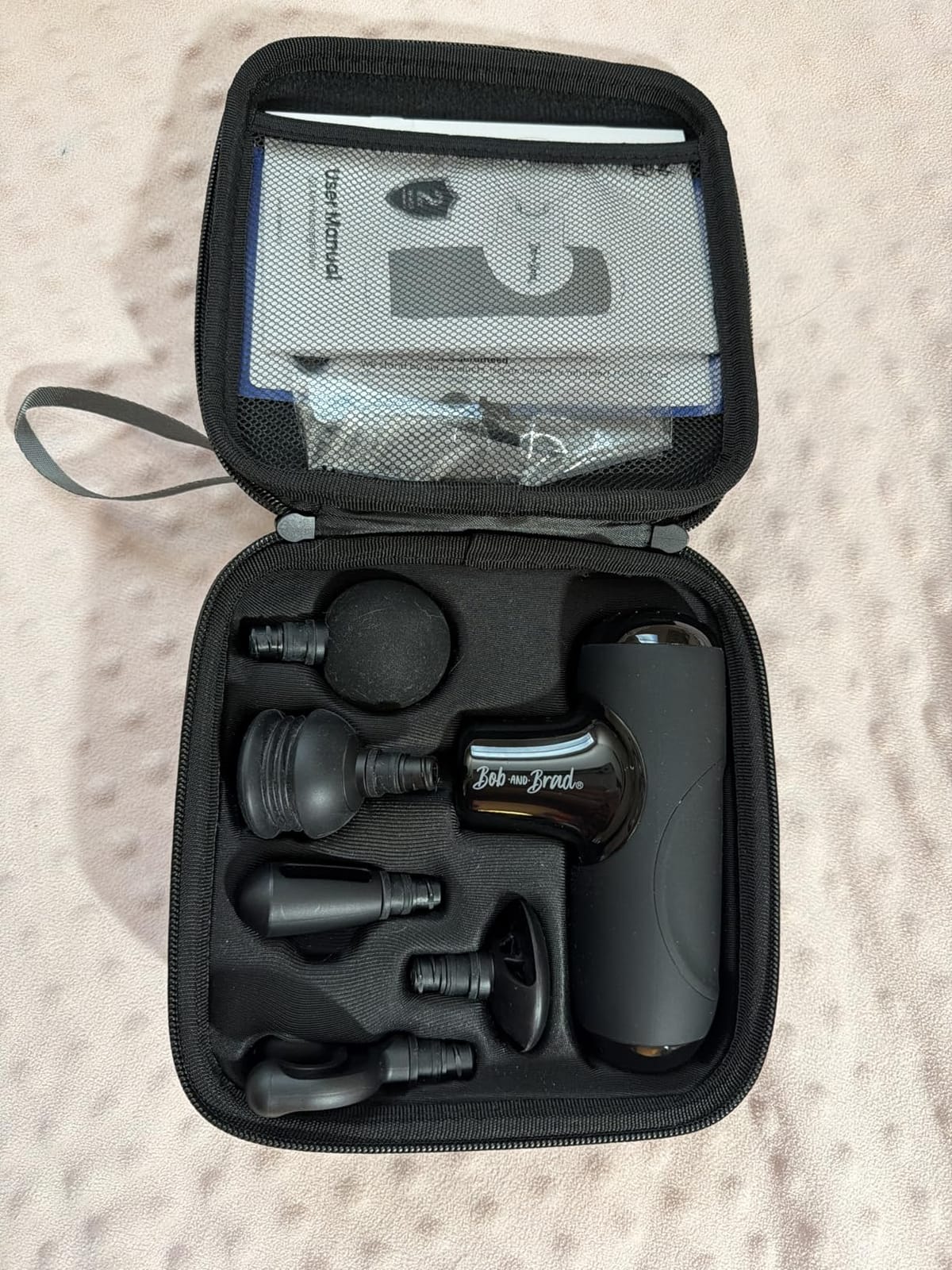
The Q2 Pro Mini is the travel answer. At 0.95 lb it is less than half the weight of most full-size units here, and it was designed by physical therapists who wanted something athletes would actually pack. It measures 5.7 by 3.4 by 1.8 inches, which fits a race kit bag or a jacket pocket.
What surprised us more than the weight is the output. Reviewers describe it as small but mighty, working into tight knots and the plantar fascia with more authority than the 7mm amplitude suggests it should. Five speeds run from 1800 to 3000 percussion per minute.
The heat and cold presets are set up as recovery modes rather than manual dials, which makes them quick to use between sessions. A 15W PD fast charge brings it from flat to full in 1.5 to 2 hours over USB-C, using cables you already own, and the brushless motor keeps it at roughly 40 decibels.
That combination of size, quiet operation and USB-C is why travel-heavy athletes keep one in a gym bag permanently. Five interchangeable heads and a portable hand case complete the kit.
Who the Bob and Brad Q2 Pro Mini suits best?
Away-day athletes. If you train at a different gym, race somewhere new or fly regularly, this is the one to carry. Half the weight of a full-size gun changes how often you reach for it.
It also suits athletes who work in an office and train at the other end of the day, since a 0.95 lb gun kept in a desk drawer is a device you will actually use.
Where the Bob and Brad Q2 Pro Mini falls short?
The 7mm amplitude is the honest limitation. It is the shallowest in this roundup, and on very dense tissue — a heavy hamstring, a chronically tight glute — you will reach the end of its travel sooner than with an 11mm or 12mm gun.
A few owners report needing a replacement after a year or more due to charging port or motor issues. The brand’s warranty support is frequently praised for handling those cases, but the failure rate is worth knowing about.
7. arboleaf Hot and Cold Massage Gun — Three-Second Temperature Switching in a 1.04 lb Body
arboleaf Hot and Cold Massage Gun Deep Tissue, Percussion Muscle Massager
35 lbs stall force
Hot plate to 113F in 3 seconds
Cold plate to 46F
T-grip
3-year warranty
Pros
- Aluminium plate switches hot to cold in about 3 seconds
- Compact 1.04 lb body that fits smaller hands without cramping
- Quiet motor and alloy construction suited to travel
- Pressure-responsive fifth speed mode tailors the percussion
- Silicone heads glide over skin and are easy to clean
Cons
- Plate reads more warm or cool than genuinely hot or cold for some users
- Stall force is lower than full-size professional models
- Some buyers report finish not matching listing photos
The arboleaf is built around one idea: make temperature therapy instant. Its aluminium plates reach 102 to 113F on the hot setting and 46 to 57F on the cold setting in about three seconds each, with four levels on both. That speed is what makes them useful rather than decorative — you can warm up a muscle and then cool the same muscle within a short window.
The T-grip is the other design decision worth understanding. It is shaped specifically for reaching the lower back on your own, which is one of the hardest areas to treat alone and one of the most common recovery complaints among lifters.
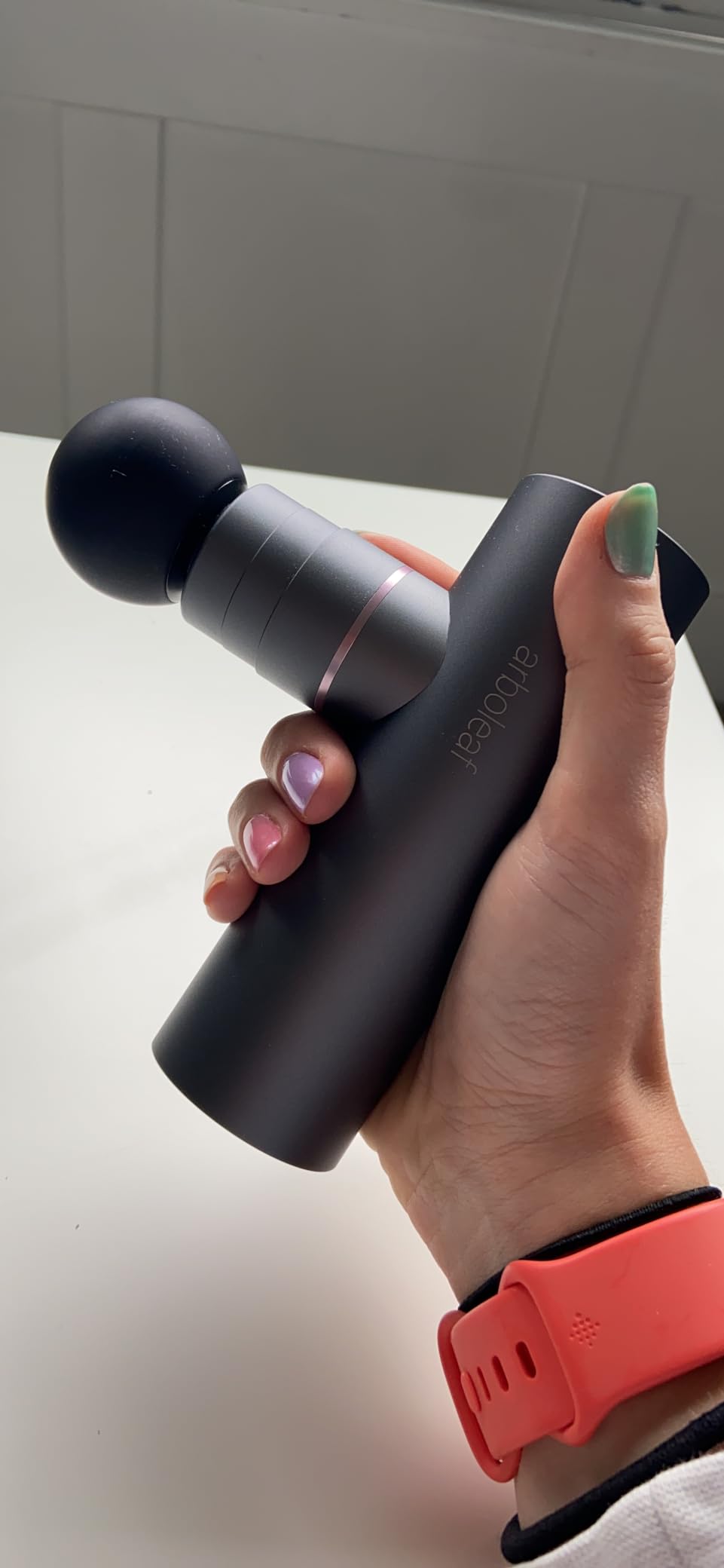
It also packs a pressure-adaptive fifth speed mode, which responds to how hard you press instead of running at a fixed speed. The range across all modes spans 1000 to 3200 RPM, and metal-denoise technology holds the operation between 35 and 55dB.
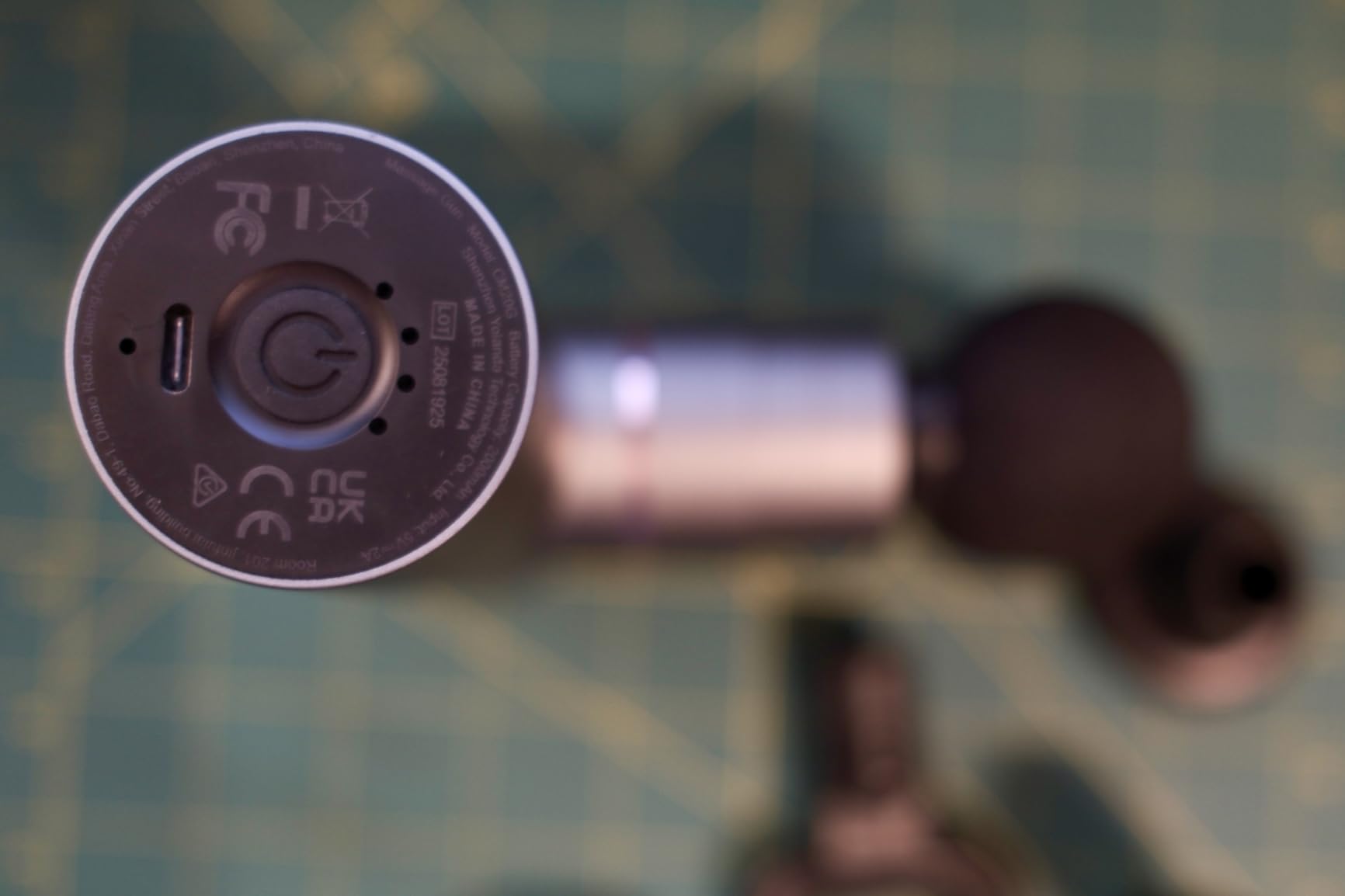
The 3-year warranty stands out in this roundup, and reviewers describe the silicone heads as gliding over skin and sanitising easily. At 1.04 lb it fits smaller hands without cramping, which matters over a long session.
Who the arboleaf suits best?
Lifters and anyone whose lower back takes the load. The T-grip and the deep lower-back access are the reason to choose this over another compact gun, particularly if you train alone and cannot reach that area comfortably with a standard hammer shape.
It also suits smaller hands. Several reviewers mention the body fitting without cramping, which is the opposite of what many full-size guns do over a long session.
Where the arboleaf falls short?
Thirty-five pounds of stall force is modest next to the 53 and 70 lb guns here. It works, but on the thickest quads and glutes you will feel it reach its limit sooner.
Forum discussion on heated and cold attachments generally finds the sensation pleasant but the therapeutic payoff uncertain, so treat the temperature feature as a comfort tool rather than a treatment.
8. Medcursor Percussion Massager — 11mm Stroke and a 35dB Motor at a Budget Tier
Medcursor Massage Gun – High Intensity Brushless Motor, Handheld Percussion Deep Tissue Massager with 6 Massage Heads for Sore Muscle and Stiffness, Gifts for Father/Dad (Black)
11mm stroke depth
35dB minimum noise
4.5 hour runtime
5 speeds from 1200 to 3200 RPM
Pros
- Very quiet high-torque brushless motor for the price
- 11mm stroke depth delivers a genuinely strong massage
- Simple one-button operation with five distinct speeds
- Runs up to 4.5 hours per charge from a large battery pack
- HSA and FSA eligible with five interchangeable heads
Cons
- Batteries arrive only partly charged so the first session is short
- 10-minute auto timer interrupts longer sessions
The Medcursor solves the two complaints that quietly ruin budget massagers: shallow travel and noise. An 11mm stroke is the second-deepest here, and a brushless motor with a 35dB minimum is the lowest published noise floor in the roundup.
That combination is unusual because quiet operation usually means a smaller, weaker motor. Here the high-torque brushless design holds 11mm depth while staying under conversational volume, which is exactly what athletes recovering in a shared flat need.
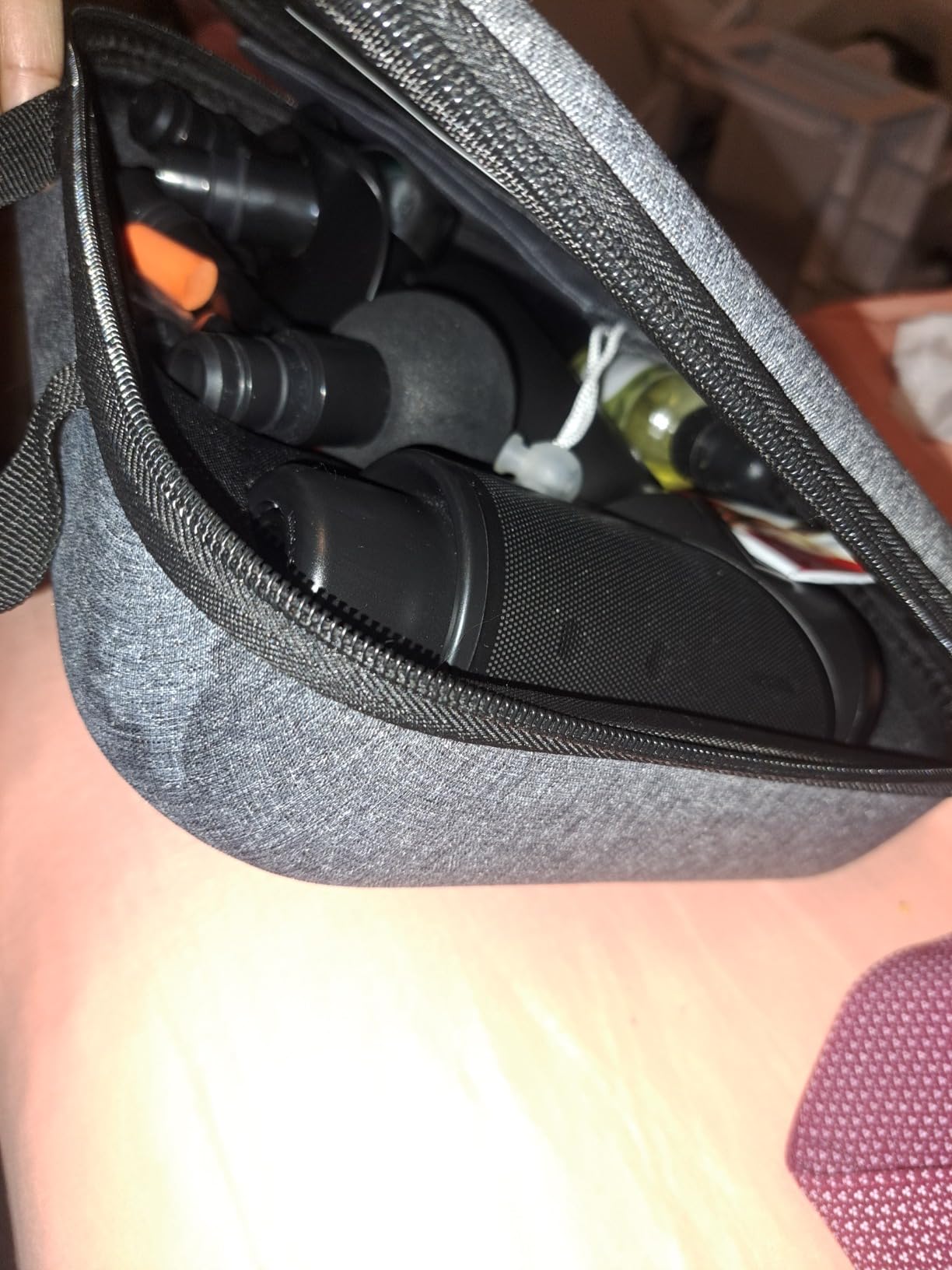
Battery capacity is unusual for this tier — 6000mAh in total across three cells, giving up to 4.5 hours of runtime. Five speed levels span 1200 to 3200 RPM and are selected with a single button, so there is no menu to learn between sets.
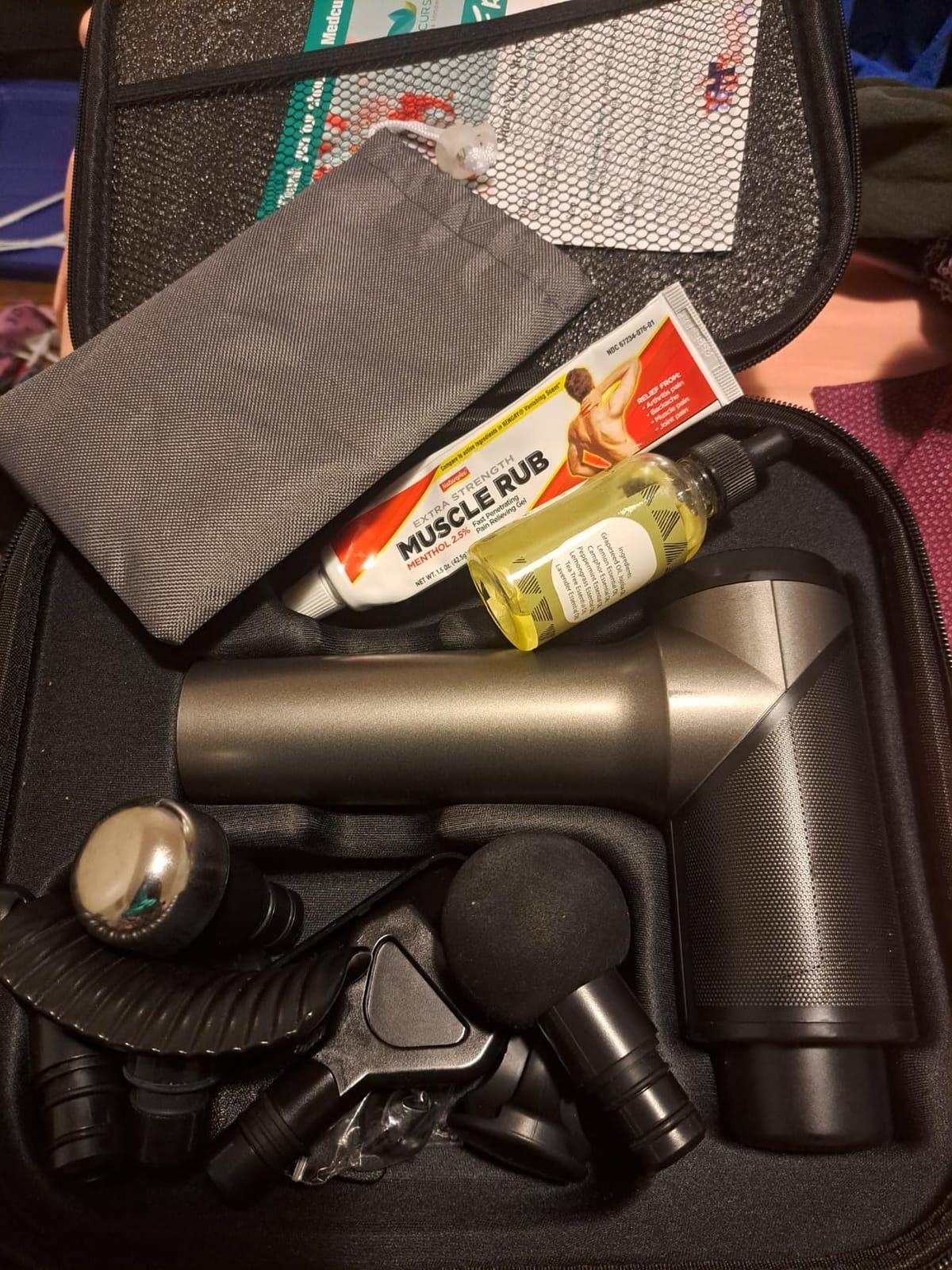
The heads cover the essentials: shovel, bump, bullet, ball and flat. HSA and FSA eligibility makes the cost recoverable on a compatible health plan, which few competitors in this roundup offer.
Who the Medcursor suits best?
Anyone recovering in a shared space. A 35dB floor means you can work a calf at full speed next to someone on the sofa without raising your voice, which removes the single most common reason a quiet requirement kills a purchase.
It suits first-time buyers too. One button, five speeds, no app and no pairing, so there is nothing to set up on the day you collect it from a courier.
Where the Medcursor falls short?
The battery arrives only partly charged, so your first session will be shorter than the advertised runtime. Give it a full charge before you plan a long recovery session.
The 10-minute auto timer cuts off mid-routine if you forget about it, and the 60-second intelligent shutdown is useful for stray knocks rather than deliberate pauses. Plan your session in blocks.
9. Youdgee 30-Speed Massage Gun — Thirty Levels and Six Genuinely Useful Heads
Youdgee Massage Gun, 30 Speeds, 6 Heads, Quiet Deep Tissue Muscle Massager
30 speed levels
6 twist-lock heads
45dB operation
2500mAh battery
1.72 lb
Pros
- Thirty speed levels give unusually fine-grained intensity control
- Quiet at 45dB and workable beside a sleeping partner
- Long runtime from the 2500mAh rechargeable pack
- All six attachments are reported as useful rather than filler
- Ergonomic handle reduces hand fatigue on long sessions
Cons
- Some reviewers find it louder than premium brands such as Theragun
- A few users wish for more power at the top end
- Heavier than some travel-sized competitors
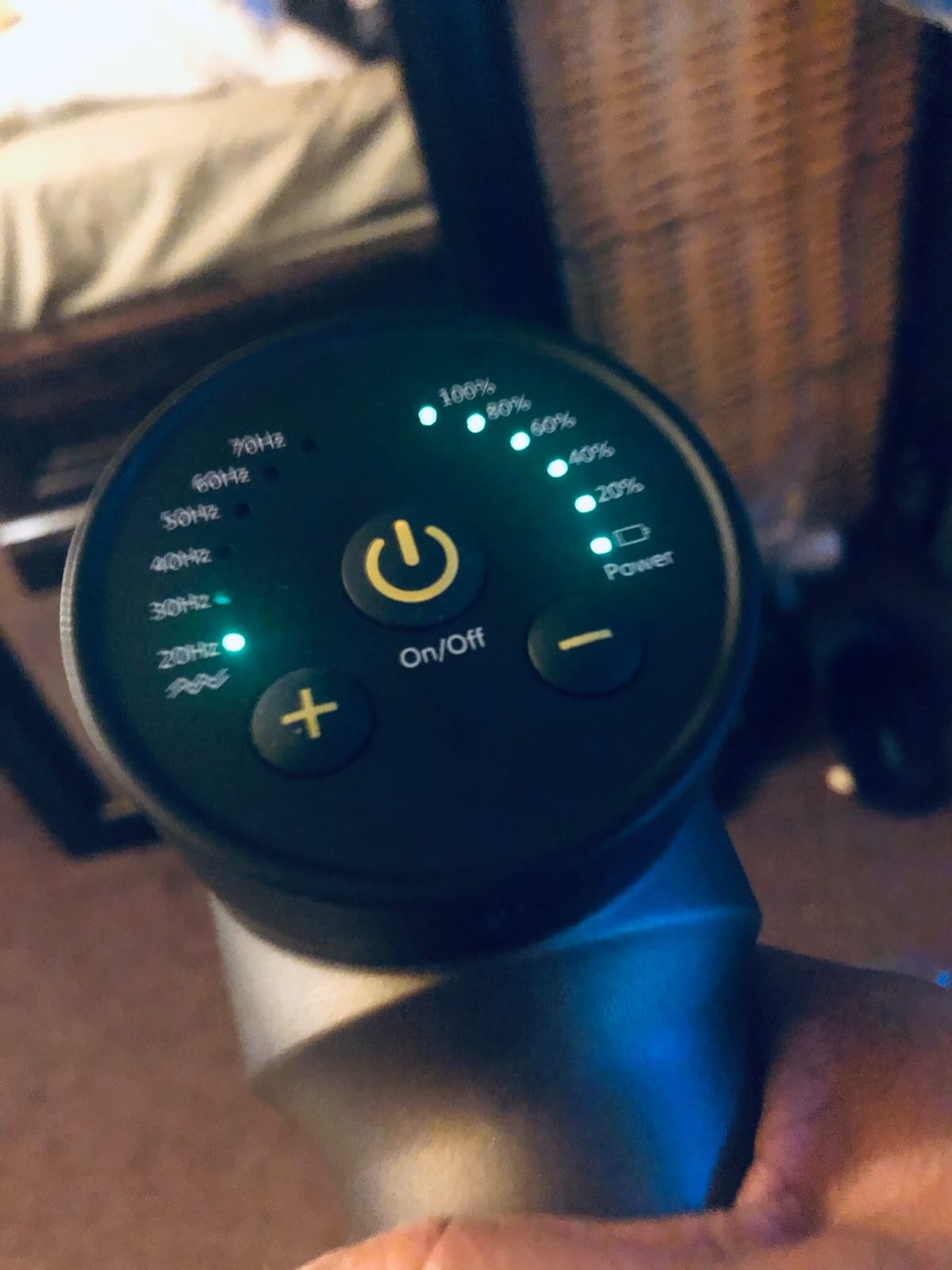
Thirty speed levels is the headline here, and it is more useful than it sounds. Almost every other gun in this roundup offers five or six steps. With thirty, you can creep the intensity up over two minutes on a tight muscle instead of jumping between noticeably different levels.
That granularity is exactly what a warm-up pass needs. A gentle activation at the low end and a deep knot treatment a few clicks away from it means you can do both in one session without swapping devices or resetting your approach.
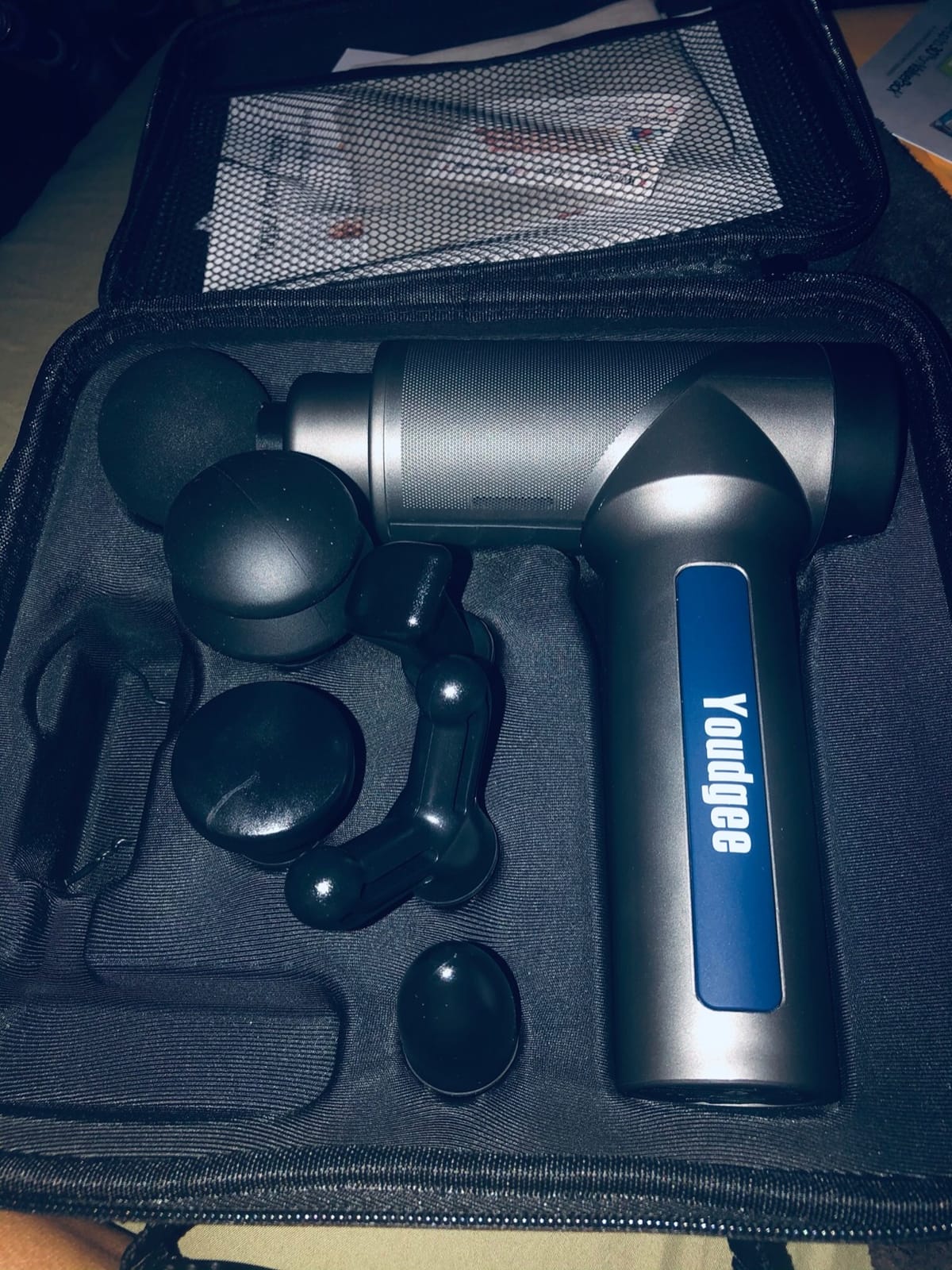
The six twist-lock heads also stand out. Most budget kits include heads that exist only to raise the count; owners here describe all six as genuinely useful, which is unusual and worth crediting.
Noise sits at 45dB, quiet enough to use while watching television or beside a sleeping partner. The 2500mAh battery supports extended runtime, and the balanced ergonomic handle is designed specifically to reduce hand fatigue, which addresses the wrist and arm complaint forum users raise about heavier guns.
Who the Youdgee suits best?
Anyone who dials in carefully. If you have been burned by a device that jumped from a massage to a bruising at the next speed, thirty levels remove the temptation to overcorrect.
It suits athletes who work in quiet environments, since 45dB stays under conversation level. The balanced grip also makes it a reasonable option for longer sessions than the heavier units here.
Where the Youdgee falls short?
Some reviewers compare it unfavourably with premium brands such as Theragun on noise, ergonomics and top-end power, and a few wish for more force at the highest settings. Thirty levels of control cannot compensate for a softer top end.
At 1.72 lb it is heavier than the travel-sized competition, so it is a gym-bag gun rather than a race-kit gun. Consider the arboleaf or the Bob and Brad Q2 Pro Mini if pack weight is the deciding factor.
10. TOLOCO EM26 Massage Gun — 12mm Amplitude and Ten Heads at the Highest Volume Here
TOLOCO Massage Gun, Deep Tissue Back Massage for Athletes for Pain Relief, Percussion Massager with 10 Massages Heads & Silent Brushless Motor, Relaxation Gifts for Men Women, Black
12mm amplitude
Up to 3200 RPM
10 massage heads
40-50dB
Up to 6 hour runtime
Pros
- Quiet brushless motor rated at 40-50dB for gym and home use
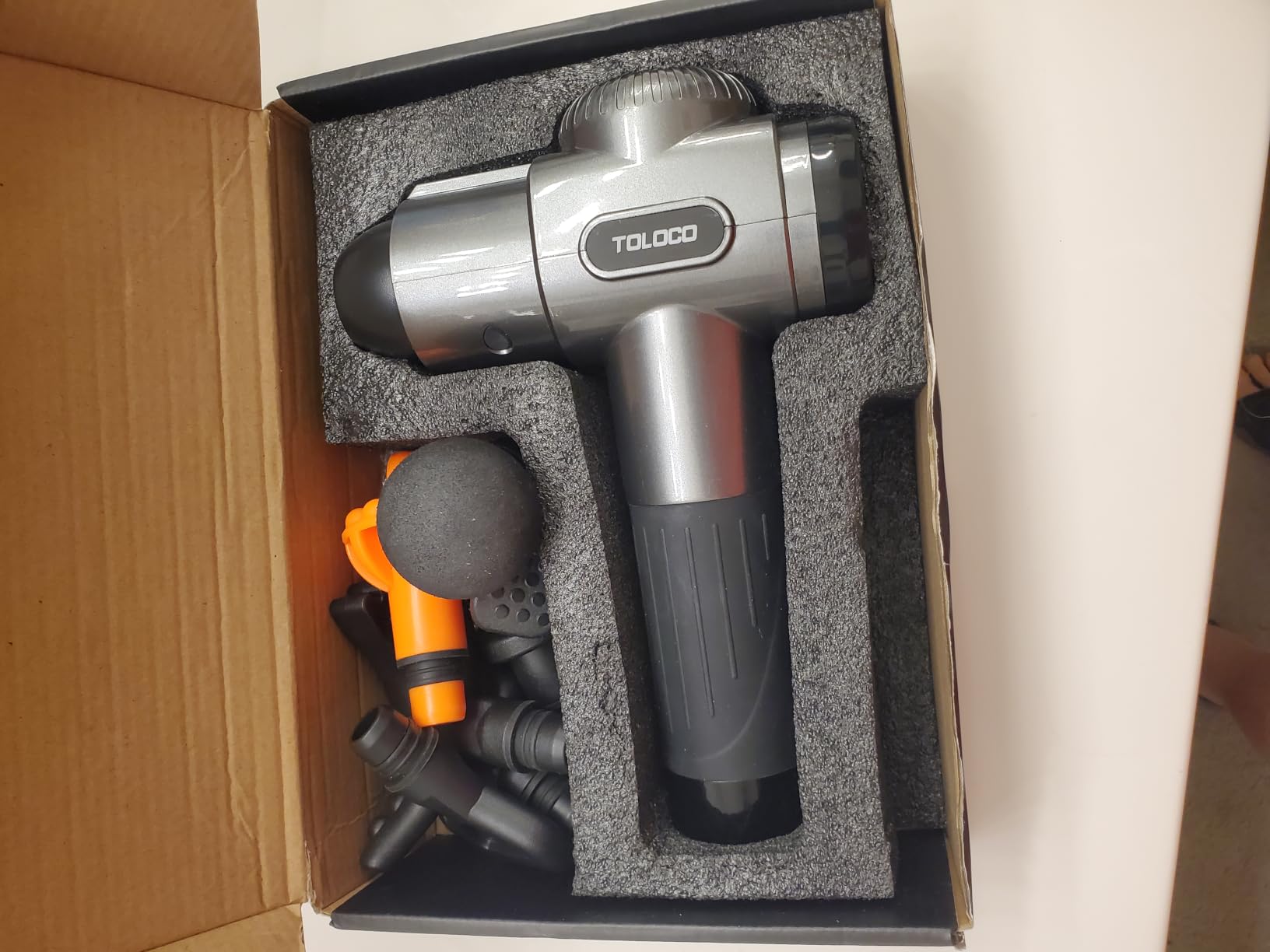
- Ten interchangeable heads cover most muscle groups
- Up to 6 hours of runtime per charge
- LED touch screen shows speed and battery level
- Lightweight cordless design that travels easily
Cons
- Charging plug not included though a USB cable is supplied
- Entry-level percussion depth against professional models
More than 62,000 reviews have been left on the TOLOCO EM26, which makes it the most thoroughly owner-tested gun in this roundup by a wide margin. When a device accumulates that volume of feedback, the consensus is worth reading carefully: buyers consistently single out quiet operation, head variety, battery life and the entry price as the reasons they are happy.
The specifications support those claims. Twelve millimetres of amplitude is joint-deepest here, speed runs up to 3200 RPM, the brushless motor is rated at 40 to 50dB, and runtime is up to six hours per charge.
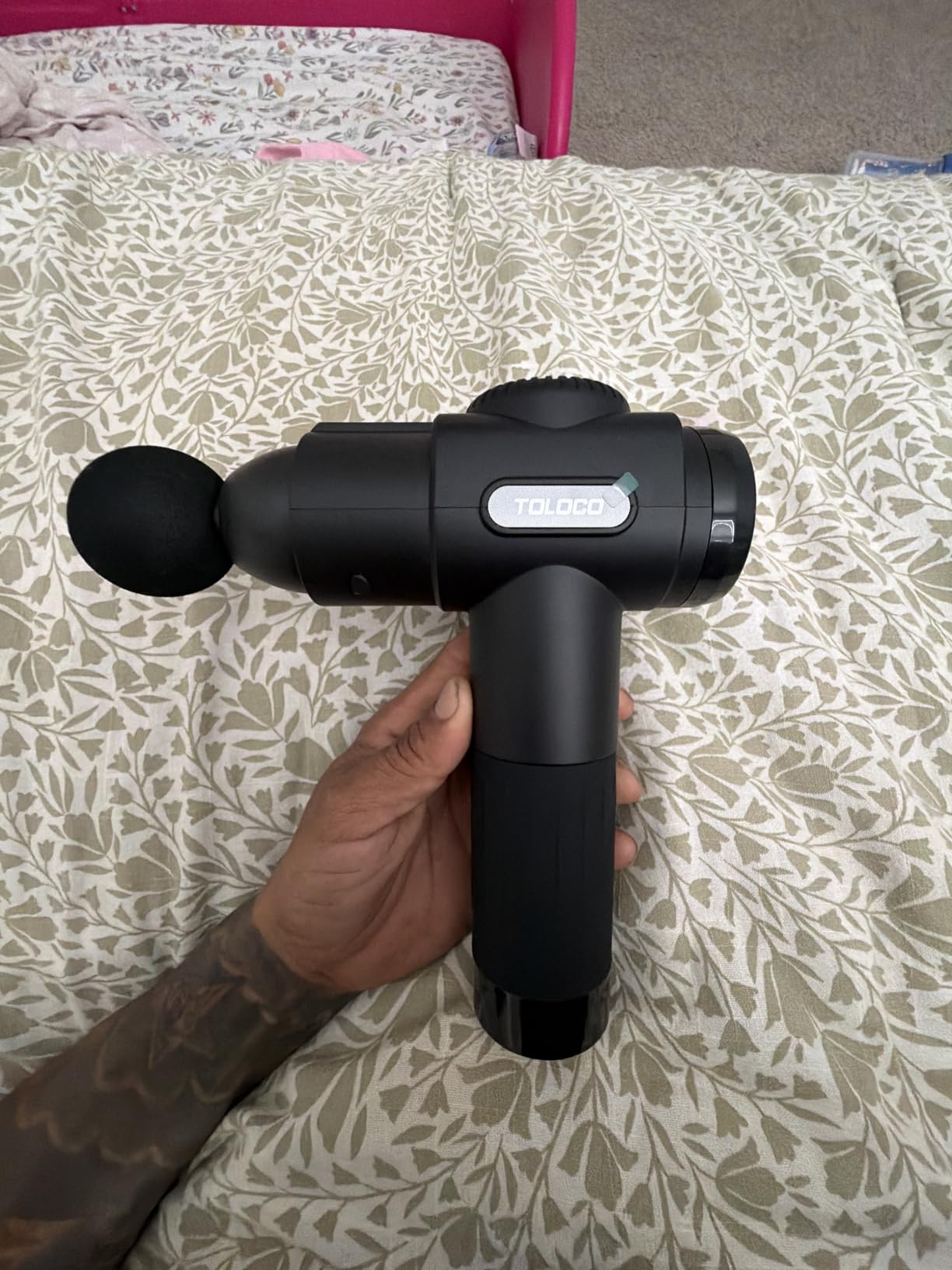
Ten massage heads is more than anything else we tested, which sounds like filler until you work through them. For an athlete moving between calves, glutes, shoulders and trigger points, the wider kit means fewer mid-session swaps and less lost time hunting for the right attachment.
The LED touch screen is clear and shows both speed and remaining battery, which removes the guesswork that plagues units with a single row of LEDs. At 1.95 lb it is light enough for extended work without the fatigue that heavier full-size guns cause.
Who the TOLOCO EM26 suits best?
Most athletes, honestly. If you want a real percussion feel, a genuine 12mm stroke and a quiet motor without committing to a premium device, this is the sensible starting point and many users never feel the need to upgrade.
It is also a strong gift option and works well for households sharing one device. The broad head selection means different athletes with different target areas can all use the same gun.
Where the TOLOCO EM26 falls short?
The charging plug is not included, only a USB cable, so you need a wall adapter to hand. It is a small issue that catches out first-time buyers in their first week.
On depth, reviewers consistently describe it as entry-level against professional models. Twelve millimetres of amplitude travels, but the force behind it is lower than the 45 to 70 lb stall force figures on the premium guns here, which you feel on dense quads.
11. Elefor M68-7 Massage Gun — 20 Speed Levels at Just Over Half a Pound
Elefor Massage Gun Deep Tissue,Percussion Back Massager Gun for Athletes Muscle Massage Gun for Pain Relief with 8 Massage Heads & 20 Speeds (Matte Black)
1200-3200 strikes per minute
20 speed levels
5.29 oz weight
8 heads
Carrying case
Pros
- Light at 5.29 oz and easy to hold through a long session
- 20 speed levels give fine control for sensitive areas
- Eight interchangeable heads cover the main muscle groups
- Quiet enough for shared spaces
- Sturdy carrying case included for travel
Cons
- Lower peak power than mid-range and premium models
- Attachment durability and motor longevity draw occasional complaints
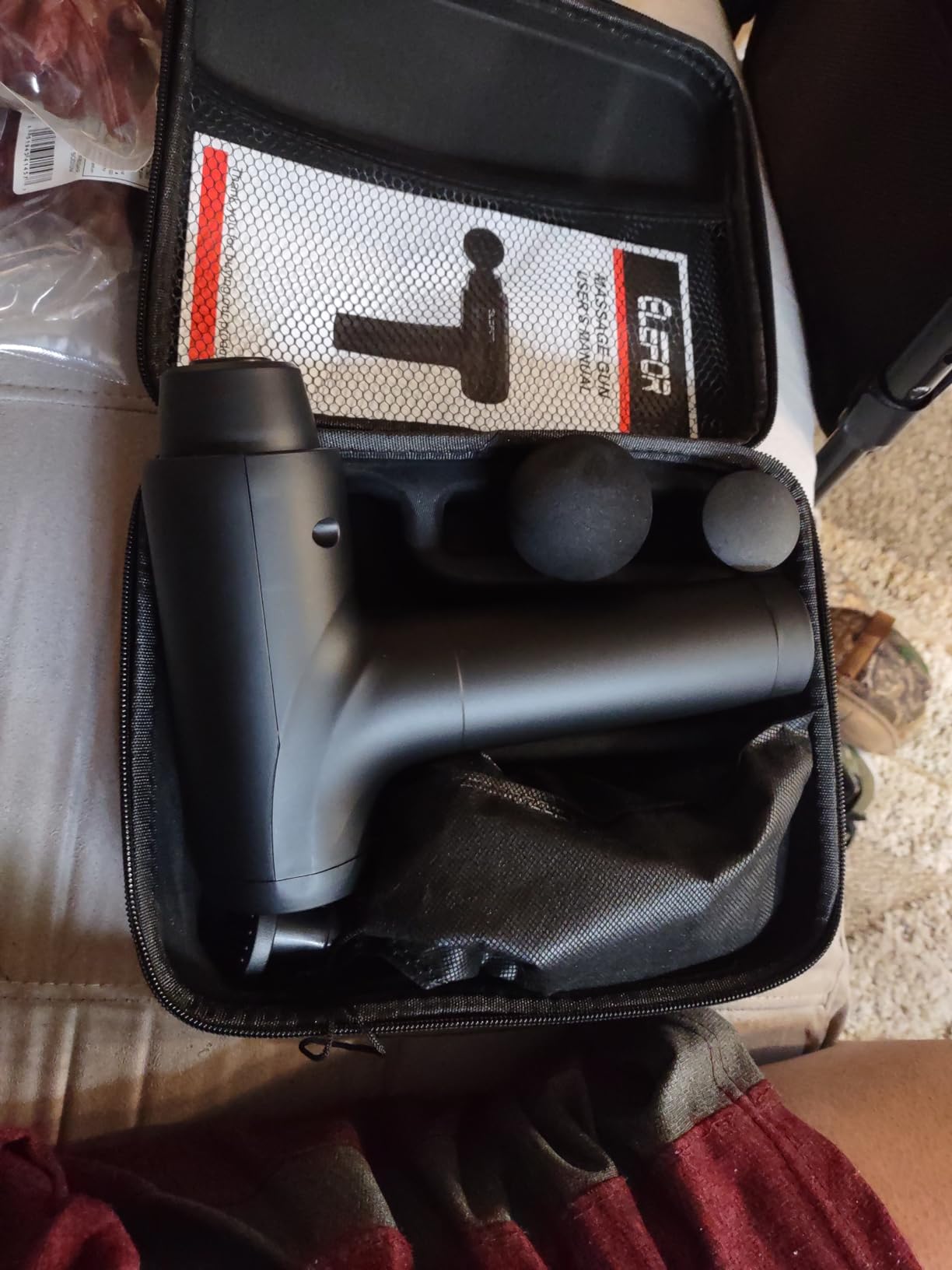
The Elefor M68-7 weighs 5.29 oz. Nothing else in this roundup comes close, and for hand comfort over a long session that matters more than it sounds — wrist and arm fatigue is one of the most common complaints about full-size guns from forum users.
It also carries 20 speed levels across a 1200 to 3200 strikes per minute range. That is genuine fine control, and it lets you drop the intensity low for sensitive areas around the shoulder blade or a tender calf.
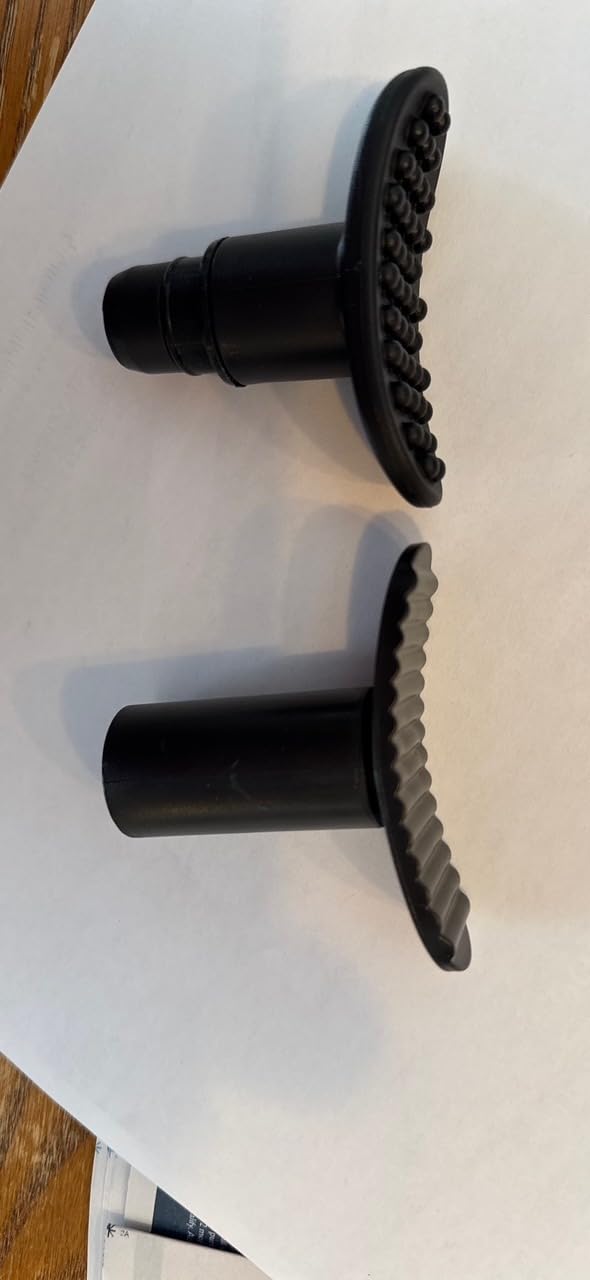
The eight interchangeable heads cover the main muscle groups, and the LCD touch screen handles selection cleanly. Reviewers treat this as a first massage gun, and at this weight it is genuinely easy to recommend to someone who has never used one.
The motor is described as ultra-quiet for use in public spaces, and the included carrying case is sturdy enough for real travel rather than a drawstring sleeve.
Who the Elefor suits best?
Newcomers and anyone with hand or wrist problems. If a 2 lb gun already feels too heavy after ten minutes, this is the version that will not stop you using it.
It also works as a second device. A light gun in the office or a travel bag alongside a fuller one at home covers both use cases without the weight of carrying a single large unit everywhere.
Where the Elefor falls short?
Peak power is the clear limitation, and reviewers say so directly. It suits general recovery work, but if your priority is deep tissue in dense muscle, the 45 to 70 lb stall force guns here reach a place this one does not.
A minority of reviews also mention attachment durability and motor longevity concerns over long ownership. Given the weight advantage it is a fair trade, but budget for a possible replacement in a few years rather than expecting decade-long service.
12. Hyperice Hypervolt Go 2 — A Recognised Pro-Athlete Brand in a 1.5 lb Body
Hyperice Hypervolt Go 2 Handheld Percussion Massage Gun Deep Muscle Tissue
1.5 lb body
QuietGlide brushless motor
3 speed settings
3 hour battery
TSA approved
Pros
- Recognisable pro-athlete brand with a compact travel-friendly body
- QuietGlide motor is genuinely quiet for a percussion device
- 1.5 lb weight and 3 hour battery suit gym bags and carry-ons
- Simple press-and-hold control with clear LED speed indicators
- TSA approved so it travels without friction
Cons
- Only 3 speed settings which is fewer than most rivals
- Needs the included 5V USB-A to USB-C cable and a separate charging brick
- Lowest rating in this roundup with 9% one-star reviews
The Hypervolt Go 2 is the brand most athletes already recognise from pro team rooms and training facilities, and in this test it delivers on the reputation in one specific way: quietness. The QuietGlide motor and 40W brushless design run noticeably soft for a percussion gun.
Forum consensus repeatedly credits the Hyperice line for quiet, smooth percussion suited to everyday post-workout use, and that is where this unit is strongest. Sessions in a shared flat at full speed without being asked to turn it off are achievable here.
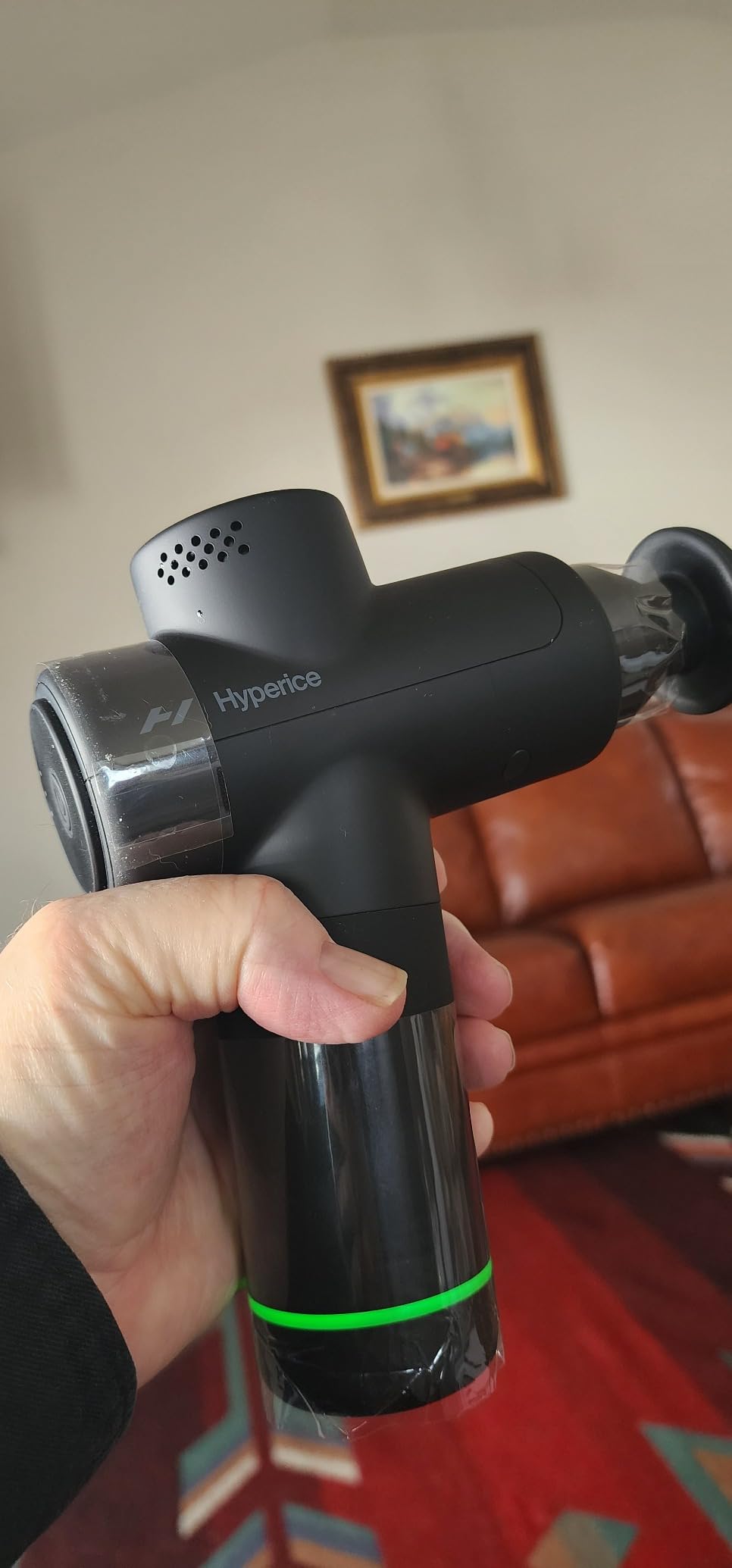
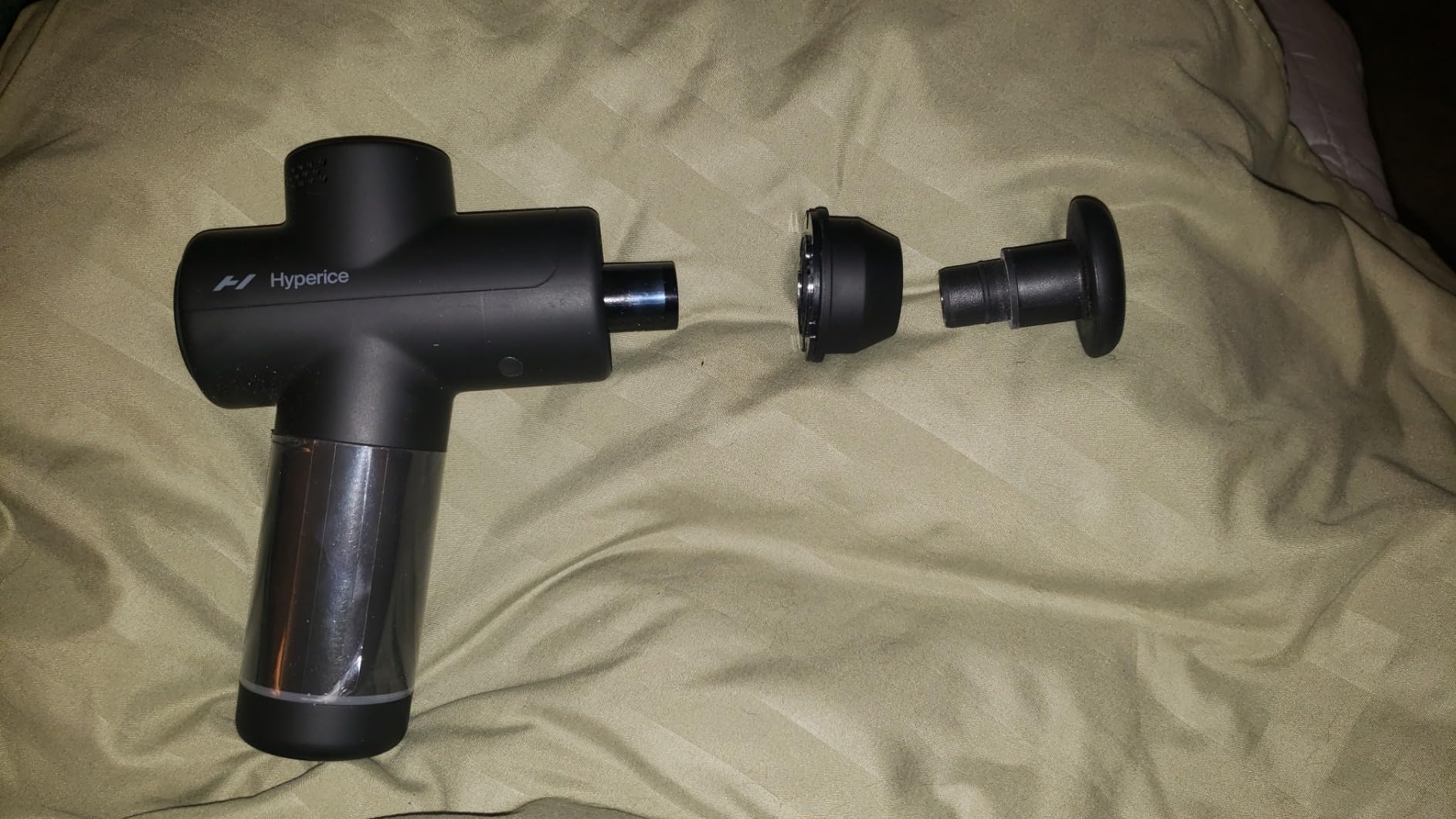
Portability is the second strength. At 1.5 lb with a 3-hour battery and TSA approval, it moves from gym to home to flight without planning, and the dimensions are small enough for a side pocket.
Operation is deliberately simple: press and hold to power on, LED indicators show which of the three speeds you are on. There is no app to pair and nothing to configure, which some athletes prefer and others will find limiting.
Who the Hypervolt Go 2 suits best?
Athletes who already trust the brand and want a compact daily tool. If quiet operation and portability are your top two criteria, this is a short and uncontested shortlist.
It suits frequent travellers too. TSA approval and the small footprint remove the usual friction of carrying a recovery device on a flight.
Where the Hypervolt Go 2 falls short?
Three speed settings is the largest constraint in this roundup. Most competitors offer five or more, and the 30-level Youdgee offers thirty. Three steps is not enough for a warm-up pass and a deep treatment in the same session.
Charging is the other friction point. The included cable runs from USB-A to USB-C, and a USB-C to USB-C cable will not work, so you need the right 5V brick. Long-term convenience favours the USB-C PD models in this test. It also shares the lowest customer rating in the group, with 9% one-star reviews.
How to Use a Massage Gun Safely?
Used correctly, a percussion device is low-risk. Used carelessly on the wrong tissue, any of these twelve will cause bruising, aggravate an injury or hide a problem you should be resting from.
Where not to use it:
Over bones, joints, the kneecap, ankle bones or the bony point of the hip.
Along the spine or on the front and sides of the neck.
On swollen, bruised, infected or freshly injured tissue.
On areas with impaired circulation, including areas affected by varicose veins or blood clots.
Over the abdomen during pregnancy, or over the chest and front of the thighs where the femoral nerve and major vessels run close to the surface.
Directly over a recent injection site or over open wounds.
How long to use it: roughly two minutes per muscle group after training, on a slow sweep rather than parking on one spot. Before training, 30 seconds of light percussion per area is enough to activate a muscle before lifting or running. Longer sessions on a single trigger point under heavy pressure are what produce the bruising people mistake for effectiveness.
When to skip it entirely: if you have acute inflammation, a suspected stress fracture, an undiagnosed pain that gets worse with load, or you are within the first few days after a significant injury. Percussion increases blood flow, and increased blood flow to an acute injury is the opposite of what you want.
Do doctors recommend massage guns? Physical therapists routinely use percussion therapy devices as one tool in a recovery programme, typically alongside mobility work, loading exercises and manual therapy. The evidence base for soreness and range of motion is reasonable, but no device replaces assessment by a qualified clinician when pain is persistent or unexplained.
As a rough pairing with your wider recovery setup, our picks on portable cold plunge tubs for athletes cover the cold side of temperature contrast, and if you also work with horses, the same principles of pressure, tempo and session timing apply to the devices covered in our guide to equine massage devices. Budget tool maintenance follows a similar discipline, which we cover in our guide to grease guns for equipment maintenance.
Buying Guide: How to Choose a Massage Gun for Training?
Most guides in this category list specifications without explaining which ones change your experience. These are the factors that actually separated the twelve units we tested.
Amplitude: how far the head actually travels?
Amplitude is the distance the massage head moves into the muscle, measured in millimetres, and it is the first spec to check. Anything under 10mm produces a surface buzz that dissipates before it reaches the tissue you are sore in.
For athletes, 11mm and 12mm is the working range. The TOLOCO EM26, Mebak 3 and Opove M3 Pro 2 all deliver 12mm, the Medcursor gives 11mm, and the RENPHO Thermacool 2 sits at 10mm. The Bob and Brad Q2 Pro Mini, at 7mm, is built for portability rather than depth.
Stall force: how hard you can press before it stops?
Stall force is the pressure the motor sustains before it stalls out, and it tells you whether you can lean into the device or whether it will bog down on the first press. Heavy lifters and field athletes need 45 lbs or more.
In this test the Opove M3 Pro 2 leads at 70 lbs, followed by the Bob and Brad X6 Pro Max at 55 lbs and the Mebak 3 at 53 lbs. The RENPHO Thermacool 2 manages 45 lbs, while the compact arboleaf offers 35 lbs. Below that you are working with a different kind of tool.
Do massage guns break up muscle knots? Partly, and it is worth being precise. Percussion stimulates local circulation and interrupts the sensation of a taut band, which reduces the feeling of a knot and the guarding around it. It does not physically break adhesions the way deep manual work can, which is why pairing a gun with a foam roller or massage ball on the same area tends to outperform either one alone.
Noise: the daily-use factor nobody lists properly
Noise decides whether a massage gun gets used daily or once a month. A unit that sounds like a jackhammer at working speed will not survive a shared flat, and shared flats are where most post-training sessions actually happen.
Measured and published figures here run from 35dB minimum for the Medcursor up to a below-55dB figure for the Bob and Brad X6 Pro Max. The Mebak 3 at 39 to 50dB, the TOLOCO at 40 to 50dB and the Bob and Brad Q2 Pro Mini at around 40dB form the quiet group. Forum users consistently rate Hyperice devices as the quietest-feeling line, which matches the QuietGlide design in the Hypervolt Go 2.
Battery, charging and long-term cost
Runtime figures cluster between three and six hours, which is one full charging cycle for most athletes. The LifePro Sonic and TOLOCO EM26 lead at up to six hours; the Opove M3 Pro 2 spans 4 to 8 hours depending on speed.
Charging standard matters more than people expect. USB-C PD, found on the Bob and Brad X6 Pro Max and Q2 Pro Mini, means one cable for your phone and your gun. Proprietary or mismatched cables, as on the Hypervolt Go 2 which requires the supplied USB-A to USB-C lead, are a permanent small irritation.
Long-term cost is the factor most guides skip. Forum reports describe budget units losing a substantial share of their runtime within a single season, with figures dropping from four or five hours to roughly two. If you plan to use a gun four or five times a week, one solid mid-range device that lasts is cheaper than a cheaper one replaced twice.
Attachments and temperature therapy
Heads matter less by count than by usefulness. The TOLOCO includes ten and the Elefor eight; what you are really checking is whether the flat, ball, bullet and fork heads are all in the box, since those cover most of a post-session routine. For lower back work the arboleaf T-grip is the only dedicated shape in this group.
Heat and cold attachments appear on four units here — the RENPHO Thermacool 2, the Bob and Brad X6 Pro Max, the Bob and Brad Q2 Pro Mini and the arboleaf. The RENPHO has the widest range, from 113F down to 46F. Treat temperature as a comfort feature: users consistently report the sensation is pleasant while the therapeutic payoff stays uncertain, and heated heads drain battery faster when run high.
Ergonomics: weight and shape decide frequency
Weight ranges from 5.29 oz for the Elefor to 2.4 lb for the Opove M3 Pro 2. Below one pound you trade depth for comfort; above two pounds, forearm fatigue becomes the limiting factor on long sessions.
Shape matters for reach. The arboleaf T-grip targets the lower back and the Bob and Brad X6 Pro Max uses a 9.65-inch chassis to reduce awkward wrist angles. Hammer-style bodies suit glutes and quads best, and triangle or wand shapes suit the upper back and shoulders.
Frequently Asked Questions
Are massage guns good for athletes?
Yes, when used correctly and consistently. Percussion before training helps activate muscles and improve range of motion, and percussion after training reduces perceived soreness so you can train again sooner. They are not a replacement for sleep, food or a real soft-tissue session, but for anyone training three or more times a week they add a portable recovery tool most athletes do not otherwise have.
Which massage gun is quietest?
Among these twelve, the Medcursor has the lowest published floor at 35dB from its high-torque brushless motor. The Bob and Brad Q2 Pro Mini operates at around 40 decibels, the RENPHO Thermacool 2 is rated at 40dB, and the Mebak 3 and TOLOCO EM26 both sit in the 39 to 50dB range. The Hyperice Hypervolt Go 2 also stands out for perceived quietness thanks to its QuietGlide motor.
Do massage guns break up muscle knots?
Partly. Percussion stimulates local circulation and interrupts the sensation of a taut band and the guarding around it, which reduces how a knot feels. It does not physically break adhesions the way deep manual work can, so pairing a gun with a foam roller or massage ball on the same area generally outperforms either one alone.
Where should I avoid using a massage gun?
Avoid bones, joints, the kneecap and ankle bones, the spine, and the front and sides of the neck. Also skip swollen, bruised, infected or freshly injured tissue, areas with impaired circulation such as varicose veins, the abdomen during pregnancy, and the chest and inner thighs where major vessels and nerves run close to the surface.
How long should I use a massage gun per muscle?
About two minutes per muscle group after training, worked as a slow sweep rather than parked on one spot. Before a session, 30 seconds of light percussion per area is enough to activate the muscle. Longer sessions on a single trigger point under heavy pressure are what produce the bruising people mistake for a good result.
What amplitude do I need for deep tissue work?
For athletes working thick muscle, 11mm and 12mm is the working range. Anything under 10mm produces a surface buzz that dissipates before it reaches the tissue you are sore in. The TOLOCO EM26, Mebak 3 and Opove M3 Pro 2 all deliver 12mm; the Medcursor gives 11mm.
Conclusion: Our Best Massage Guns for Athletes in 2026
After six weeks and twelve devices, the Opove M3 Pro 2 is our pick for the best massage guns for athletes in 2026. Its 70 lbs stall force and 12mm amplitude are the strongest combination on deep tissue work, the 4 to 8 hour battery survives double sessions, and the shell is built to take knocks. If your forearms are sensitive to 2.4 lb of weight, the Mebak 3 offers 53 lbs of stall force at 1.68 lb with a pressure sensor that guides you.
For temperature work, the RENPHO Thermacool 2 spans 113F down to 46F at 45 lbs of stall force, and the Bob and Brad X6 Pro Max reaches most of your back unaided with a 9.65-inch chassis and a 2-year warranty. The TOLOCO EM26 is the value pick at 12mm amplitude with ten heads and the deepest owner-tested feedback here. For anything that travels, the Bob and Brad Q2 Pro Mini at 0.95 lb or the Elefor at 5.29 oz will get used more often than anything larger.
Pick the one that matches your sport and your schedule, charge it fully before your first session, and check the amplitude and stall force figures against the muscle groups you actually work. That is where the right answer lives.