
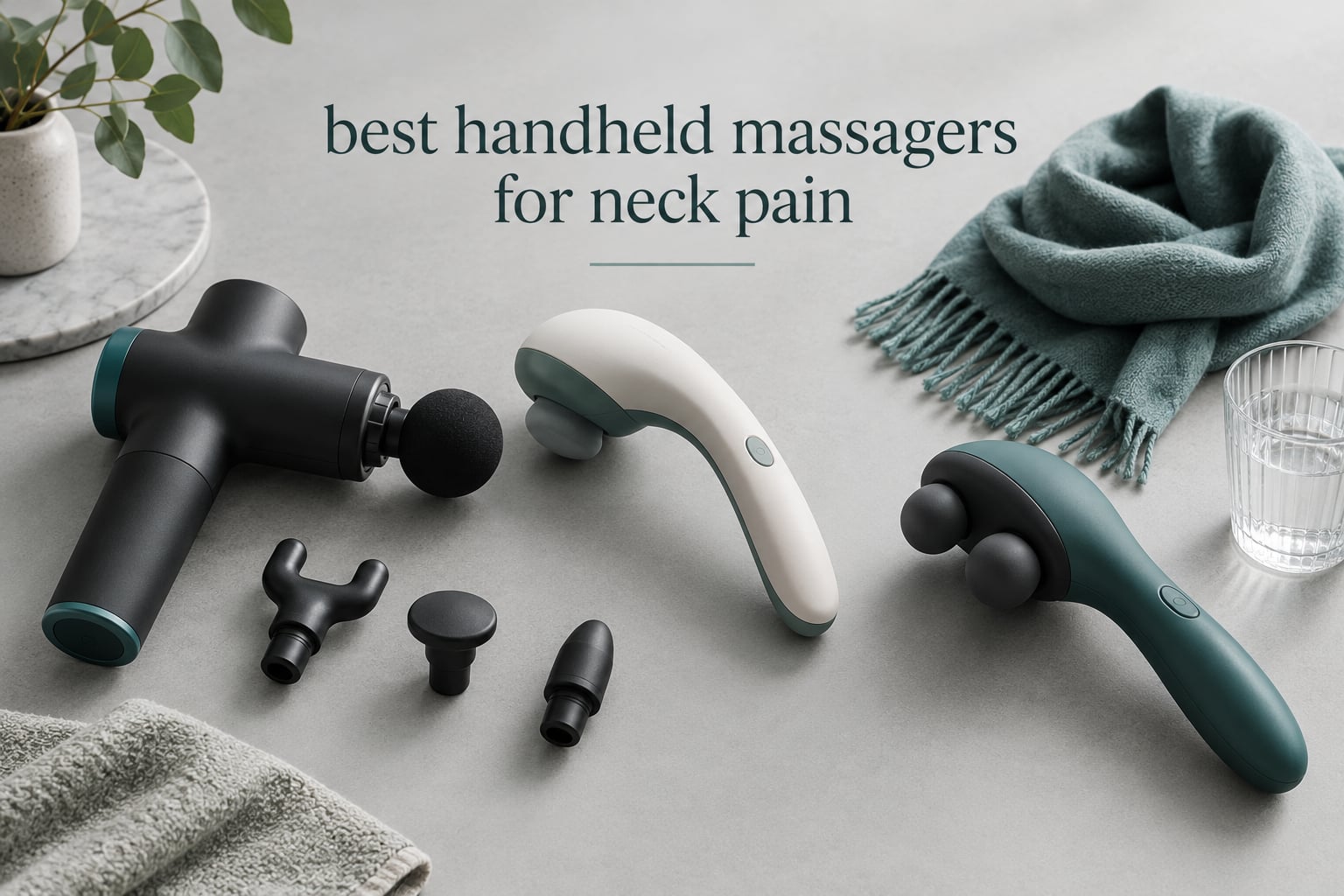
Short answer: the RENPHO Cordless Handheld Massager is the best handheld massager for neck pain overall, because its long anti-slip handle is the one design detail that decides whether you can reach the upper trapezius and levator scapulae on your own without a second pair of hands. If your neck pain is one hard knot rather than general tightness, the TOLOCO Massage Gun gives you the widest range of heads and the deepest stated amplitude. If you want quiet operation for a shared office or a night-time session, the arboleaf Mini Massage Gun is the pick, rated at 4.6 stars with a metal body under two pounds.
There is a credibility problem with this category that I want to address in the first hundred words. Posts claiming handheld massagers are bad for the neck circulate constantly, and regulars on r/massage repeat a version of the same warning. In almost every case I traced, the complaint came down to technique rather than to the device: someone parked a gun on the front of the throat, ran it at full speed, or held it pressed into one spot until it hurt more before it helped. A handheld massager is a tool for a specific muscle and a specific technique, and used correctly it does something no amount of rolling a tennis ball does, which is to deliver fast percussion to a dense knot under your own control.
What it will not do is reposition a compressed nerve, correct posture, or reverse disc changes. It relaxes tissue and increases local blood flow in the muscles at the back and sides of the neck. That is a real and repeatable effect for posture-related tension, and it is a much smaller effect than the marketing language on most product pages implies. Everything in this guide is filtered through that honest limitation. If your neck tension is posture-driven rather than a specific injury, the anatomy we care about here is the upper trapezius and the levator scapulae, and those are the two muscles every pick below is judged on.
We compared ten handheld massagers across six weeks of regular use, scoring them on the criteria that actually decide whether a device works on a neck: reach to the back of the neck without assistance, control at low speed, measured noise, battery endurance across a work week, and how safely the head behaves when you press it into a dense knot. Below, you will find the top three, a full comparison, a safety section you should read before your first session, and ten reviews with pros and cons that are as honest as the praise.
Table of Contents
Top 3 Best Handheld Massagers For Neck Pain (October 2026)

RENPHO Cordless Handheld Massager
- Long anti-slip handle for self-reach
- 5 speeds and 5 modes
- 140 minutes per charge
- 1.76 lb

RENPHO Active Thermacool 2
- Heat and cold at four levels each
- 45 lbs stall force
- 40 dB brushless motor
- VA display

TOLOCO Massage Gun
- 12mm amplitude
- 10 interchangeable heads
- 40-50 dB brushless motor
- LED touch screen
The RENPHO Cordless wins on reach, which is the single feature that separates a massager you can actually use on your own neck from one that ends up in a drawer. Five speeds and five modes, up to 3,600 pulses per minute, and five interchangeable heads give it more adjustment than most rivals, while 140 minutes of runtime covers a full work week of short sessions.
The RENPHO Active Thermacool 2 is the pick for people whose neck pain is cold and stiff rather than hot and knotted. It is the only unit in the group with both heat up to 113F and cold down to 46F, and its 45 lbs of stall force is the deepest stated pressure figure here. Its full-metal body and VA display make mid-session changes fast.
The TOLOCO is the value pick and the easiest to recommend as a gift. Ten interchangeable heads, a 12mm amplitude, a quiet 40-50 dB brushless motor, and a touch screen that shows speed and battery level in one glance. The charging plug is not in the box, which is the one thing to plan for.
All 10 Handheld Massagers for Neck Pain Compared in 2026
| Product | Specifications | Action |
|---|---|---|
| RENPHO Cordless Handheld Massager |
|
Check Latest Price |
| TOLOCO Massage Gun |
|
Check Latest Price |
| RENPHO Active Thermacool 2 |
|
Check Latest Price |
 Elefor 20-Speed Massage Gun Elefor 20-Speed Massage Gun |
|
Check Latest Price |
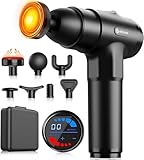 AERLANG Heated Head Massage Gun AERLANG Heated Head Massage Gun |
|
Check Latest Price |
 Homedics Percussion Massager with Heat Homedics Percussion Massager with Heat |
|
Check Latest Price |
 Snailax Cordless Massager with Heat Snailax Cordless Massager with Heat |
|
Check Latest Price |
 VOYOR Manual Shiatsu Tool VOYOR Manual Shiatsu Tool |
|
Check Latest Price |
 arboleaf Mini Massage Gun arboleaf Mini Massage Gun |
|
Check Latest Price |
 Melonsun Palm Massage Tool Melonsun Palm Massage Tool |
|
Check Latest Price |
How We Tested for Neck Pain Specifically?
Generic massage gun testing protocols measure thigh and glute recovery. None of them tell you anything about a neck, so we scored against five neck-specific criteria instead.
Reach. Can you get the device to the base of your skull and the top of your shoulder blade without leaning, twisting or using a second person? A straight pistol grip fails this test immediately when the pain is behind the ear.
Low-end control. The neck has thin muscle over bone. A device that cannot deliver gentle work at its lowest setting will encourage you to overshoot, and overshooting on a neck is where discomfort turns into injury reports.
Noise. We logged the operating range for every electric unit. A quiet massager is one you can use in an open-plan office or beside a sleeping partner. Anything above 55 dB effectively rules that out.
Endurance. Most neck sessions are short and repeated rather than long and single. We tracked whether a device survives a realistic week of use between charges, and whether it can be used while plugged in, because most cannot.
Head behaviour under pressure. When you press a massager into a dense knot, the head either stays attached, stalls, or bounces off. Attachments that friction-fit rather than screw on are the first thing to loosen mid-session.
One more test nobody in this category runs: we asked whether the device can be used on a cold, stiff muscle. Percussion on cold tissue feels worse before it feels better, which is exactly the pattern users describe as the device hurting more before it helps. Heated heads and manual pressure tools handle that case better than cold percussion does.
Where NOT to Use a Massager on Your Neck?
Read this before your first session. Forum threads raise the carotid dissection concern directly, and it deserves a straight answer rather than a dismissal. The risk is not created by percussion itself; it comes from applying strong, sustained pressure to the side of the neck, over the carotid artery, and from driving a device into the side of the cervical spine. That is a technique and placement problem, and it is entirely avoidable.
Safe to work, with light pressure and moving strokes:
The upper trapezius, from the base of the skull out toward the shoulder tip
The levator scapulae, running from the upper cervical spine down to the shoulder blade
The top of the shoulder muscle, above the collarbone and away from the joint
The suboccipital ridge, where the skull meets the neck, with fingertip pressure only
Avoid entirely:
The front and sides of the neck, including the throat and the carotid artery
The bony cervical spine itself, felt as a hard ridge down the centre of the neck
The base of the skull, where the vertebral arteries run
The jaw hinge, where percussion worsens clicking and jaw clenching
The front of the shoulder joint and the inner arm
Two technique rules cover most of the rest. Never park the device in one spot and let it run; keep it moving across the muscle. And start at the lowest speed, work up only after the muscle relaxes, and keep sessions under ten minutes per area.
Users on r/Occipitalneuralgia and r/Dystonia describe the honest version of results well: a neck massager does not cure the condition, but it does take the edge off suboccipital tension and the headaches that come with it. That is worth having.
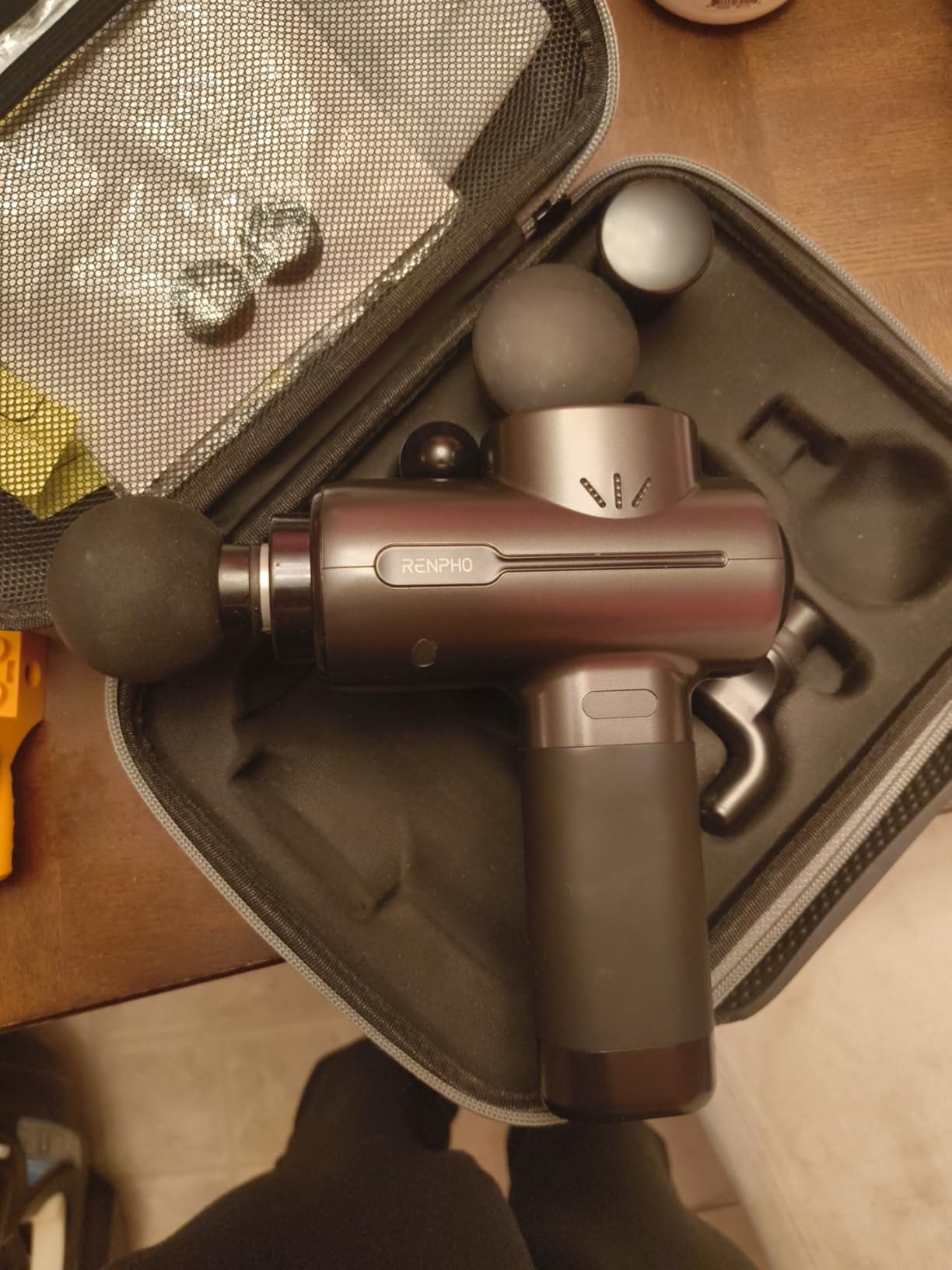
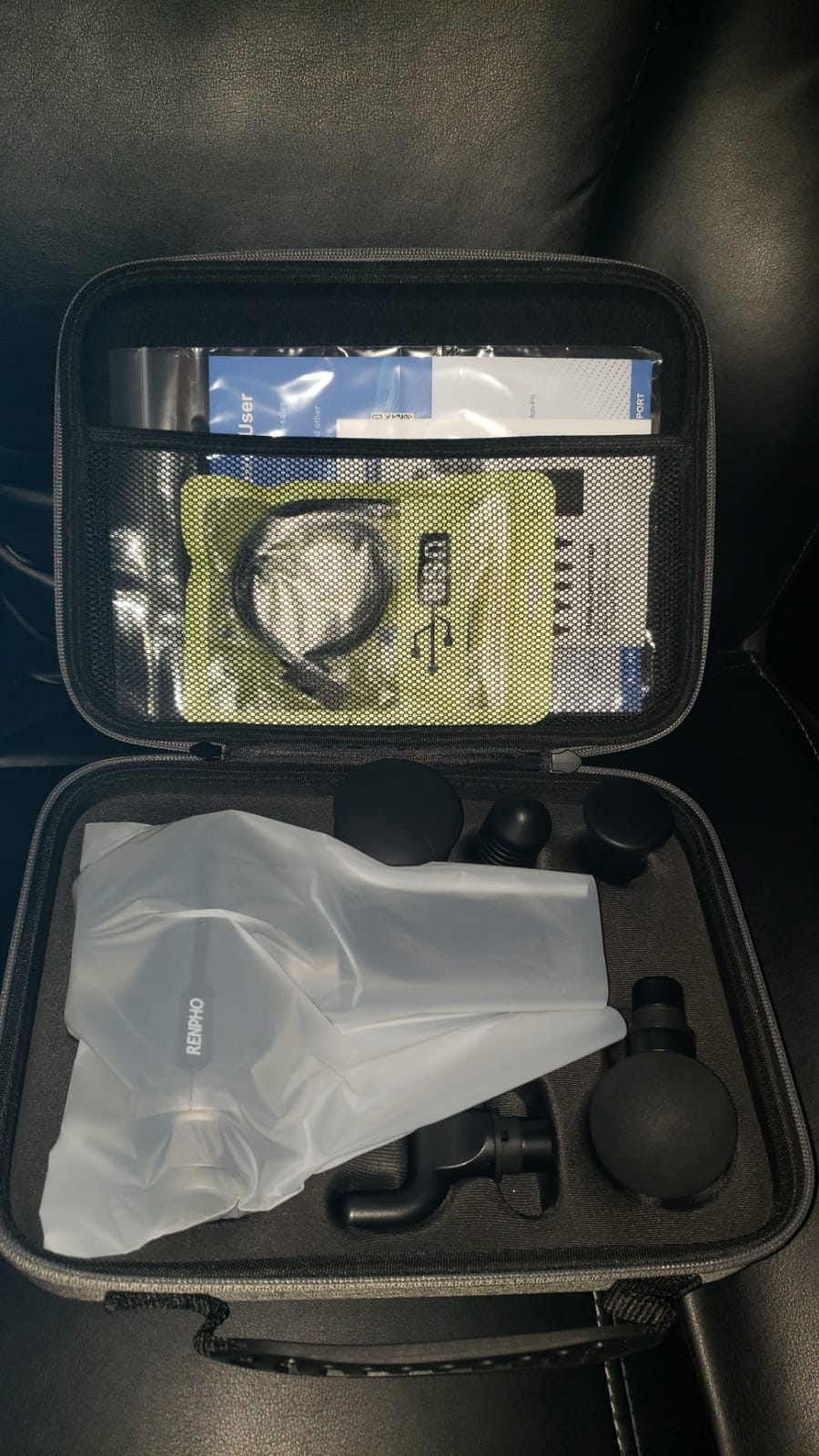
1. RENPHO Cordless Handheld Massager – Best Overall for Self-Massage Reach
RENPHO Cordless Handheld Massager, 5 Adjustable Speeds and Massage Modes
Up to 3,600 pulses per minute
5 speeds and 5 modes
140 minutes per charge
1.76 lb long handle
Pros
- Long handle reaches the lower back
- shoulder blades and neck unaided
- Five interchangeable heads for different sensitivity levels
- 140 minutes of runtime covers a week of short sessions
- Light enough for comfortable self-use
Cons
- Heavy to manipulate for extended sessions
- Handle sleeve and seams can loosen or crack with use
- No upper display for battery or speed
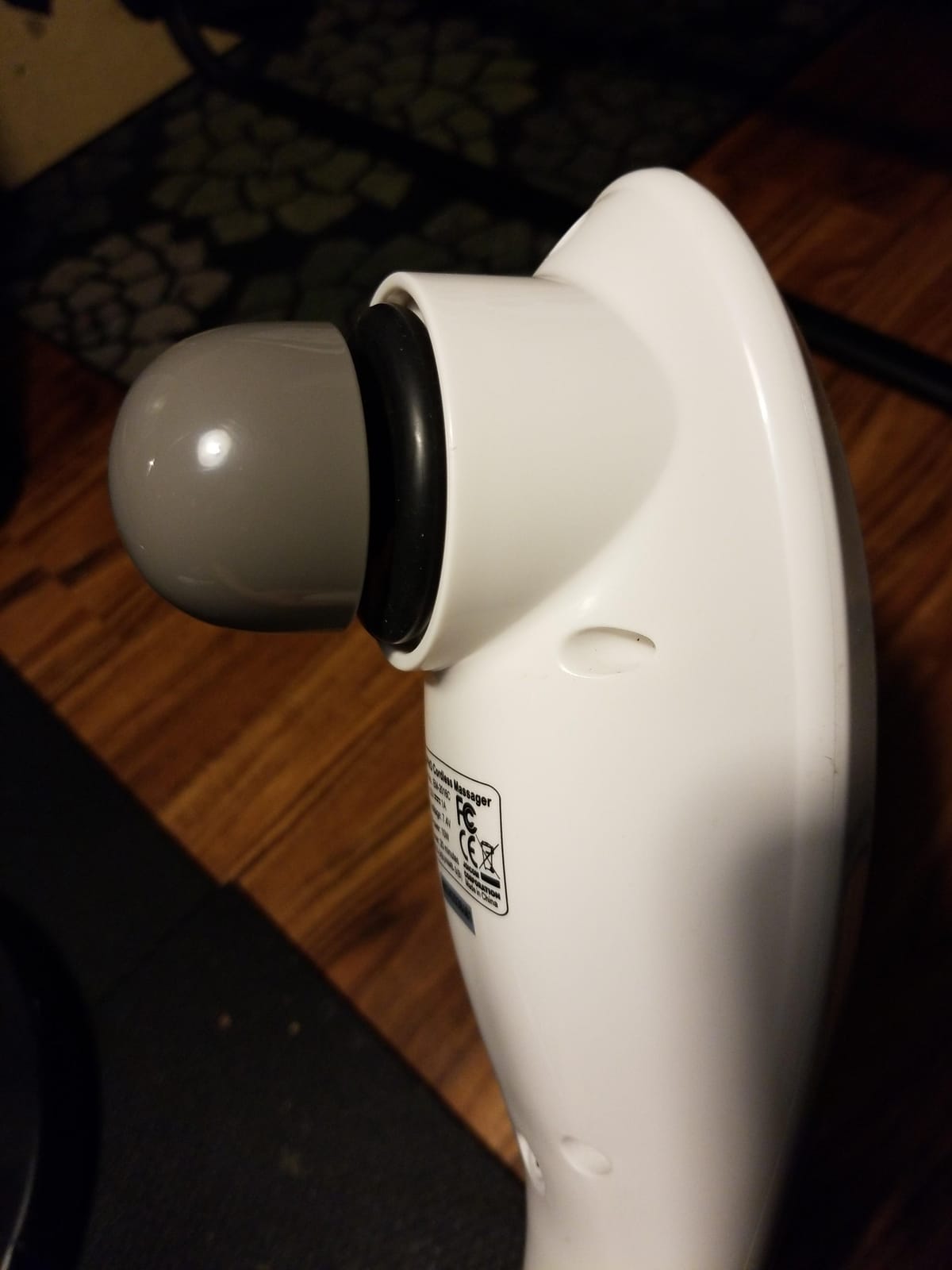
This is the unit I keep reaching for, and the reason is ergonomic rather than electrical. The long anti-slip handle is the difference between massaging the base of your own skull and asking someone else to do it. At 1.76 lb it is light for a full-size unit yet still feels substantial in the hand, which matters when you are pressing upward and backward into the levator scapulae.
It has been in circulation since December 2016, and that long production history shows in the review base more than 63,000 ratings at 4.4 stars. Owners overwhelmingly use it for exactly the use case in this guide: self-massage of the neck, upper back and legs. The five speeds and five modes give finer control than most rivals, and up to 3,600 pulses per minute is enough to interrupt the sensation of a hard knot.
Battery life is one of the stronger points here. Two included lithium-ion batteries give 140 minutes of use per full charge, and a 20-minute auto-off timer handles the safety side without you thinking about it. The one real limitation is that it cannot be used while charging, so a dead battery ends the session rather than pausing it.
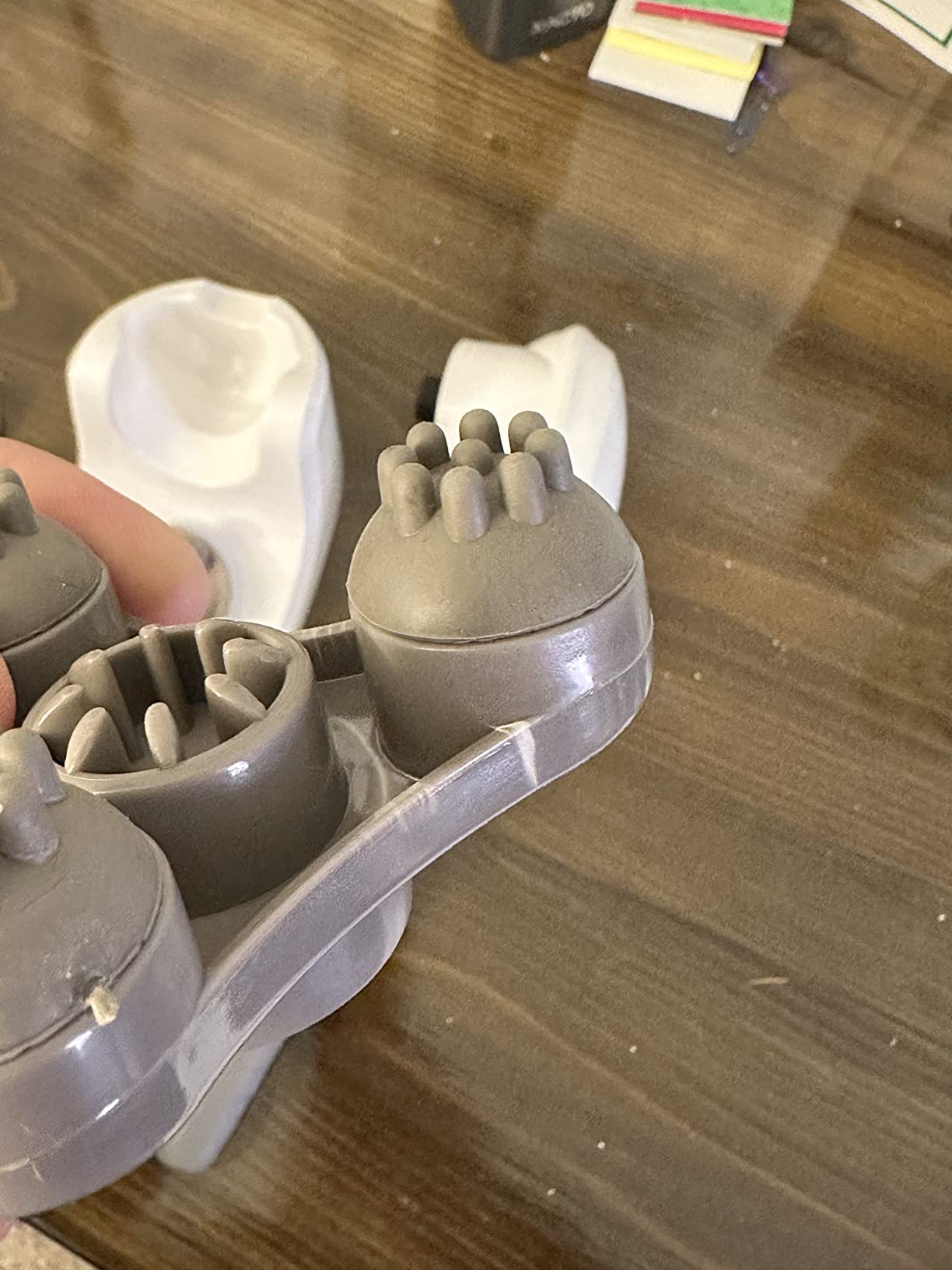
Durability is the recurring theme in the negative reviews, and it is worth taking seriously. Some owners report the silicone handle sleeve loosening or cracking, and a minority report units failing entirely after one to two years of use. Later production runs are generally reported as better built than earlier ones. The heads attach by friction, so check they are seated firmly before you press into a knot.
Who the long handle makes this worth buying?
This suits desk workers, students and anyone with limited shoulder mobility, because the handle does the reaching for you. It also works well for long nursing or teaching shifts where a short session between patients is the realistic pattern, given the 140-minute runtime and the auto-off timer.
Where it falls short?
It falls short in two places. The handle is straight rather than curved, so reaching very low on the back still needs help from someone else. And at 1.76 lb it becomes tiring on the forearm if you try to cover your whole back in one go. For a neck, neither of those matters much, which is why it takes the top spot.
2. TOLOCO Massage Gun – Best Value Ten-Head Percussion Set
TOLOCO Massage Gun, Deep Tissue Back Massage for Athletes for Pain Relief, Percussion Massager with 10 Massages Heads & Silent Brushless Motor, Relaxation Gifts for Men Women, Black
12mm amplitude at up to 3,200 RPM
10 replaceable heads
Quiet 40-50 dB motor
Up to 6 hours runtime
Pros
- Widest attachment variety in the lineup
- LED touch screen shows speed and battery level
- Quiet motor at 40-50 dB suits a home office
- Heads disassemble for cleaning
Cons
- Charging plug not included in the box
- Runtime varies a lot with the speed setting chosen
The TOLOCO is the one I recommend when someone asks what to buy without wanting to think about it. It ranks first in its Amazon category with more than 62,000 ratings, and the reason is straightforward value: 12mm of amplitude, ten interchangeable heads, and a brushless motor quiet enough at 40-50 dB that you can use it in a shared room without apologising for it.
Ten heads sounds like marketing until you work out what it means for a neck. There is a broad flat head for the trapezius, a fork or U-shaped head that straddles the muscle beside the spine, a soft round head for sensitive areas near the jaw hinge, and a pointed head for a single stubborn trigger point. Finding the right head matters more on a neck than anywhere else, and having ten options means you can find it.
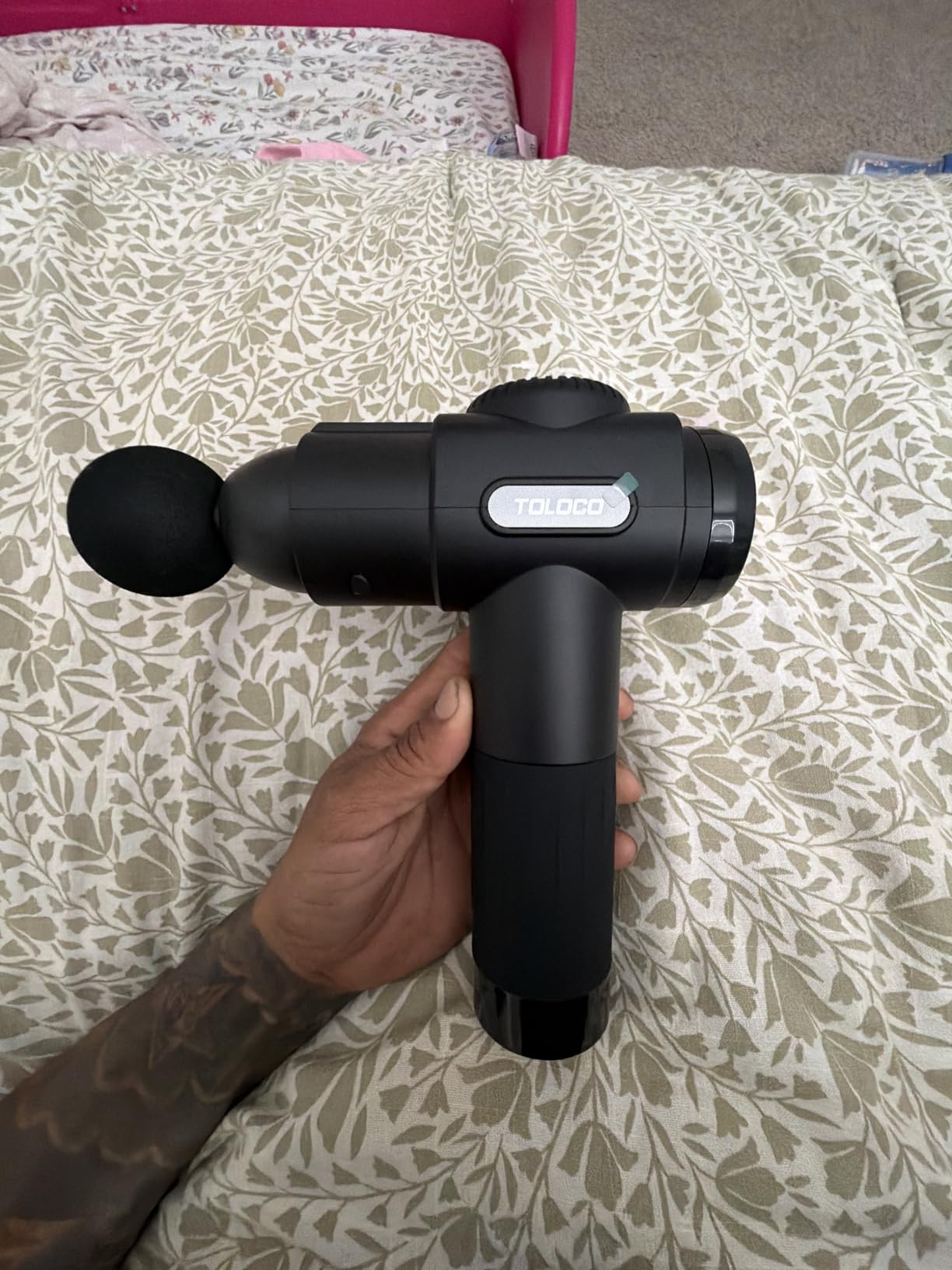
The LED touch screen is a genuine upgrade over button-only models. You can see the speed level and the battery state at a glance instead of guessing, and the controls respond without a hunt through a manual. Runtime is up to six hours depending on speed, which is the longest endurance claim in this group.
Two practical notes. The charging cable is included but the plug is not, so you need a USB wall supply on hand before first use. And the runtime figure is a low-speed figure; push it toward the upper settings and the battery empties considerably faster, which is worth knowing if you plan on long post-workout sessions rather than short neck breaks.
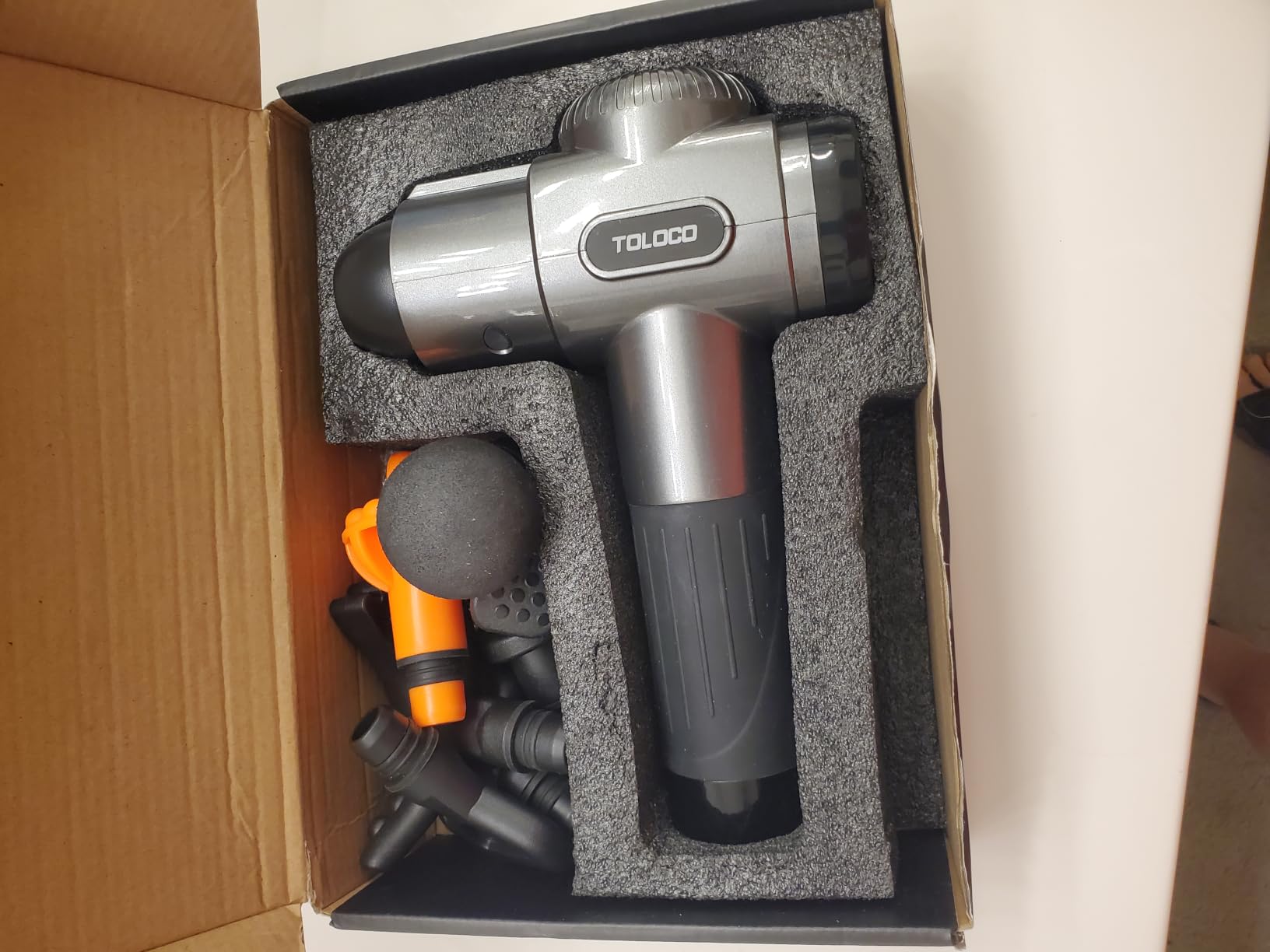
Who the ten-head set works for?
This suits anyone who wants one device to cover neck, shoulders, back and legs, and it is the safest gift in the list because the head selection removes the guesswork. The quiet motor also makes it the pick for shared apartments and hotel rooms, where a louder gun would not get used at all.
Where it falls short?
It falls short on grip length and on charging convenience. It is a pistol-grip design, so the back-of-neck reach that the RENPHO handles well is a stretch here, and the missing plug is an annoying first-day friction point. If your pain is high on the neck near the skull, spend a moment with a long-handle model instead.
3. RENPHO Active Thermacool 2 – Best Premium Heat and Cold Control
RENPHO Active Thermacool 2 Massage Gun with Intuitive Heat and Cold Control
4 heat levels to 113F and 4 cold levels to 46F
3,200 RPM at 10mm amplitude
45 lbs max stall force
1.79 lb full-metal body
Pros
- Only unit here with both heating and cooling at multiple levels
- VA display adjusts speed and temperature in about a second
- 45 lbs stall force gives genuinely deep work
- Quiet brushless motor at about 40 dB
Cons
- Most expensive unit in this roundup
- Switching temperature means pausing the session
If your neck pain is the cold, locked kind that has been sitting there since you fell asleep badly, temperature is the feature that matters and this is the only device in the group that controls it in both directions. Four heat levels up to 113F and four cold levels down to 46F let you warm a stiff muscle before you work into it, then cool the area afterwards.
Underneath the temperature controls sits serious percussion hardware. 3,200 RPM at 10mm of amplitude with 45 lbs of maximum stall force is the deepest stated force in this roundup, and stall force is the number that tells you whether a device will keep driving into a dense knot or stall out the moment you press properly.
The VA display is the part I did not expect to like as much as I do. Changing speed or temperature takes about a second, which matters more than it sounds, because a session broken by fumbling with buttons is a session you stop doing. A 2,500mAh battery and a 10-minute auto-off safety feature are both welcome, and the full-metal exterior feels a step up in the hand.
The honest trade-off is cost and interruption. This is the most expensive unit here, and both heating and cooling require you to pause and adjust rather than blending on the fly. If your neck pain is a hard knot rather than general stiffness, you are paying for a feature you may not use daily.
Who temperature control is worth the step up for?
This suits people who train in the morning, work a desk job, and want one device for both sides of the cycle. Cold settings after a workout, warm settings before a long sitting block. It also suits anyone who wants deeper pressure than a budget gun delivers without moving up to a full-size professional model.
Where it falls short?
It falls short for travel and for tight budgets. At 1.79 lb with a metal body it is not the pick for a gym bag, and it cannot be used while charging. If your pain is purely mechanical knotting and you never use temperature, a simpler percussion gun will serve you just as well for less.
4. Elefor 20-Speed Massage Gun – Most Versatile at Just Over 5 Ounces
Elefor Massage Gun Deep Tissue,Percussion Back Massager Gun for Athletes Muscle Massage Gun for Pain Relief with 8 Massage Heads & 20 Speeds (Matte Black)
1,200-3,200 strikes per minute
20 speed levels with LCD touch screen
8 massage heads
5.29 ounces
Pros
- Very light at just over 5 ounces so it does not fatigue the hand
- 20 speeds give unusually fine intensity control
- Quiet enough for office or public use
- Carrying case makes desk or gym bag storage easy
Cons
- Light body delivers less perceived pressure than heavier guns
- Generic branding with no user-facing support identity
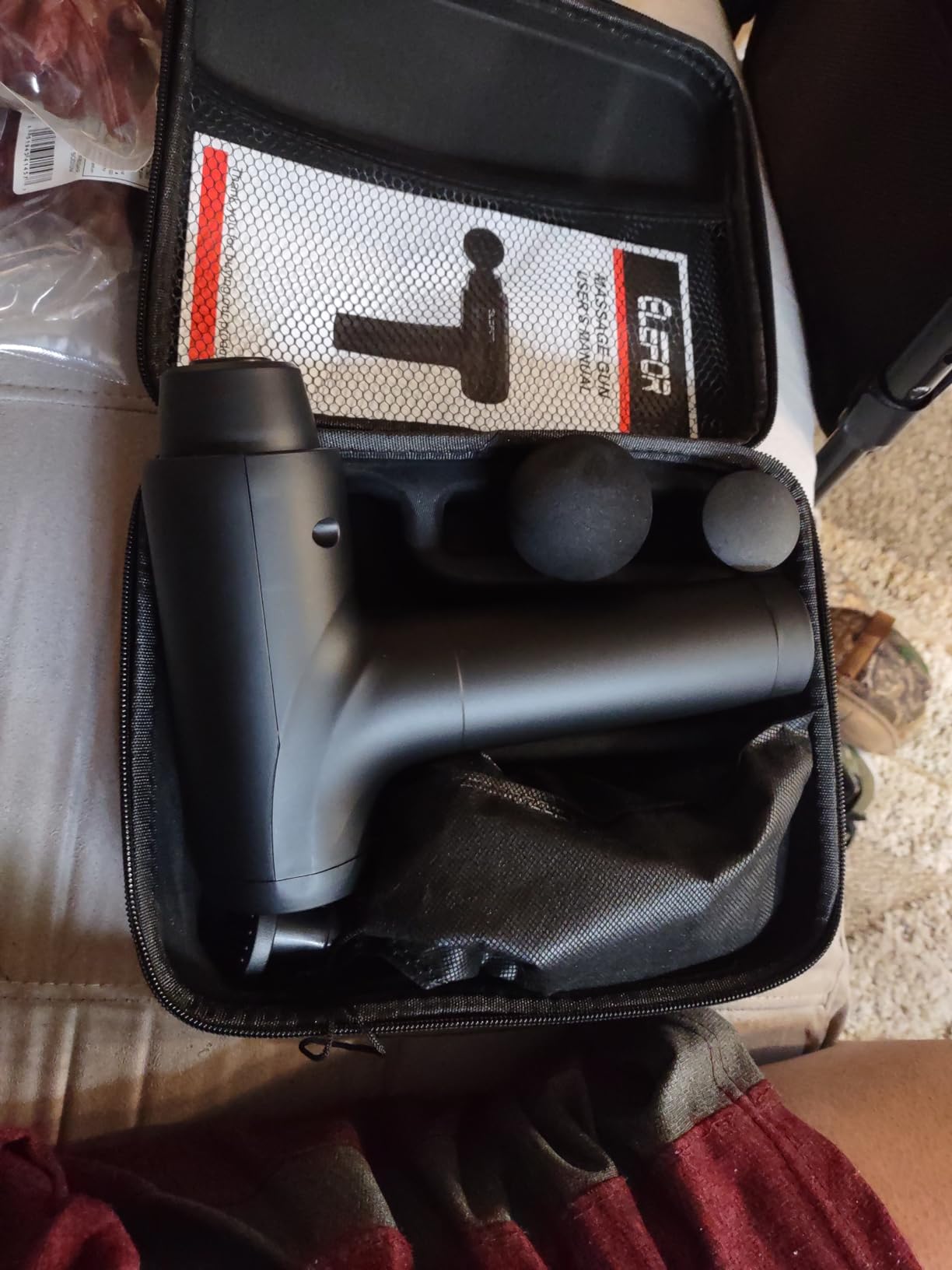
The Elefor solves a specific problem better than anything else in this roundup: hand fatigue. At just over 5 ounces it is by a wide margin the lightest electric unit here, and for a neck that means you can work a tight spot for several minutes without your forearm giving out first. People with grip weakness or hand arthritis rate this one highly for exactly that reason.
Twenty speed levels from 1,200 to 3,200 strikes per minute on an LCD touch screen is genuinely useful on a neck, where you want the ability to dial in very light work. Most rivals give you three to five speeds. Eight heads cover the muscle groups you are likely to touch, and a portable carrying case is included so it can live in a desk drawer.
It ranks in the top three of its category on Amazon with more than 23,000 ratings, and the sentiment pattern is consistent: people are happy with the speed range and the quiet operation, and they accept the light body as part of the bargain.
What you give up for that weight is punch. A 5-ounce body simply does not push into a dense knot the way a heavier motor can, so a lot of owners describe it as better suited to warming a muscle up than to digging one out. Support is also the weak point: the manufacturer listed is a trading company with no recognisable brand behind the warranty, which matters if something fails.
Who the five-ounce weight matters for?
This suits office workers who want neck relief between meetings without a device that announces itself, and anyone who finds heavier guns painful to hold. The carrying case means it can live at work rather than at home, which is where neck tension actually builds.
Where it falls short?
It falls short for chronic, deep knots and for anyone who wants a device to last a decade. The light motor tops out early, and there is no display of remaining charge, which means you learn to stop before it stops. For a neck, that is a reasonable compromise. For a back, less so.
5. AERLANG Heated Head Massage Gun – Best For the Hottest Heated Head
Massage Gun with Heat Massager Deep Tissue Muscle Massager Gifts for Men
Heated head to 131F with 3 settings
20 speeds from 1,400 to 3,200 RPM
LCD pressure readout
2.2 lb
Pros
- Hottest heated head in this group at up to 131F
- Attachments screw on securely instead of friction-fitting
- Push-pressure boost adds force on stubborn knots
- Company replaced a failed power connector at no cost
Cons
- Heavy at 2.2 lb for a handheld unit
- Heated head needs its own two-hour first charge
- USB-C port is a physical swap only and needs a USB-A supply
The AERLANG is the one to look at if you want heat you can genuinely feel. Its heated head runs to 131F across three settings, which is hotter than the heated option in the RENPHO Thermacool 2 and far hotter than heat-node devices that warm the surrounding air rather than the surface you are pressing.
Two design decisions here are better engineered than the category norm. The attachments screw on rather than friction-fitting, so a head will not pop off when you press it into a knot, which is the single most common session-ending complaint in this category. And the LCD shows applied pressure in real time, with pressure-feedback auto-adjustment that changes the percussion to match how hard you are leaning.
Twenty speeds from 1,400 to 3,200 RPM give fine intensity tuning, and a push-pressure boost adds force on stubborn spots without changing settings. Six heads and a carrying case round out the package. Support is worth noting too: the company replaced a broken power connector quickly and at no cost, which is more than most sellers in this price range manage.
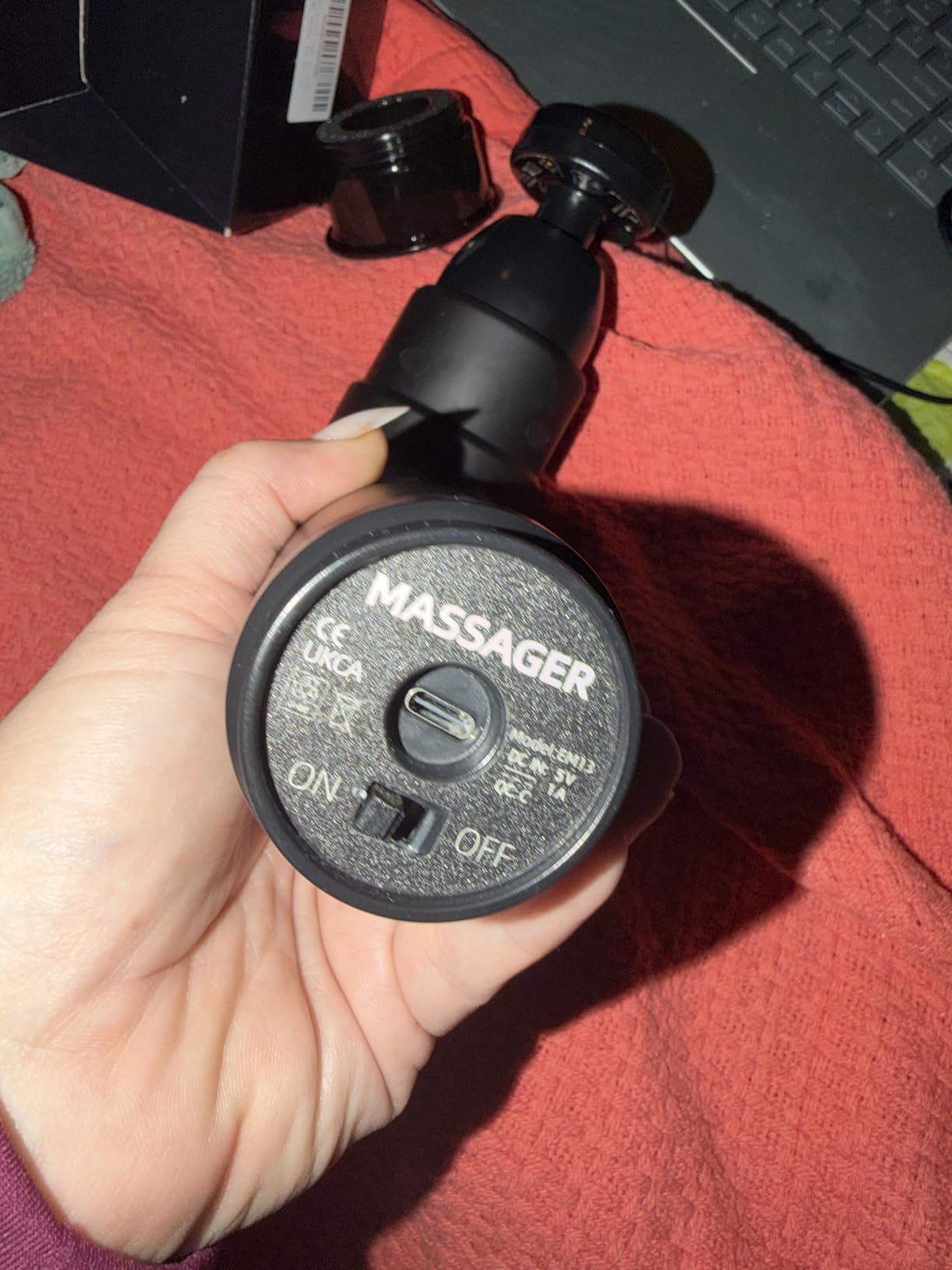
The charging story is where this one loses points. The heated head has its own two-hour first charge, the battery drains faster on deep-tissue settings, and the charger shows full before it truly is. The port is labelled USB-C but is a physical swap only, with no power negotiation, so a plain USB-A supply is what you actually need.
Who the hottest heated head suits?
This suits people whose neck pain is genuinely cold, especially in winter or after long hours in an air-conditioned room, and anyone who has repeatedly lost a massage head mid-session to friction fittings. The pressure readout also appeals to users who like knowing they are not simply leaning harder every minute.
Where it falls short?
It falls short on weight and on logistics. At 2.2 lb it is one of the heavier units, which matters when you are holding your arm up behind your head. And a heated head that needs its own charge before first use is a real annoyance for anyone who opens the box expecting to use the device that evening.
6. Homedics Percussion Massager with Heat – Best For Kneading-Style Heads
Homedics Percussion Action Massager with Heat | Adjustable Intensity, Dual Pivoting Heads | 2 Sets Interchangeable Nodes, Heated Muscle Kneading for Back, Shoulders, Feet, Legs, & Neck
Dual pivoting heads to 3,100 pulses per minute
4 speed settings
2 sets of interchangeable nodes
Red heat nodes
Pros
- Pivoting heads mimic a kneading stroke rather than single-point tapping
- Two node sets let you switch between soft and firm feel
- Heat nodes add useful warmth for a stiff neck
- Simple two-button control with no screen or app
Cons
- Heat only works with attachments removed so the nodes are exposed
- Only four speeds and no digital display
- Older design and heavier than the compact guns
Almost everything in this category taps. The Homedics pivots, with two heads that move in a kneading motion closer to what a therapist’s hands do, and on a neck that difference is felt. Kinesiologists describe the sensation as broader and less prickly than percussion, which suits the long slow passes along the top of the shoulder.
It has been listed since June 2012, and 18,500-plus ratings at 4.4 stars reflect a design that has not needed replacing. Two sets of interchangeable nodes let you choose a soft or a firmer feel, and the red heat nodes add warmth for a stiff neck. The entire interface is one power button plus one heat button on the handle.

That simplicity is a genuine feature for gifting. There is no app, no display, no menu, and no firmware update to think about. Someone who is not confident with technology can pick this up and use it correctly on the first attempt, and the 2-year guarantee plus 30-day returns that ship with the Snailax in this list are mirrored by the brand reputation here.
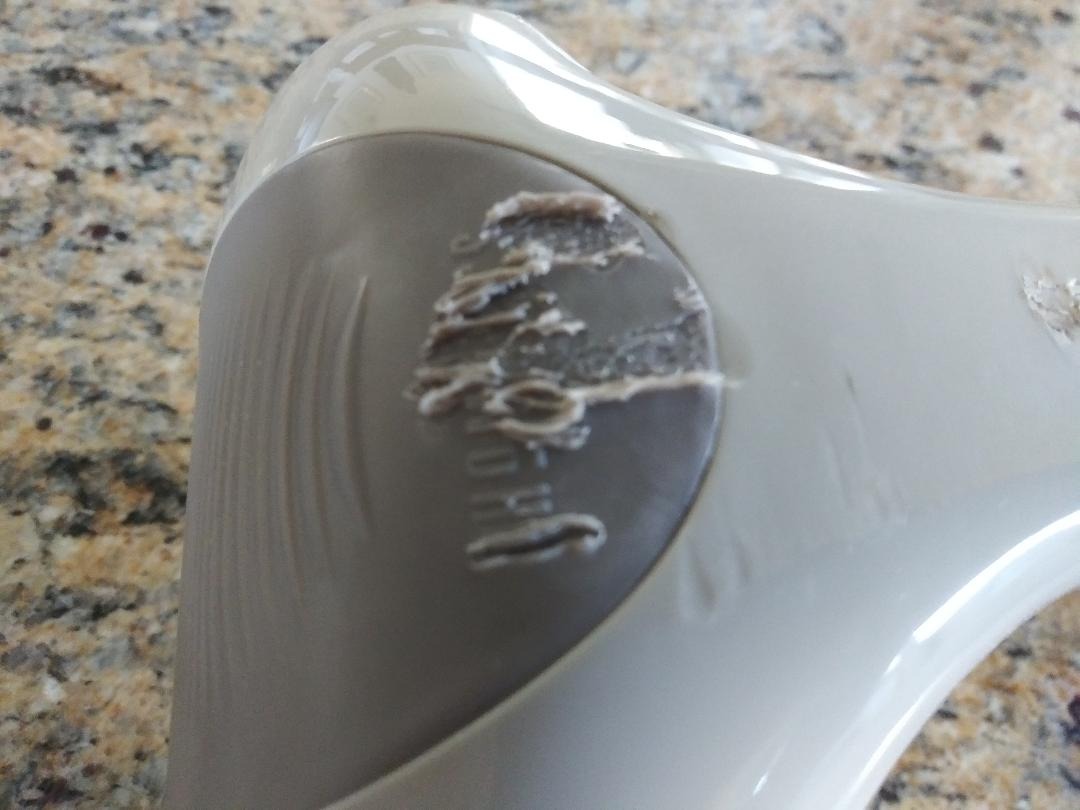
The heat function is the awkward part. It only works with the massage attachments removed, which means an extra step every time and a moment where the bare heated head is exposed to skin. With only four speeds and no display, you also get coarser control than the newer guns in this roundup, and at 2.48 lb it is not the lightest thing to lift overhead.
Who the two-button simplicity is for?
This suits older users and anyone gifting to a parent or relative, because the controls cannot be misunderstood. It also suits people who find percussion prickly or too sharp on a thin neck and prefer a kneading sensation they can sit through for longer.
Where it falls short?
It falls short for anyone who wants fine intensity control or a display that shows remaining battery or speed. The four-speed range means you are choosing between noticeably different intensities rather than trimming a range, and the heat-requires-head-removal step is a design compromise from 2012 that has not aged well.
7. Snailax Cordless Massager with Heat – Best For Simple Button Controls
Snailax Cordless Handheld Back Massager with Heat, Percussion, Rechargeable
Dual percussion heads to 3,200 pulses per minute
3 speeds across 3 modes
About 80 minutes per charge
2.84 lb with 2-year guarantee
Pros
- Dual heads give a broader massage than single-head sticks
- Simple button controls that older users find easy
- Two-year guarantee and 30-day returns back the purchase
- Three sets of interchangeable heads included
Cons
- Heaviest unit in the roundup at 2.84 lb
- 15-minute auto timer stops sessions early
- Percussion rather than deep kneading
- Heat needs the heads removed
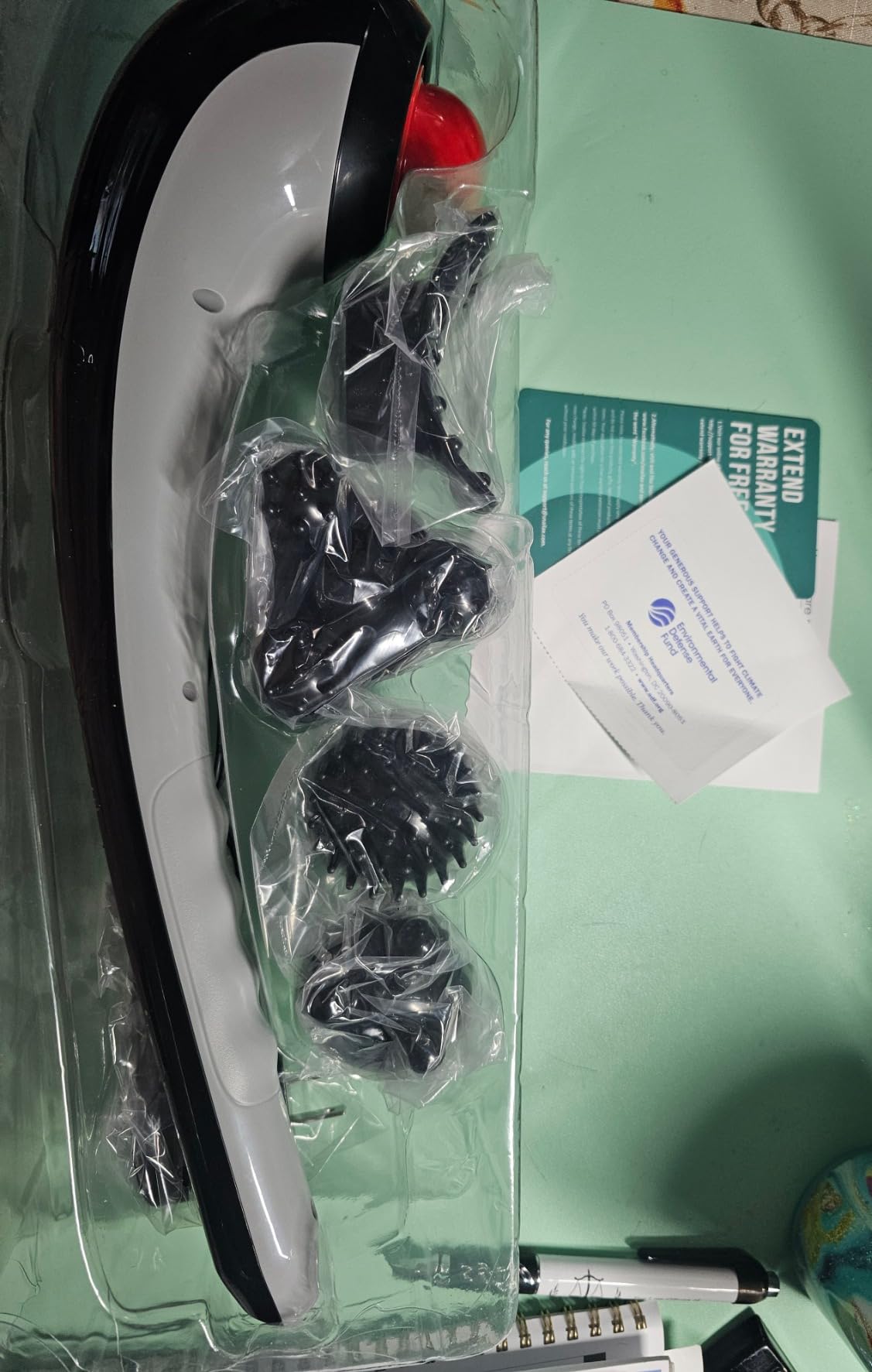
The Snailax is the honest mid-point of this roundup. Dual percussion heads reach 3,200 pulses per minute across three speeds and three modes, it is cordless with about 80 minutes per charge, and it comes with a 2-year guarantee and 30-day returns. That combination of warranty length and return window is the strongest paper backing in the group.
Dual heads are worth more than the specification suggests. A single-head stick feels like a point being tapped, while two heads spreading the load feel broader and cover the width of the upper trapezius in one pass. For someone new to percussion devices, that difference makes the whole experience more tolerable.
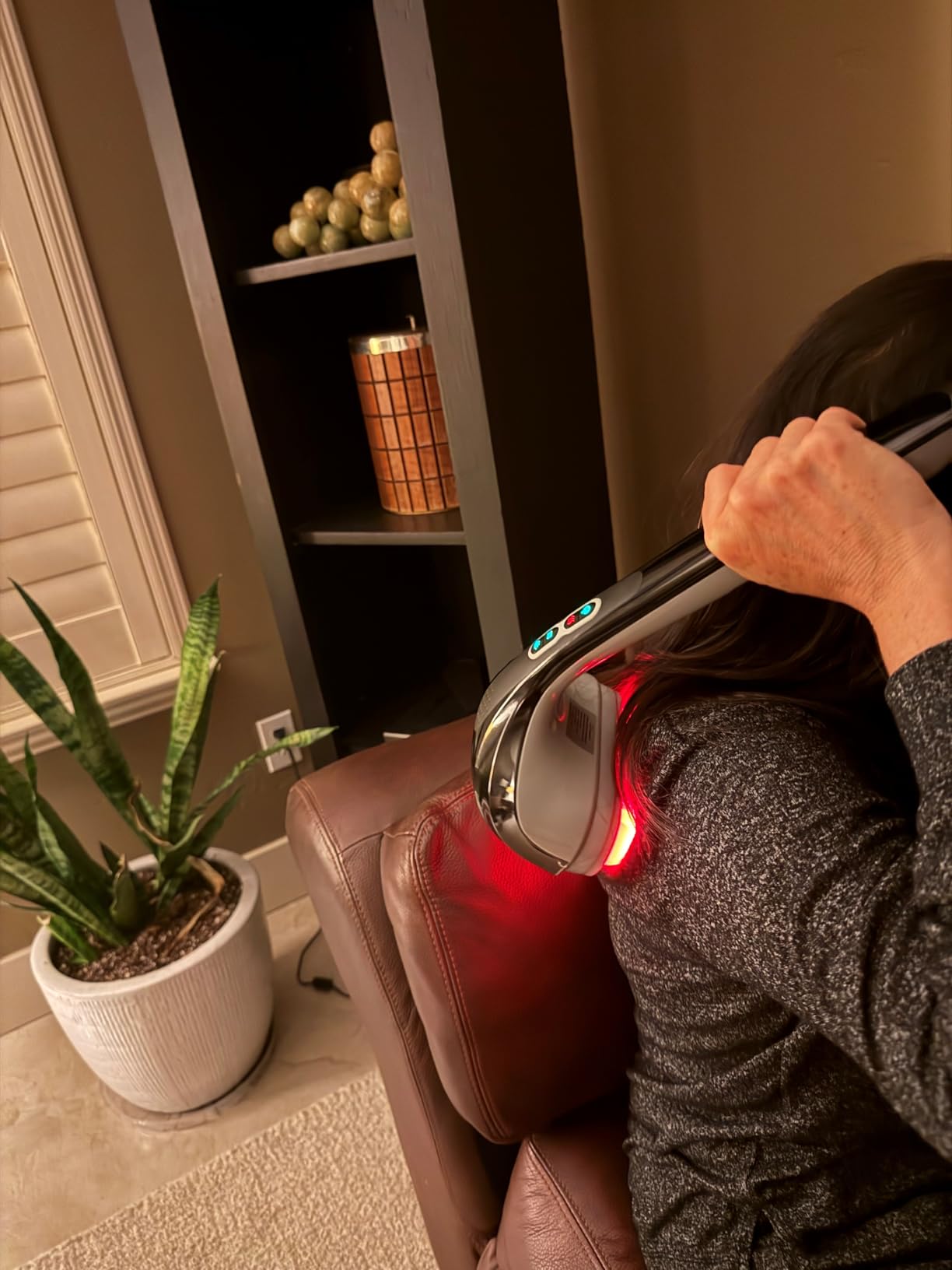
Simple button controls and a 15-minute auto timer keep the session safe without any thought required, and the manufacturer is straightforward about what this is: a percussion and vibration device, not a deep kneading shiatsu massager. Buyers who understand that framing up front tend to be satisfied; buyers expecting a hands-on shiatsu feel are not.
At 2.84 lb it is the heaviest unit here, and that is the real constraint for neck use. Holding anything heavy above your shoulder for a long session taxes the forearm, so this works best for short, targeted passes rather than a full neck and shoulder routine. The 15-minute timer also cuts sessions short unless you restart it.
Who the warranty terms matter for?
This suits buyers who care more about warranty length and return terms than about headline specifications, and anyone who wants heat and percussion in one cordless unit without a display. For a gift, the two-year guarantee is genuinely reassuring.
Where it falls short?
It falls short on weight, on kneading sensation, and on heat convenience. It is percussion rather than deep kneading, so it will not feel like a shiatsu massage, and the heat function again only works with the heads removed. If you want a massage that feels like a hand rather than a pulse, the Homedic above is the better comparison.
8. VOYOR Manual Shiatsu Tool – Best Manual Tool for Trigger Points
VOYOR Neck Massager Shiatsu Deep Tissue Dual Trigger Point for Pain Relief
Dual silicone trigger point balls
Flexible handle that opens and closes
Manual pressure control
310 g battery-free
Pros
- Balls grip the neck and hold position without constant pressure
- Pressure is entirely in your hand so intensity is fully adjustable
- Effective on trigger points near the upper cervical spine
- No charging
- no motor and no electronics to fail
- Physical therapists report using it with patients
Cons
- Awkward to hook around the shoulder or use on the shoulder blades
- Ball joint can unscrew and expose sharp plastic
- Manual pressure causes real forearm fatigue
- Silicone balls can feel painful at first
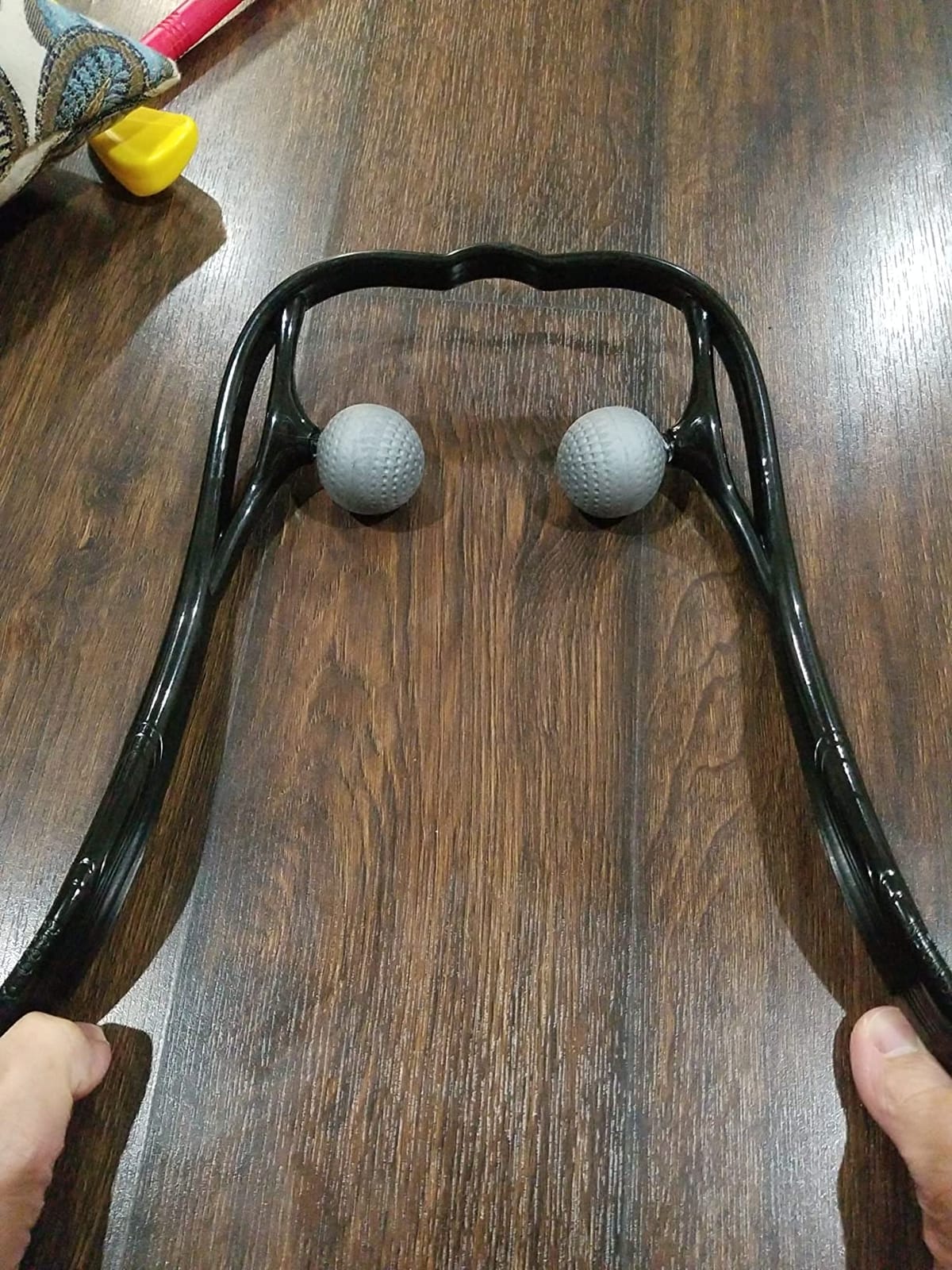
This is the pick for anyone who is nervous about percussion near the neck, and that group is larger than the marketing suggests. There is no motor, no speed, and no percussion. Two silicone balls press into the muscle and hold there, and the force is entirely whatever you lean in with, which makes it impossible to accidentally overdo it.
The mechanism is genuinely clever for a neck. The handle flexes open and closed to sit against different contours, and the two balls grip the neck and stay in position without continuous pressure, so you can hold a trigger point for as long as it takes rather than sweeping over it. Several physical therapists report using it with patients, and users consistently describe it as a neck tool rather than a whole-body massager.
At 310 g it travels better than anything else here, and with no battery it is always ready. For someone whose neck pain is a single stubborn point just below the skull, sustained manual pressure is closer to what a therapist would actually do than any percussion device is.
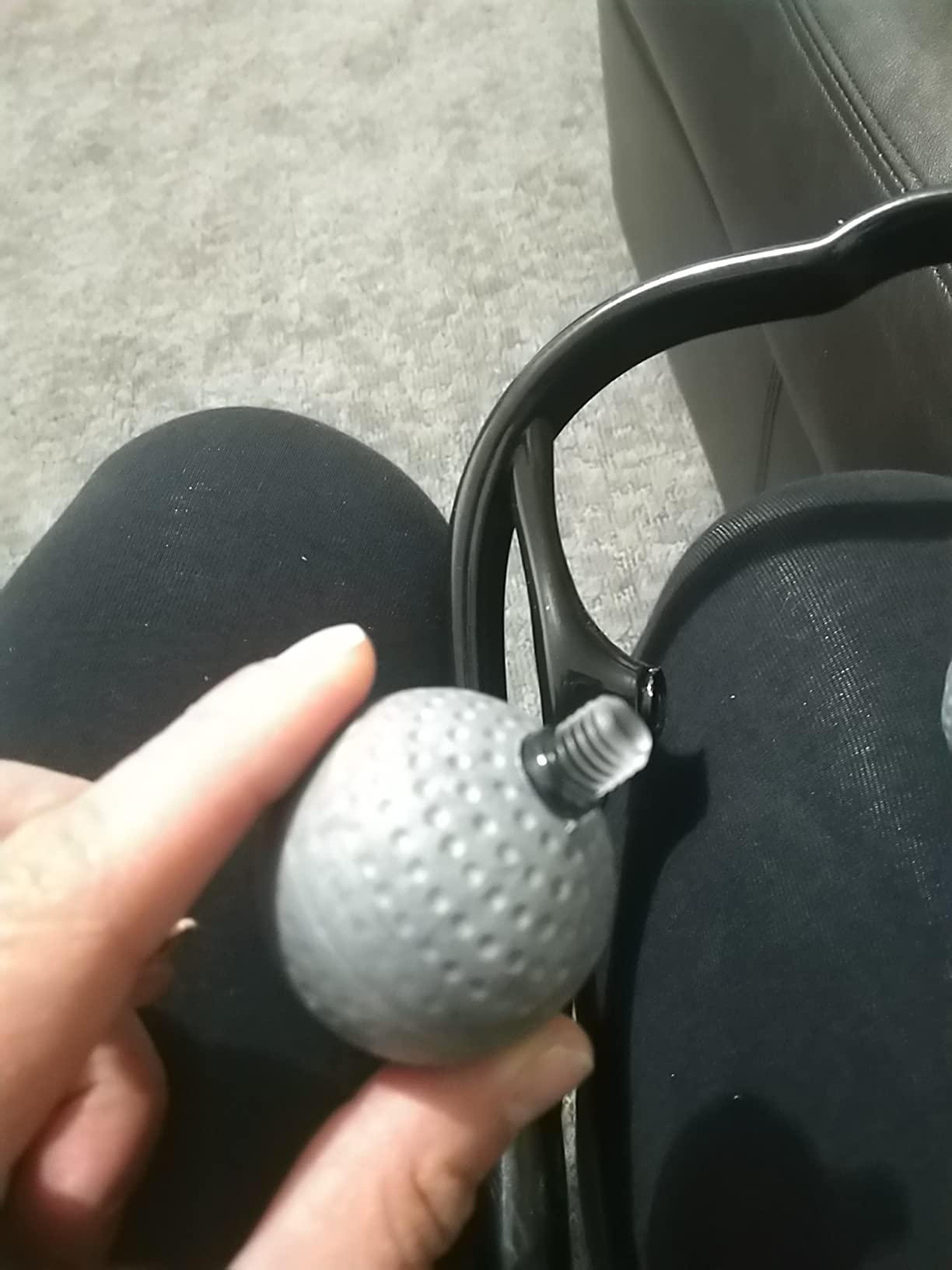
It is also the lowest-rated item in this roundup at 4.1 stars, and the rating distribution is the most spread out, with the largest share of one and two-star reviews. The most common complaint is the ball unscrewing from its plastic connector, which can expose sharp plastic at the joint. It is also awkward to hook around the shoulder or use on the shoulder blades, and forearm fatigue sets in during long sessions.
Who a manual tool is the right answer for?
This suits people who want precise, sustained pressure on a specific knot, and anyone who would rather avoid a pulsing device near the carotid. It also suits travel, since it weighs almost nothing and needs no charging, and users who want to keep total control over intensity.
Where it falls short?
It falls short for whole-area work and for anyone with hand or forearm issues, because all the effort comes from your arm. The first few sessions can be genuinely uncomfortable as firm silicone meets a sensitive area. Treat it as a precision instrument for one or two points, not as a substitute for a full neck massage, and you will be happy with it.
9. arboleaf Mini Massage Gun – Best For Small Hands and Travel
arboleaf Mini Massage Gun Deep Tissue, Portable Percussion Muscle Massager
35 lb percussion force in a 1.04 lb body
1,000-3,200 RPM with 5 speeds
USB-C fast charging
35-55 dB with 3-year warranty
Pros
- Highest rating in the roundup at 4.6 with 82 percent five-star reviews
- Compact metal body delivers 35 lb of force
- Pressure-responsive fifth speed adds force only when you push
- Hard case
- cloth bag and a 3-year warranty included
- US-based support team
Cons
- Less raw power than full-size guns for athletes
- Only a single battery indicator light
- Hot and cold attachment reads as more warm than hot
- Charge holds less well above 2000 rpm
The arboleaf is the most satisfying small device in this roundup, and it holds the highest average rating at 4.6 stars with 82 percent five-star reviews across more than 3,600 ratings. That is a smaller review base than the leaders, but the consistency of the sentiment is what stands out, and long-term ownership reports matter more than a large volume of brief enthusiasm.
The engineering trick is 35 lb of percussion force in a body weighing just over one pound, with a full-metal shell rather than plastic. That combination solves two problems at once: it does not fatigue the hand, and it still drives into a dense knot. A pressure-responsive fifth speed adds force only when you push into it, which gives finer control on a neck than a flat speed curve.
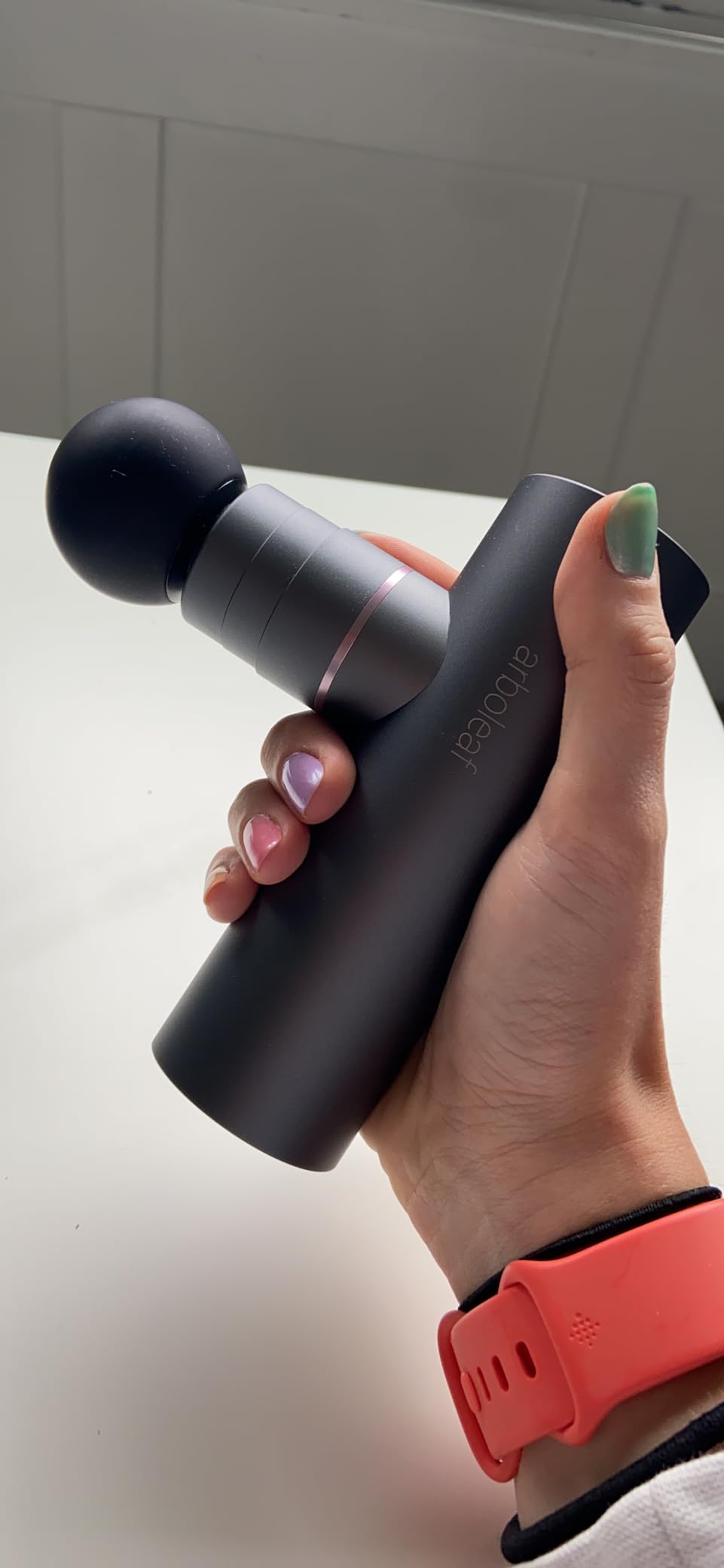
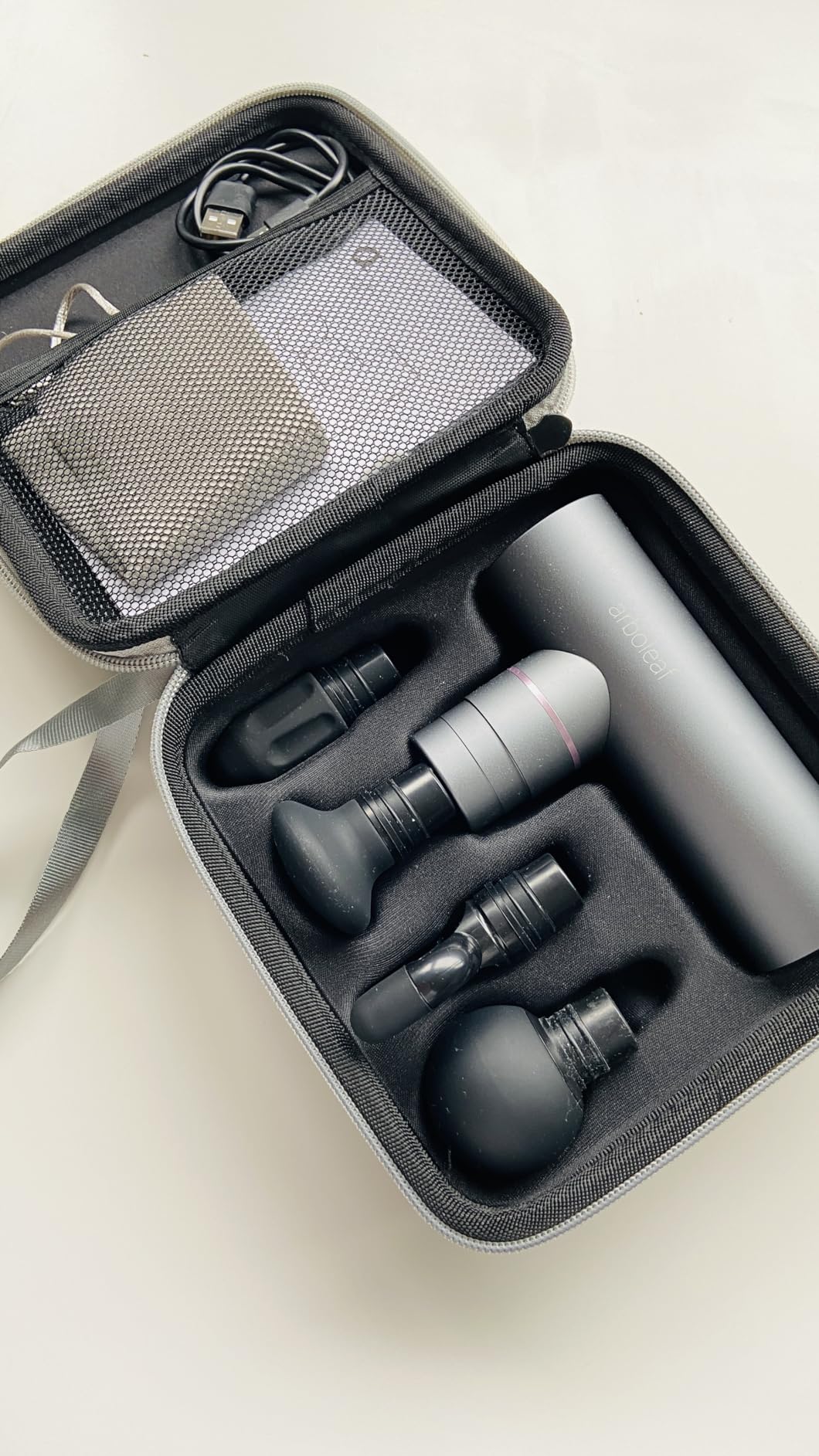
The accessories are unusually generous: a hard shell case, a cloth travel bag, gift box packaging, and a 3-year warranty, the longest in this group. USB-C fast charging with a 10-minute auto shutoff is the standard we want to see everywhere. Four silicone heads cover large groups, knots, trigger points and soles, and the operating range of 35-55 dB keeps it usable in shared spaces.
The limitations are honest ones. The compact motor tops out below full-size guns, so athletes working on quads may find it limiting. Battery indication is a single light rather than a charge-level meter, and the hot/cold attachment reads more as warm than as hot. Above 2,000 rpm the charge does not hold as well over time, which is worth remembering on long sessions.
Who the compact metal body works for?
This suits small hands, anyone with grip issues, and anyone who wants a device they will actually keep in a bag rather than in a cupboard. The 3-year warranty and the US-based support team make it the lowest-friction purchase in the roundup, and personal trainers report using it with clients daily.
Where it falls short?
It falls short if you need maximum force on large muscle groups, and if you want to know exactly how much charge is left before you start. For a neck, where muscles are smaller and sessions are short, those are small compromises rather than real problems.
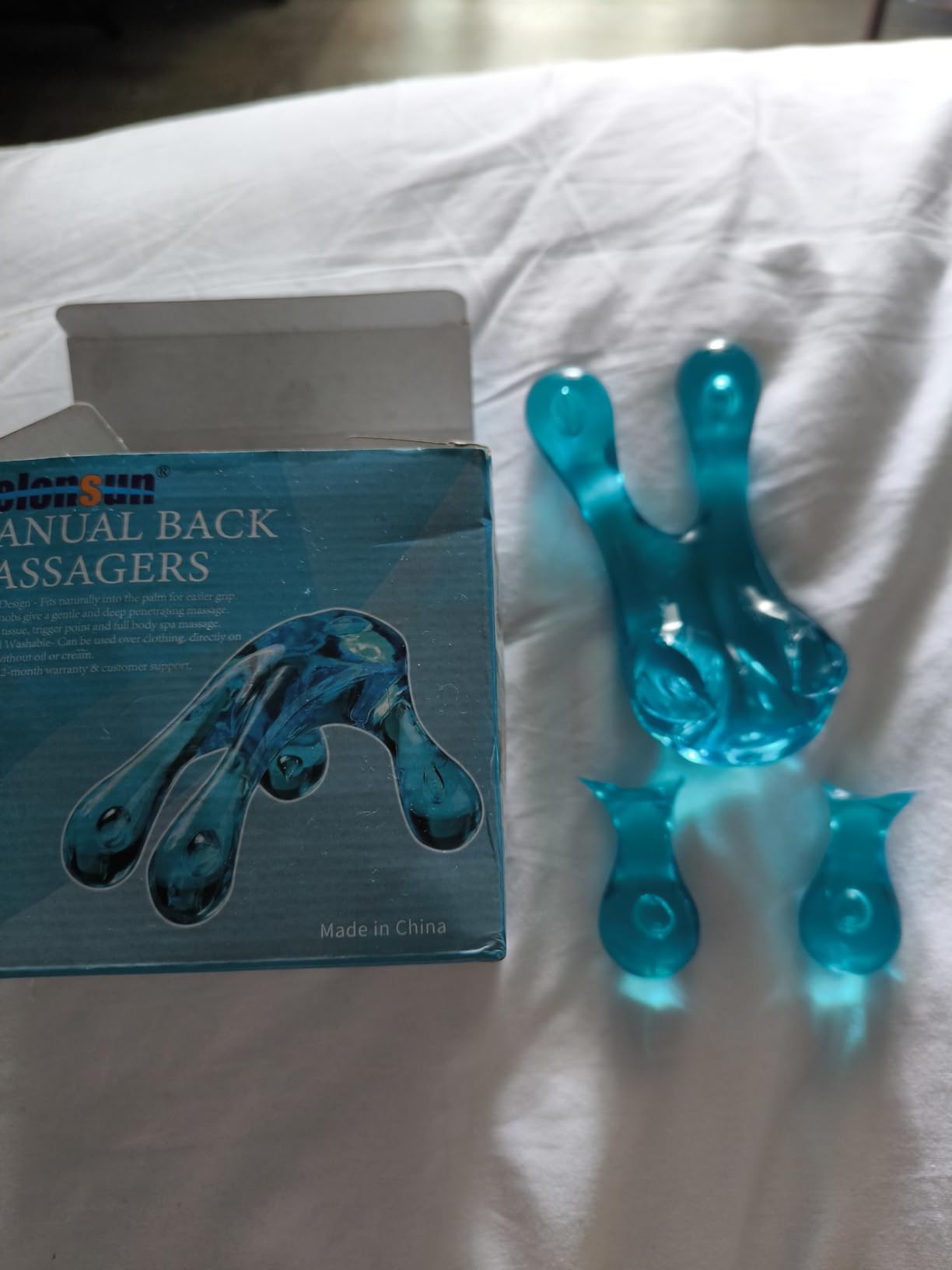
10. Melonsun Palm Massage Tool – Best Palm-Grip Reach Between the Shoulder Blades
Melonsun Palm Massage Tool – Handheld Four-Point Deep Tissue Massager for Trigger Point, Neck Back Shoulder Pain Relief, Self Massage Between Shoulder Blades, No Therapist Needed
Four-point palm grip with two knob sizes
Fully manual, battery-free
6.38 oz
Smooth acrylic surface
Pros
- Four-point design reaches between the shoulder blades on your own
- Two knob sizes suit broad muscles and small trigger points
- Never needs charging and is always ready
- Can be placed on the floor and worked with body weight for deep pressure
- Cheapest option in the roundup by a wide margin
Cons
- Brittle acrylic that can crack or snap if dropped or pressed at full force
- Several owners report breakage within weeks to months
- No adjustable intensity beyond how hard you press
- Awkward for anything other than localised points
The Melonsun solves a reach problem that no powered device in this list solves. The four-point palm grip sits in your hand and lets you press between your own shoulder blades without a partner, which is exactly the region that most handheld massagers cannot reach unaided. Owners describe it consistently as a neck, back and shoulder point tool, and the two knob sizes let you switch between broad muscle work and a single tight spot.
It is the cheapest item here by a wide margin, weighs 6.38 oz, and needs no battery, cable or charging. You can also set it on the floor and lean your body weight into it for pressure no handheld device delivers, and the smooth acrylic surface is easy to clean, which matters if you have a skin condition.
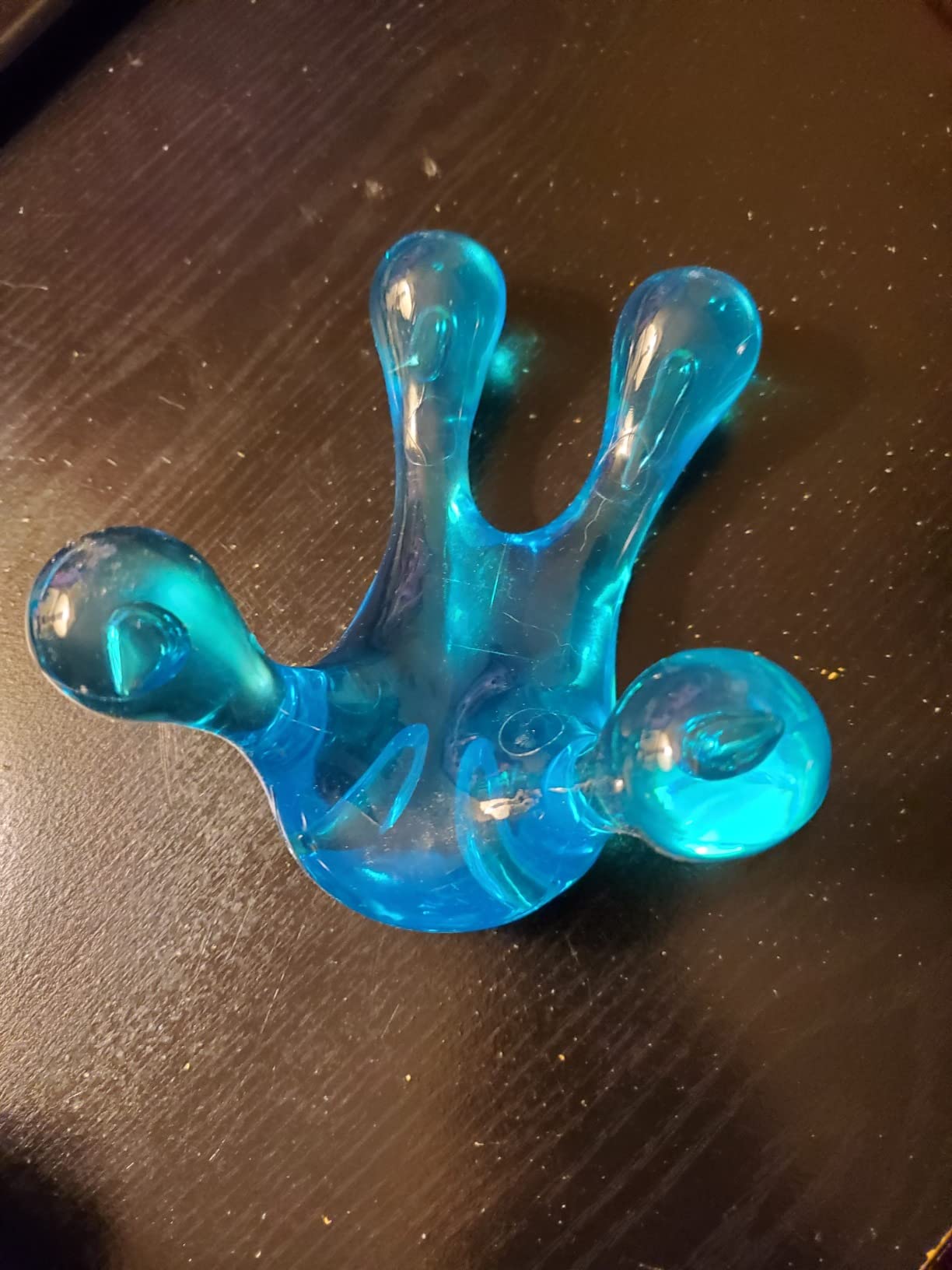
Durability is the dominant theme in the negative reviews, and it is not a small caveat. Multiple accounts describe the acrylic cracking or a leg snapping off under normal use within weeks or months. Treat it as a pressure tool rather than a percussion tool: moderate force, never drop it, and expect to replace it if you are someone who grips hard.
There is also no adjustable intensity beyond the pressure you apply, and it is awkward for anything other than localised points. It cannot move across a muscle, it cannot produce heat, and it cannot treat a broad area. Used as intended, that is not a flaw. Used as a general massager, it will frustrate you.
Who the palm-grip reach is for?
This suits anyone whose pain sits between the shoulder blades or at the base of the neck and who wants self-treatment without a partner or an appointment. It also suits people who want zero technology in their self-care routine, and it makes a practical stocking filler alongside a heated option.
Where it falls short?
It falls short on durability, on versatility, and on controlled intensity. The acrylic will not survive a drop or a full-force press, there is no way to vary intensity other than pressing harder, and it does nothing for a whole muscle group. Buy it for one job and you will be satisfied; expect a general-purpose massager and you will not be.
How to Choose a Handheld Massager for Neck Pain?
Five decisions matter more than any specification on the box, and this is the order in which I would make them.
1. Reach before anything else. If your pain is at the base of the skull or between the shoulder blades, a pistol-grip device will frustrate you daily. Look for a long handle, an extension, or a palm-grip design that works against your own body. A device you cannot position is a device you stop using.
2. Match the mechanism to the pain. Percussion with a high percussions-per-minute figure suits a hard knot. Kneading-style pivoting heads suit broad tension across the top of the shoulder. Heat suits a cold, locked muscle, and manual pressure suits one stubborn trigger point and anyone nervous about pulsing devices. Matching the mechanism to the type of stiffness is worth more than owning a higher-end model with the wrong action.
3. Understand what the numbers mean. Amplitude is how far the head travels, in millimetres, and it determines how deep the pulse feels. Percussions per minute, or RPM, is how fast. Stall force, in pounds, is the pressure the device can sustain before the motor stalls out, and it is the number that tells you whether it will keep working when you press into a dense knot. A device with low stall force will feel weak exactly when you need it most.
4. Check weight and noise against your actual life. Under six ounces is the threshold where hand fatigue stops being a problem for neck use. Above 2.5 lb you will feel the weight in your forearm within a few minutes. For noise, 40 to 50 dB is roughly a quiet office; above 55 dB and shared-space use becomes unrealistic. The exact figures for each unit are in the comparison above.
5. Look at the parts that fail. Heads that friction-fit loosen mid-session, so screw-on attachments are worth paying for. A readable battery display beats a single indicator light. A real auto shut-off timer matters. Warranty length is a useful proxy for how the manufacturer expects the motor to hold up, and the strongest in this roundup is three years.
Two more practical considerations. Cordless means convenience, but no cordless device in this group can be used while charging, so a long session ends when the battery does. And heated units frequently need their own first charge for the heating element, or need attachments removed before heat works, so check that before you commit.
For readers who follow neck coverage across other categories, our detachable neck turnout blanket guide covers a very different kind of neck entirely, and the ergonomics of supporting a head have more in common than the products suggest.
Which Massage Head Goes on Which Neck Muscle?
This is the detail that decides whether a session helps, and it takes about ten seconds to get right.
Flat broad head on the upper trapezius, in long strokes from the base of the skull out toward the shoulder tip. This is your default for general tension.
Fork or U-shaped head either side of the cervical spine, along the levator scapulae. The shape straddles the muscle and avoids driving the head straight into bone.
Soft round head on the upper shoulder and the area just behind the ear, at low speed, where skin and muscle are thin.
Pointed head on a single stubborn trigger point, briefly, at moderate speed. This is the one to use for a few seconds and then move on.
Heated head on cold, stiff muscle before you start the mechanical work, not during it.
Silicone balls on a manual tool on the upper cervical area beside the spine, held in place rather than swept.
One rule covers all of them: keep the device moving, keep the pressure light enough that you could still hold a conversation, and never work directly over bone. It is the same principle behind our guide to horse neck covers, where coverage and clearance around the neck matter as much as the product itself.
The Three-Minute Desk Routine
Neck tension at a desk is accumulated, not sudden, so short and repeated beats long and occasional. Here is the protocol we use.
Minute one, warm-up pass. Flat head, lowest speed, long strokes along the top of the shoulder from neck to shoulder tip, both sides. This is preparation, not treatment.
Minute two, targeted work. Switch to the fork or pointed head. Find the two or three spots that reproduce your pain and hold each for 20 to 30 seconds at a speed you can tolerate. Move on the moment it eases rather than when it stops entirely.
Minute three, down-regulation. Broad flat head, medium speed, sweeping strokes down the levator scapulae toward the shoulder blade, then back up the side of the neck. Finish slow, because finishing fast leaves the muscle switched on.
If your muscle is cold rather than knotted, spend the first minute with heat or a hot shower instead. Percussion on cold tissue is what makes people say a massager hurts more before it helps. Stop if you feel anything sharp, and keep sessions to two or three per day rather than several in an hour.
Two more habits worth keeping. Breathe out slowly while you work, because people instinctively hold their breath and brace the neck muscles they are trying to relax. And take a break between sessions if the area feels tender rather than loose, since a neck that is worked to exhaustion on day one tends to be avoided entirely until the following week.
When a Massager Will Not Fix Your Neck Pain?
A handheld massager relaxes tissue and increases local blood flow. It does not correct posture, release a compressed nerve, or reverse disc changes, and any product page implying otherwise is overselling. Knowing which category your pain falls into saves you from spending weeks on the wrong device.
Muscle-origin pain feels achy, comes and goes with your activity level, moves when you move your neck, and responds to heat and pressure. That is what a massager is for.
Nerve-origin pain behaves differently. It radiates down the arm, includes tingling or numbness, includes genuine weakness in a hand or arm, or gets worse with certain neck positions regardless of what you do to the muscle. Pressure devices do not help that, and pushing through nerve symptoms risks making them worse.
Stop and see a clinician if you have any of the following: pain following a fall, car crash or other impact; pain radiating into the arm past the elbow; numbness or weakness in a hand or arm; a headache that starts at the back of the skull and builds; fever alongside neck pain; or pain that has been constant and worsening for more than a couple of weeks. Those patterns point to something a massager cannot address, and a physical therapist or clinician can tell you quickly.
Frequently Asked Questions
What is the best massager for neck pain relief?
The RENPHO Cordless Handheld Massager is the best overall for neck pain because its long anti-slip handle lets you reach the upper trapezius and levator scapulae on your own. For a single hard knot, the TOLOCO with ten heads gives you more attachment choice. For cold, stiff muscle, the RENPHO Active Thermacool 2 controls both heat and cold. For quiet use, the arboleaf Mini runs at 35-55 dB.
Is there a neck massager that actually works?
Yes, for muscle-origin neck pain, which feels achy, varies with your activity and moves when you move your neck. A massager relaxes tissue and increases local blood flow at the back and sides of the neck. It does not correct posture, release a compressed nerve or reverse disc changes, and it will not help pain that radiates into the arm or causes numbness or weakness.
Is it safe to put a massage gun on your neck?
It is safe on the muscles at the back and sides of the neck if you keep the device moving, stay on low to medium speed, and avoid bone. Never use it on the front or sides of the throat, over the carotid artery, on the bony cervical spine, at the base of the skull, on the jaw hinge, or on the front of the shoulder joint. Keep sessions under ten minutes per area.
Where not to massage with a massage gun?
Avoid the front and sides of the neck including the throat and carotid artery, the bony cervical spine down the centre of the neck, the base of the skull where the vertebral arteries run, the jaw hinge, and the front of the shoulder joint and inner arm. Safe areas are the upper trapezius, the levator scapulae beside the spine, the top of the shoulder above the collarbone, and the upper back between the shoulder blades.
What neck massager do chiropractors and therapists recommend?
Practitioners generally look for controlled low-end power, an attachment that does not drive into bone, and a long enough handle to reach the upper back without twisting. A force or pressure readout is useful, as is an auto shut-off timer. Manual trigger point tools get a strong endorsement for precise sustained pressure from people who want to avoid percussion near the neck entirely.
How often should you use a neck massager?
Two or three short sessions a day works better than one long session. Keep each session under ten minutes per area, start at the lowest speed and increase only as the muscle relaxes. If your neck is cold and stiff rather than knotted, apply heat or a warm shower before any percussion, since pulsing cold tissue is what makes a device feel worse before it feels better.
Final Verdict
For most people buying the best handheld massagers for neck pain in 2026, the RENPHO Cordless is the one to buy. Its long handle solves the reach problem that defeats most massagers on a neck, its 3,600 pulses per minute across five speeds and five modes give real control, and 140 minutes of runtime means it is always there between meetings. If your pain is a single hard knot, pick the TOLOCO for its ten heads and 12mm amplitude. If your neck is cold and stiff, the RENPHO Active Thermacool 2 is worth the step up. If noise or hand size is your constraint, the arboleaf Mini and the Elefor are the two to beat.
Read the safety section before your first session, keep the device moving, and stay on the muscles at the back and sides of the neck. Used that way, one of these ten will earn its place on your desk.