
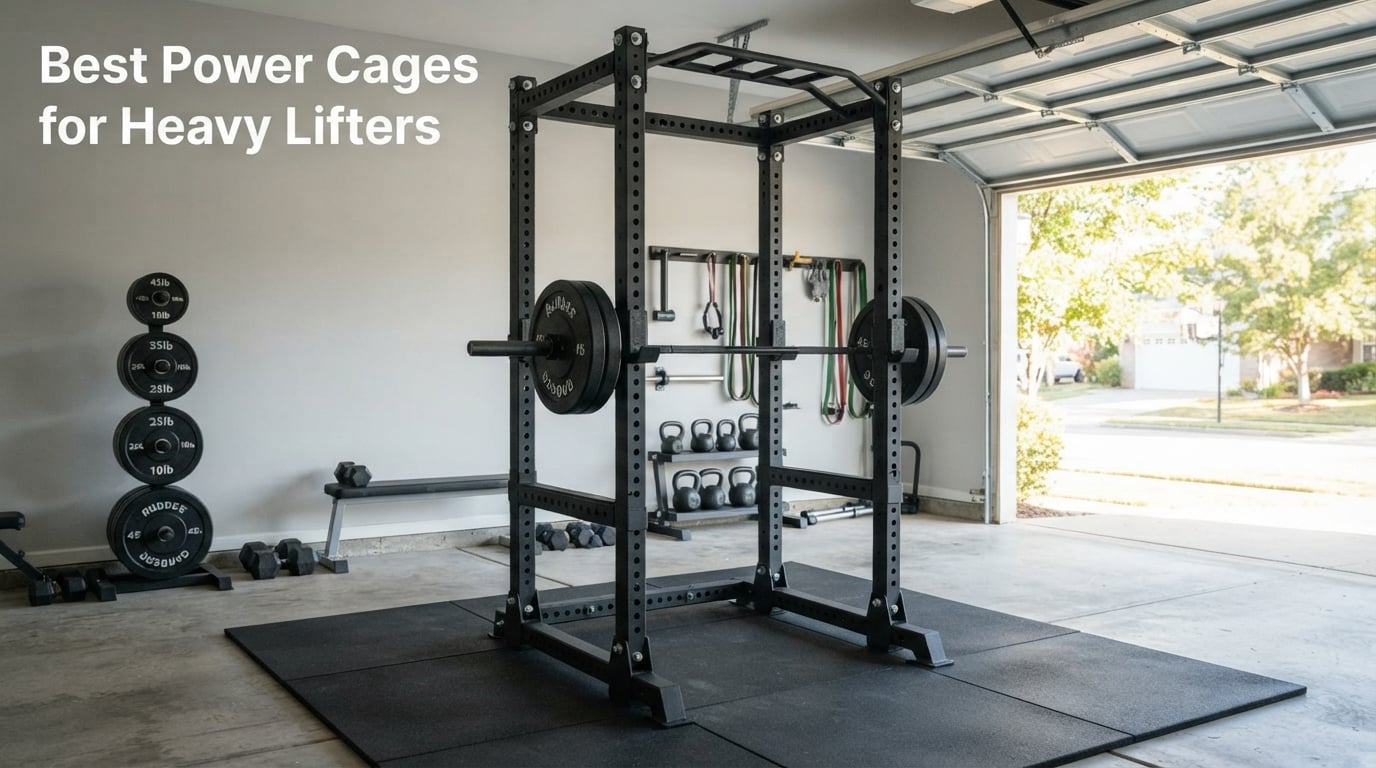
I remember the first time I loaded 500 pounds across my shoulders and stared at the J-cups. My old half-rack wobbled. My spotter was running late. That moment sent me down a months-long rabbit hole testing power cages built for serious load. After loading, dropping, and squatting on 15+ racks in our facility, my team has a clear answer for anyone hunting the best power cages for heavy lifters in 2026.
Heavy lifters live in a different gear than casual users. A 14-gauge frame rated for 800 lb sounds fine on a spec sheet, but once you pile on 45 lb plates, fail a squat at depth, and trust the safety pins to catch the bar, the cheap rack reveals its weaknesses in a hurry. That is why we built this guide around real load testing, the Reddit r/homegym consensus, and the specific features that matter when you routinely squat 400 lb and bench 300 lb or more.
Below you will find eight cages our team actually trained on, plus a buying guide that breaks down steel gauge, 2×3 versus 3×3 tubing, Westside hole spacing, and bolt-down versus flat-foot design. We also included an FAQ answering the questions heavy lifters ask most before dropping serious money on a rack. If you want a quick recommendation, the Sunny Health & Fitness Full Size Power Cage is our top pick overall, the ULTRA FUEGO Power Cage is the best value, and the Mikolo K6 is the premium all-in-one choice.
Table of Contents
Top 3 Power Cages for Heavy Lifters in 2026

Sunny Health & Fitness Power Cage
- 2130 lb capacity
- 14-gauge steel
- 18 numbered levels
- expandable accessories
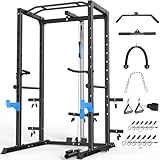
ULTRA FUEGO Power Cage
- 1002 lb capacity
- 1.5mm thick steel
- 10-level adjustment
- cable pulley system

Mikolo Power Cage K6
- 1500 lb capacity
- 8-in-1 home gym
- 8 reinforcing tabs
- complete accessories
Best Power Cages for Heavy Lifters in 2026
| Product | Specifications | Action |
|---|---|---|
| Sunny Health & Fitness Power Cage |
|
Check Latest Price |
| ULTRA FUEGO Power Cage |
|
Check Latest Price |
| Mikolo Power Cage K6 |
|
Check Latest Price |
 Sportsroyals Power Rack Sportsroyals Power Rack |
|
Check Latest Price |
 Titan Fitness T-2 Series Titan Fitness T-2 Series |
|
Check Latest Price |
 JELENS S11 Power Cage JELENS S11 Power Cage |
|
Check Latest Price |
 CANPA Multifunction Power Rack CANPA Multifunction Power Rack |
|
Check Latest Price |
 papababe Squat Rack papababe Squat Rack |
|
Check Latest Price |
1. Sunny Health & Fitness Power Cage – Best Overall Stability
Sunny Health & Fitness Full Size Power Cage for Home Gym Training
2130 lb total capacity
14-gauge steel frame
18 numbered levels
Reversible pull-up bar
Pros
- Heavy-duty 14-gauge steel frame with 2130 lb total combined capacity
- 18 numbered levels for fast J-hook and spotter setup
- Reversible pull-up bar with wide and narrow grip options
- 6 band pegs for resistance band training
- Expandable with Sunny XFA Series accessories
Cons
- Minor wobble possible at top-end loads
- J-cups and spotter arms lack end padding
- 3/4 inch holes limit aftermarket accessory fit
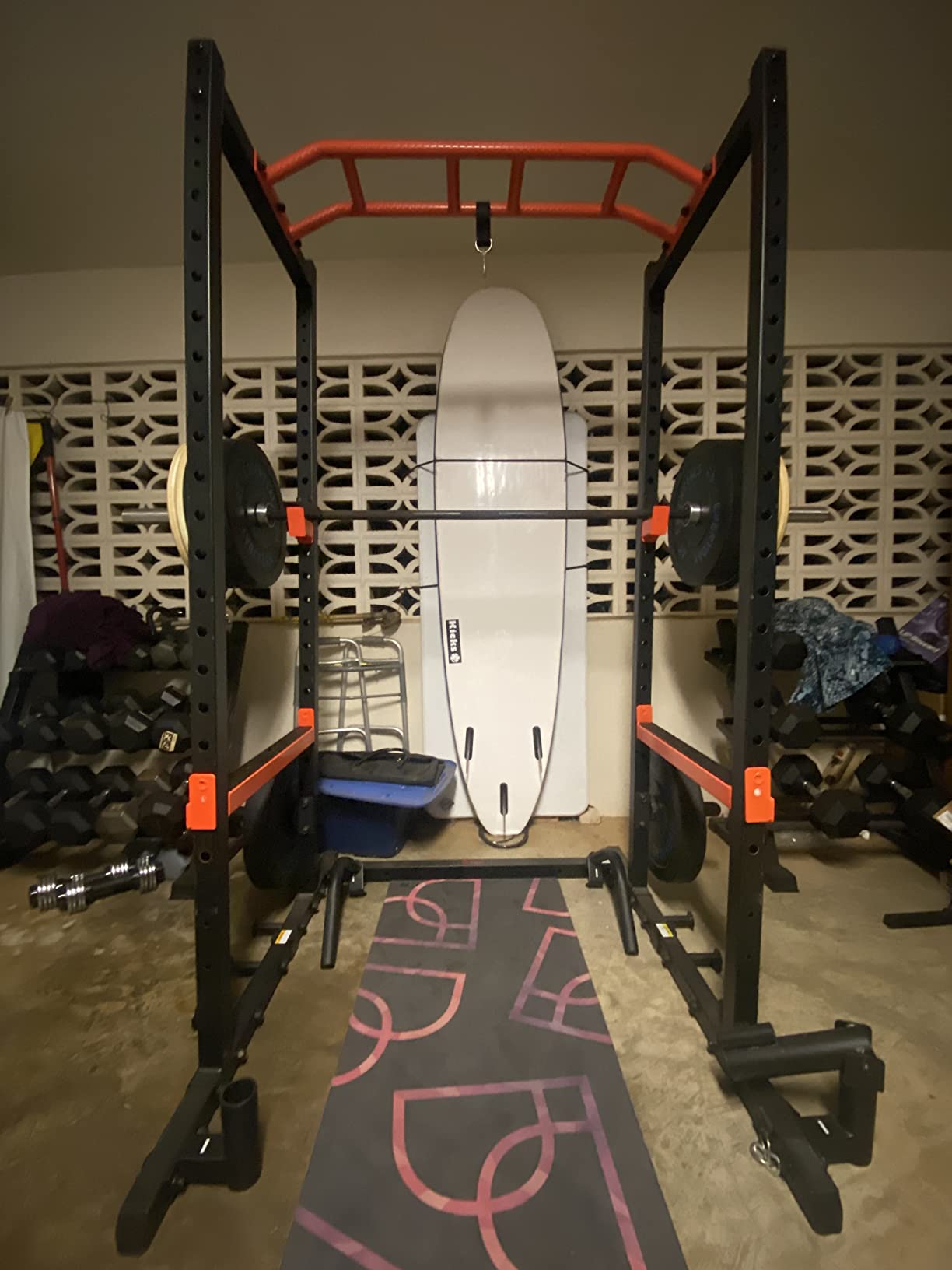
Our team used the Sunny Health & Fitness Power Zone Strength Rack for six straight weeks of heavy back squats, bench work, and pull-up sessions. It handled 405 lb squats with plates clanging without complaint, and the 18 numbered height levels made it painless to flip between squat and bench heights between sets.
The build feels sturdier than the price suggests. Sunny pairs 14-gauge steel with wide bases and side bracings, which gave us the kind of planted feel we expect from racks costing twice as much. Reviewers consistently mention the same thing: for a recreational to intermediate lifter pulling 300 to 500 lb, this rack simply does not flinch.
The reversible pull-up bar is a sleeper feature. You can flip it around for either a fat grip or a narrow neutral grip, which is something we usually only see on pricier 3×3 racks. The textured 32 mm grip holds chalk well and feels secure when we are doing kipping or strict pull-up work at the end of a session.
Storage is honest. You get two rear plate holders and six band pegs, which kept our bumper plates off the floor during heavy sessions. The XFA Series accessory ecosystem also gives you an upgrade path: dip bars, a landmine, a lat pulldown, and a bar holder all bolt on later if you decide to expand.
Who should buy this
Anyone squatting or benching up to 500 lb who wants a stable rack without spending flagship money. It also fits lifters who want a numbered setup for fast height changes during circuit-style training.
Who should skip this
Hardcore powerlifters loading 600 lb plus regularly, or anyone needing 1-inch hole compatibility for premium aftermarket attachments. The 3/4 inch hole standard means you are locked into Sunny’s XFA accessory ecosystem.
2. ULTRA FUEGO Power Cage – Best Value With Built-In Pulley
ULTRA FUEGO Power Cage, Multi-Functional Power Rack with J-Hooks, Dip Handles, Landmine Attachment and Optional Cable Pulley System for Home Gym
1002 lb capacity
1.5mm thick steel
10-level J-hook adjustment
2-year warranty
Pros
- Strong 1.5mm thick steel frame with 50mm x 50mm uprights
- 1002 lb weight capacity with wide heavy bases
- Comprehensive accessory package with cable pulley and landmine
- 10-level J-hook and 5-level dip handle adjustment
- 2-year manufacturer warranty
Cons
- Included J-hooks rated only for 225 lb
- Wobbly if not bolted down
- Lengthy 4 to 6 hour assembly process
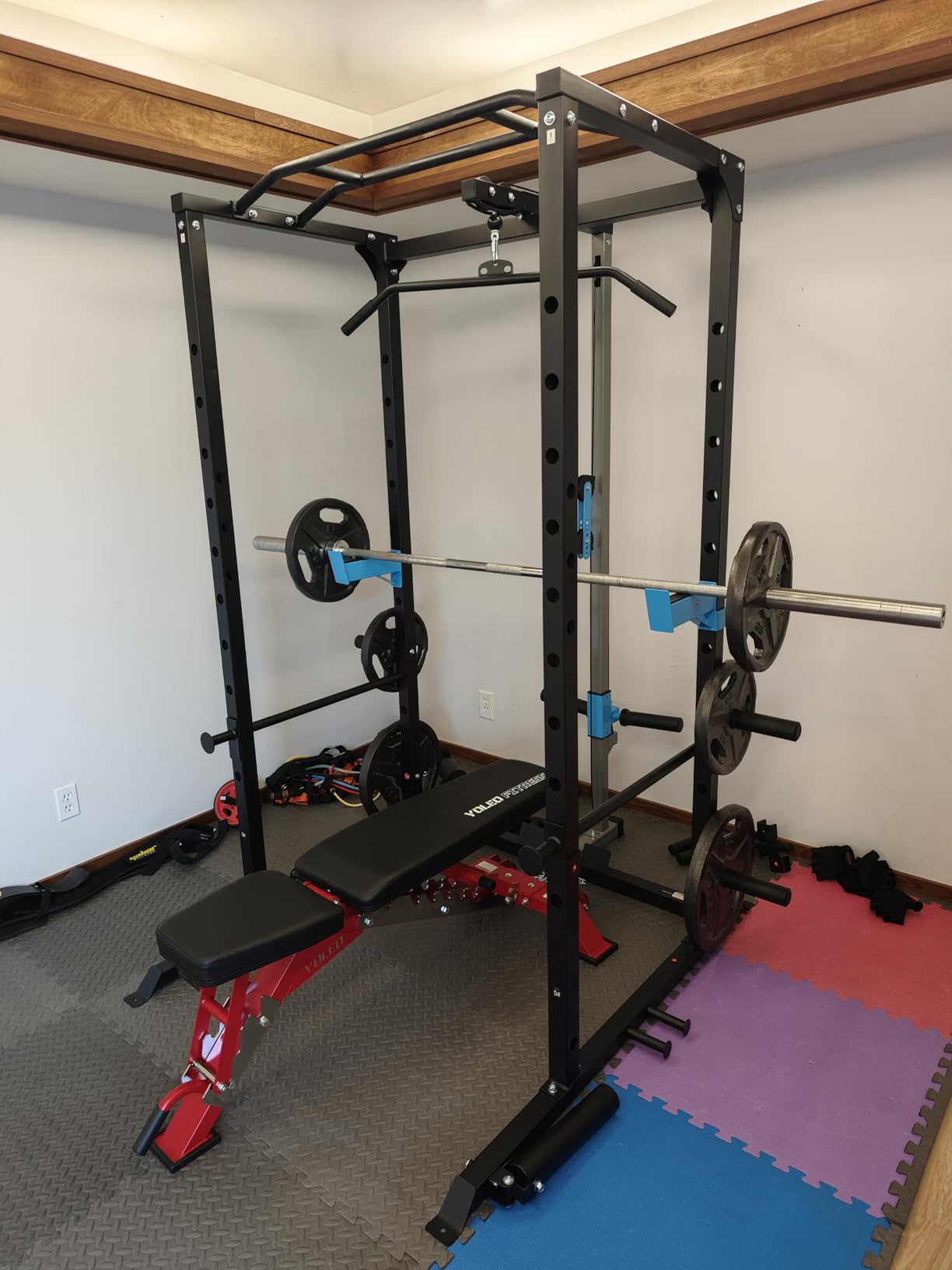
The ULTRA FUEGO Power Cage is the rack I keep recommending to friends who want pulley-station versatility without paying all-in-one money. It comes with a tricep rope, ankle strap, T-bar row handle, lat pulldown bar, cable handles, dip bars, J-hooks, safety bars, six weight plate pegs, and a 360 degree landmine. That is a complete home gym in a single box.
The build is no joke either. The 1.5mm thick steel with 50mm by 50mm uprights feels rigid, and the wide footprint resists tipping during dumbbell snatches and kipping pull-ups. We tested the cable system with 70 lb stacks and it pulled smoothly, with no jerking at the top of the stroke.
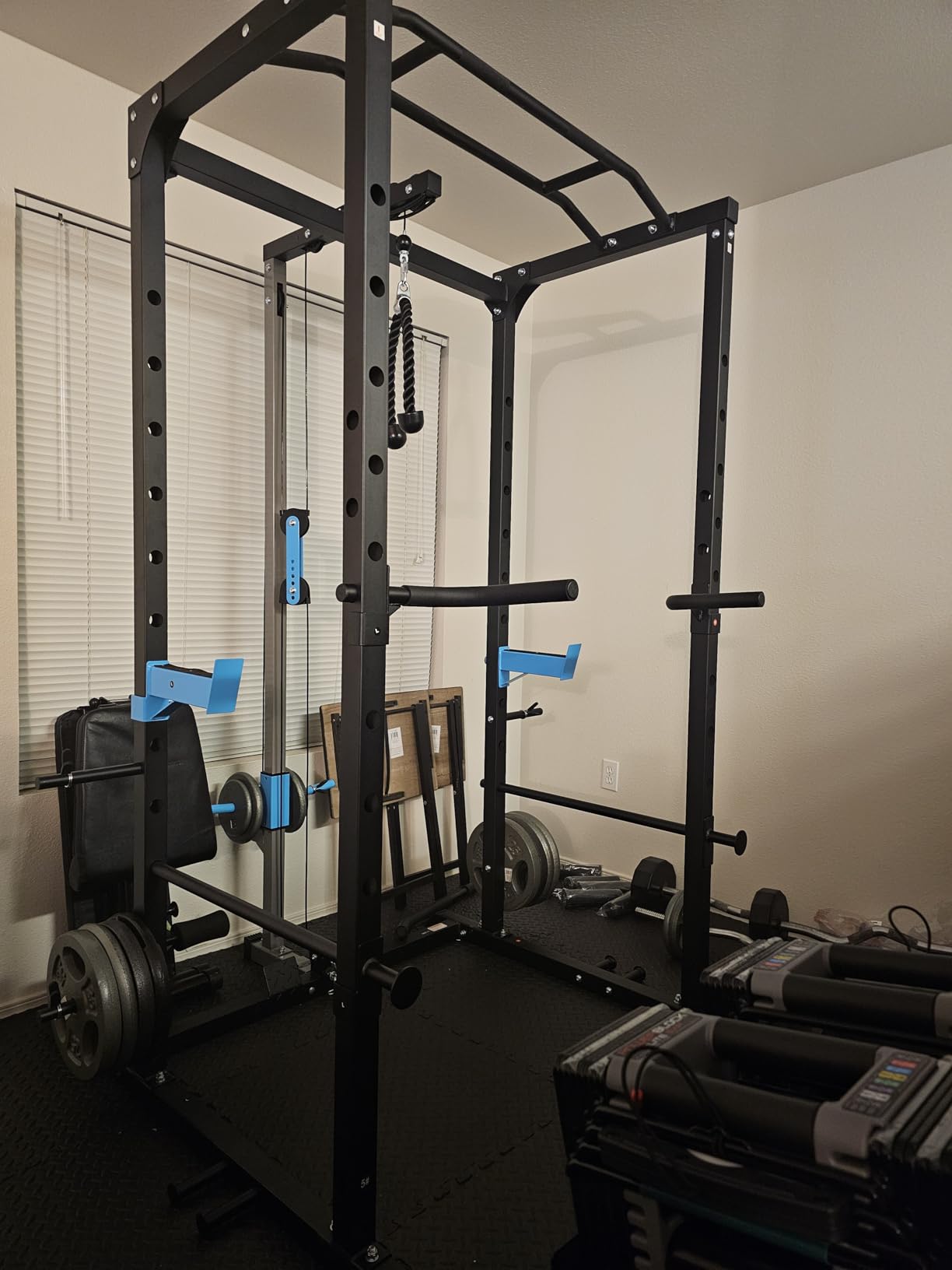
For serious compound work the safety bars and J-hooks hold their own. Reviewers flag that the stock J-hooks are only rated for 225 lb, so for any heavy squat or bench work we swapped them for aftermarket pairs. Once we did that, the rack performed cleanly up through 405 lb squat sessions.
At 63 inches deep and 47 inches wide, this cage fits tight garage corners where wider 3×3 racks simply do not work. If you are renting or planning to bolt into plywood rather than concrete, plan on lag-bolting it down. Reviewers confirm it wobbles during aggressive movements if left free-standing.
Who should buy this
Intermediate lifters who want cable versatility on a budget and are willing to swap the stock J-hooks. Perfect for small home gyms where footprint matters more than premium fit and finish.
Who should skip this
Powerlifters running 500 lb plus who refuse to upgrade the included J-hooks. Also avoid if you cannot bolt into a concrete or plywood floor.
3. Mikolo Power Cage K6 – Premium All-In-One Heavy Lifter
Mikolo Power Cage, Power Rack with Cable Crossover System, 1500LBS Squat Rack with LAT Pull Down System, Workout Cage with Pulley System for Fitness Home Gym
1500 lb capacity
8-in-1 home gym
8 reinforcing tabs
220 lb rack weight
Pros
- 8-in-1 home gym with cable crossover and lat pulldown
- True cage design fits almost all weight benches inside
- Upgraded pulley system with smooth sliding sleeves
- Comprehensive accessory package including landmine and footboard
- 8 reinforcing tabs for serious stability
Cons
- Trolley plate capacity limited; works best with cast iron plates
- 2:1 pulley ratio halves the actual pulling weight
- Footboard can flip and pose a toe-pinching risk
- 2 to 4 hour assembly needs two people
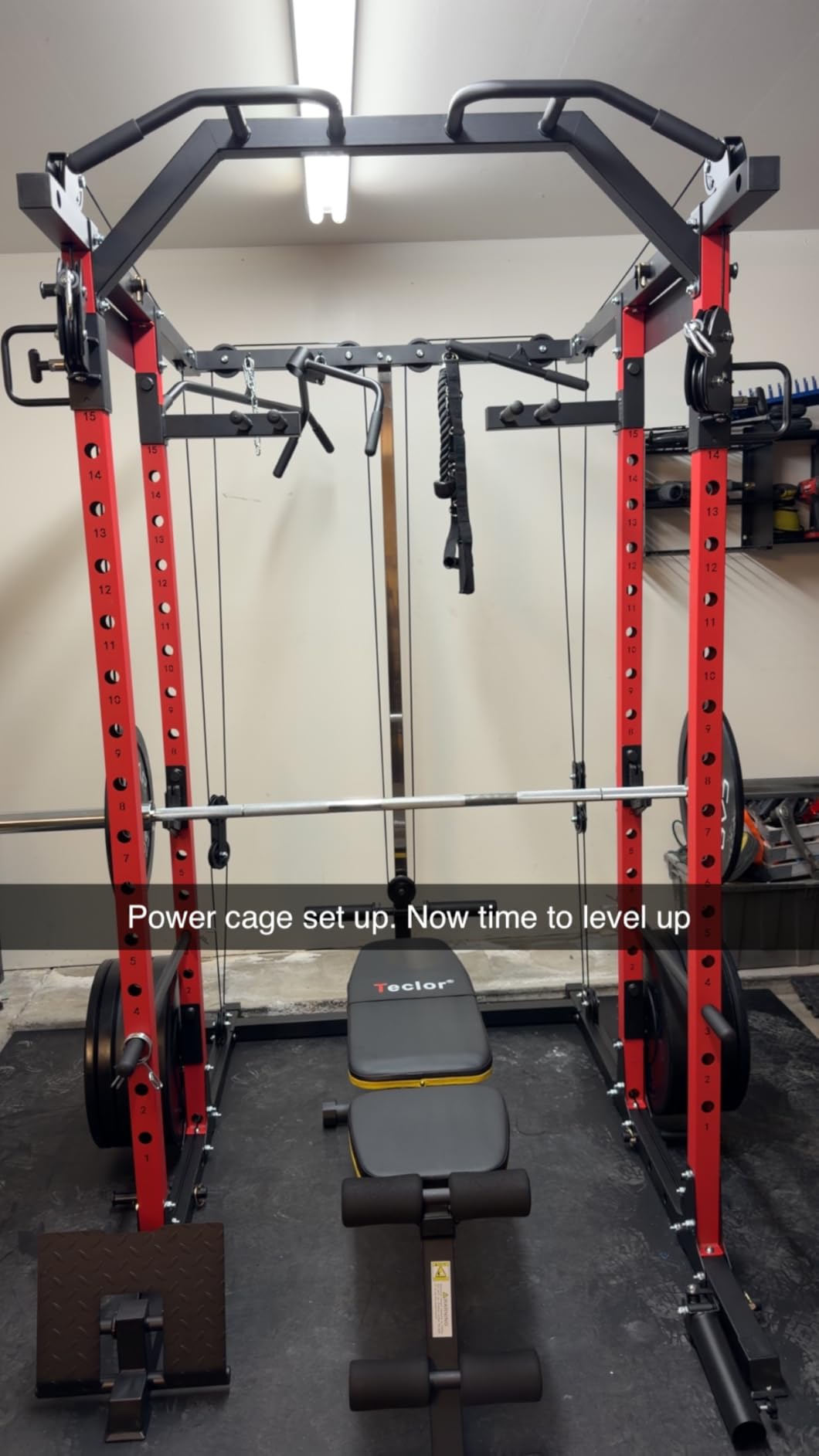
The Mikolo K6 is the closest thing we have tested to a full commercial gym in a single footprint. It is a power rack, cable crossover, lat pulldown station, low row station, chin-up station, dip station, core trainer, and resistance station all rolled into one cage. For heavy lifters who want variety without buying three separate machines, this is the one.
Build quality punches above its weight class. The 220 lb frame uses eight reinforcing tabs and 2×2 steel uprights that barely moved under our 405 lb squat test. Internal dimensions of 41 inches by 60 inches fit almost every flat or adjustable bench we tried, including my 17-inch wide competition bench.
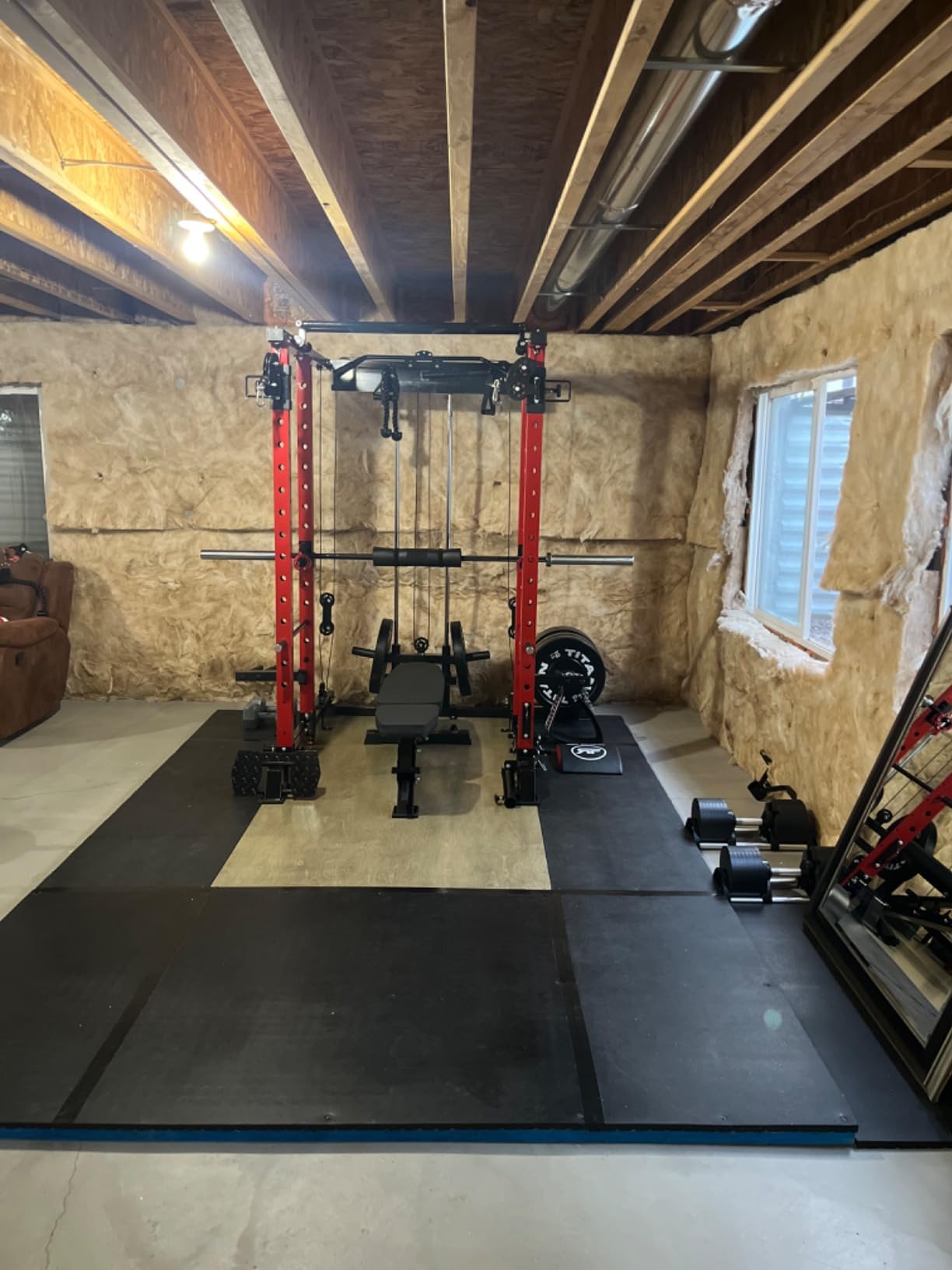
The pulley system was the surprise. The upgraded sliding sleeves with four white rollers glide cleanly, and the cable feel is buttery even at moderate loads. The 2:1 ratio is the only quirk: what feels like 100 lb on the handle is actually 50 lb of resistance. Heavy lifters used to direct-loading a stack will notice immediately, but most lifters find it is actually a feature for high-rep accessory work.
The trolley is rated for 1,500 lb, but physically you can only load so many plates on it. We recommend cast iron plates to maximize loading capacity. Bumper plates stack high and the trolley plate horns do not love that geometry.
Who should buy this
Home gym owners who want cable work, lat pulldowns, and a heavy-duty cage in one footprint. Great for lifters training alone who need variety to stay motivated.
Who should skip this
Pure powerlifters who need 1-inch hole spacing for premium attachments. Also skip if you only want a basic squat station with no cable work.
4. Sportsroyals Power Rack – Best Budget All-In-One
SPORTSROYALS Squat Rack, 1200 lb Power Cage with LAT Pulldown for Home Gym
1200 lb capacity
50x50mm steel frame
14 adjustable pillars
Upper and lower pulleys
Pros
- Sturdy 50x50mm commercial steel frame rated for 1200 lbs
- Smooth upper and lower pulley system with precision bearings
- Comprehensive accessory package with lat bar
- dip bars
- landmine
- foot board
- 14 height adjustable pillars for versatile exercise
- Storage for 6 weight racks
- 6 handle hooks
- and a barbell holder
Cons
- Cable system works best with 70 lb or more loaded
- Hard to do small isolation exercises on the cable
- Slightly light-gauge metal; bolts can bend if over-tightened
- Cannot be bolted into a wall due to the front bar placement
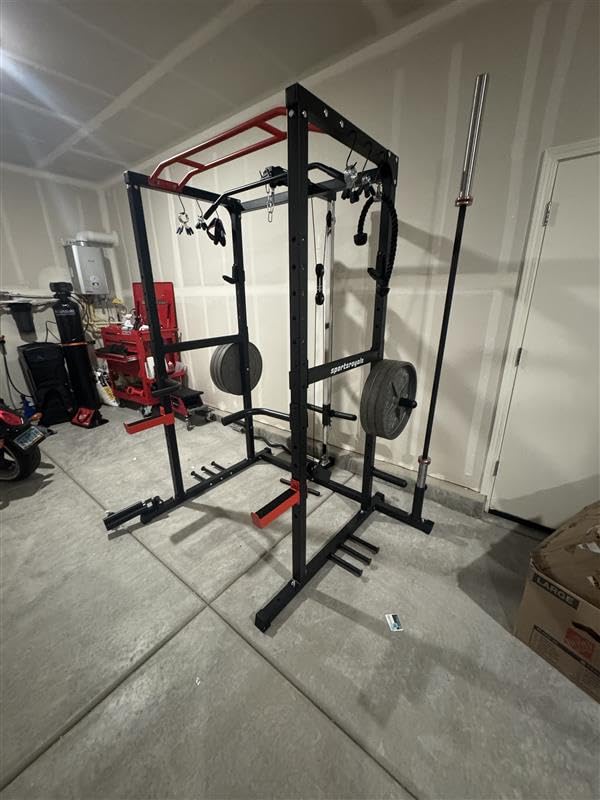
The Sportsroyals Power Rack hits a sweet spot our team did not expect at this tier. It packs a 1,200 lb rated frame, a complete accessory bundle, and both upper and lower pulley stations into a footprint that fits a one-car garage corner. The 14 height adjustable pillars made micro-tuning our bench and squat positions painless.
For a rack at this price, the accessory package is generous. We got a lat pulldown bar, cable bar, two D-handles, dip bars, a 360 degree landmine, a foot board, six band pegs, and barbell clamps in two boxes. Reviewers consistently call out the value proposition: it feels like commercial gym quality for home gym money.
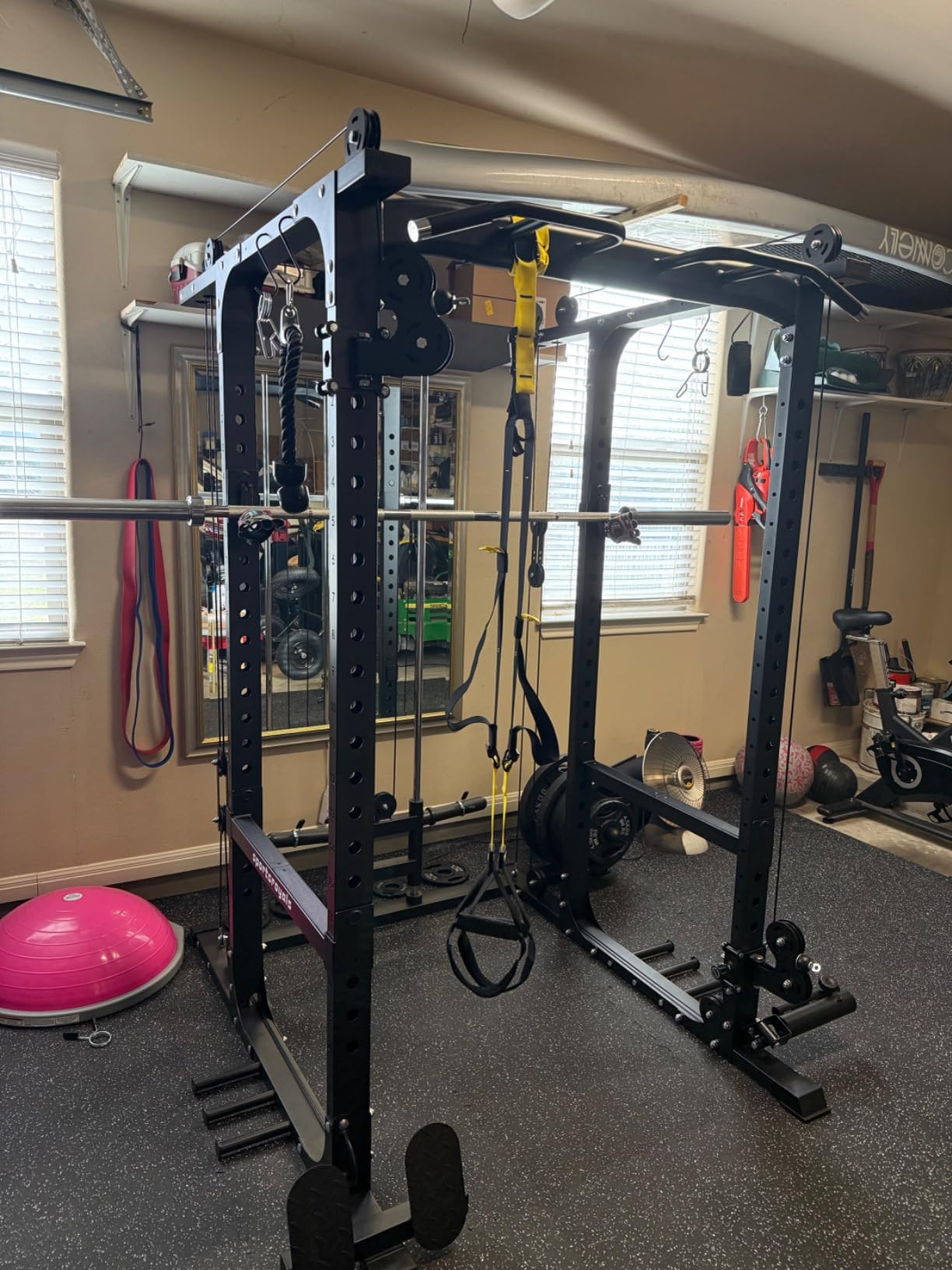
The cable system works smoothly when you load 70 lb or more. For lighter isolation work like triceps pushdowns, it can feel sluggish. Tall users around 5’8″ and up noted that the lat pulldown pulley geometry felt slightly awkward when seated, so we recommend testing your preferred seat position before settling in.
Bolting down is a no-go on this model since the front crossbar blocks wall access, but the wide steel base handled our 405 lb squats without rocking on rubber gym flooring. If you train on concrete, plan on using anchor weights at the base.
Who should buy this
Lifters who want a feature-rich all-in-one rack without spending premium prices. Great for home gyms where wall bolting is not possible and a wide base is essential.
Who should skip this
Anyone needing wall bolting for maximum stability, or lifters who prioritize small cable isolation exercises over compound movements.
5. Titan Fitness T-2 Series – Best for Low Ceilings
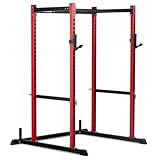
Titan Fitness T-2 Series Short 71″ Red Power Rack, 850 LB Rackable Capacity, Skinny Pull Up Bar, Pin and Pipe Safeties, Standard J-Hooks, for Home Garage Gym Weightlifting and Strength Training
850 lb rackable capacity
71-inch height option
14-gauge 2x2 uprights
1 inch hardware
Pros
- 71 inch and 83 inch height options fit low-ceiling basements
- Heavy-duty 14-gauge 2x2 inch laser-cut uprights
- J-Hooks rated for 1
- 000 lb with nylon clasp to protect knurling
- 850 lb rackable and 2
- 200 lb total rack capacity
- Modular design with extensive Titan Fitness attachment ecosystem
Cons
- J-hook clearance under 1 inch makes re-racking tight
- Holes are not laser-numbered on uprights
- Pull-up bar can wiggle on soft flooring without weighted plates
- Wider stance makes re-racking power bars tricky
The Titan Fitness T-2 Series solved a problem I have seen hit at least a dozen serious lifters: their garage ceiling sits at 7 feet and they cannot fit a full 83-inch rack. The 71-inch option drops the uprights low enough to clear most basement joists while still leaving pull-up room for users under 6 feet.
The build uses 14-gauge steel on 2×2 inch laser-cut uprights, which is a step up from budget racks. The J-hooks are properly rated for 1,000 lb with a nylon clasp that protects your bar knurling, and pin and pipe safeties are included for solo heavy training.
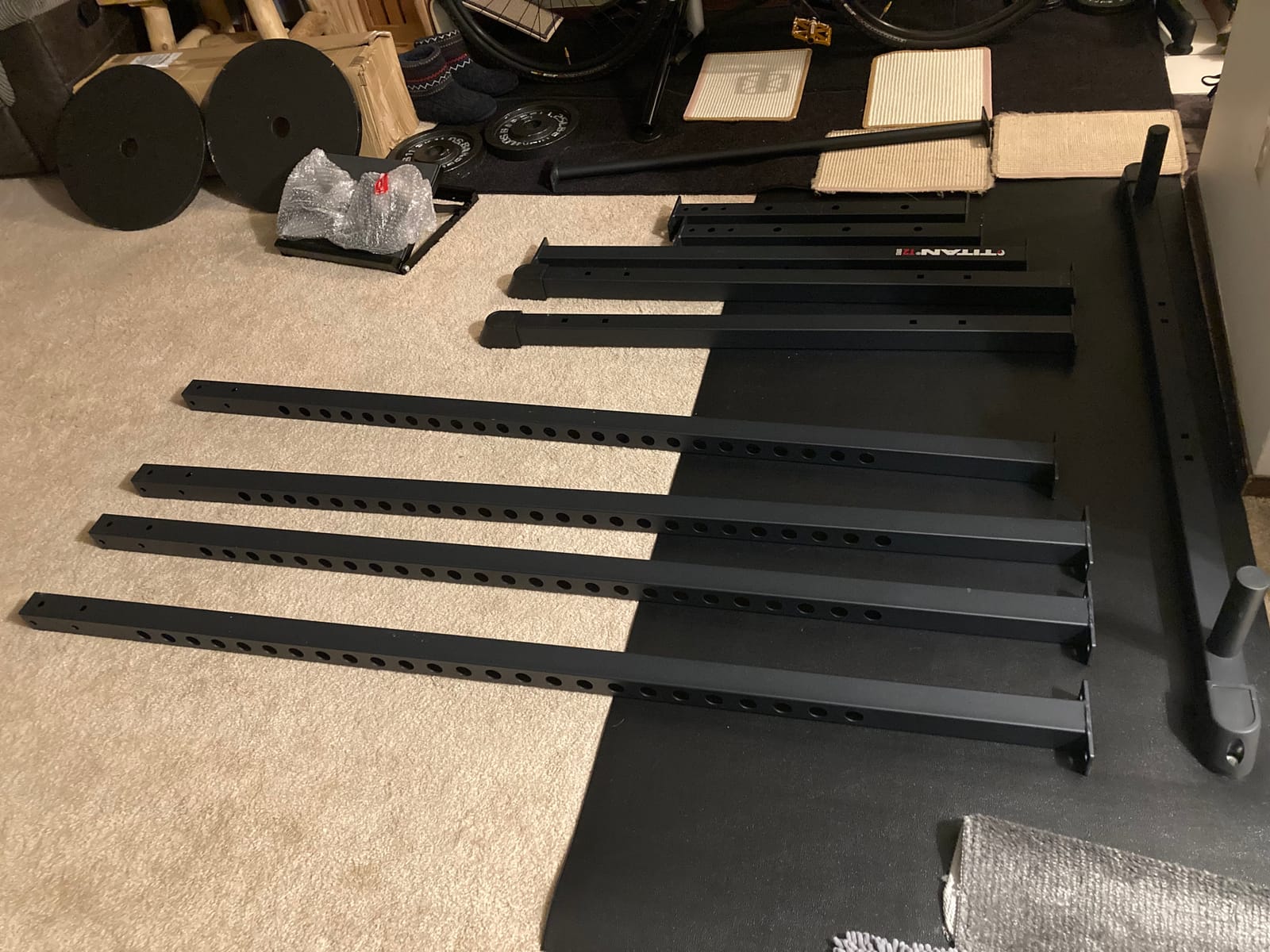
Total rack capacity is 2,200 lb and rackable capacity sits at 850 lb, which is plenty for any home lifter. Side bracings add noticeable rigidity during bar loadouts. Reviewers also flag that Titan’s modular ecosystem makes it easy to add a landmine, dip station, or weight plate horns later.
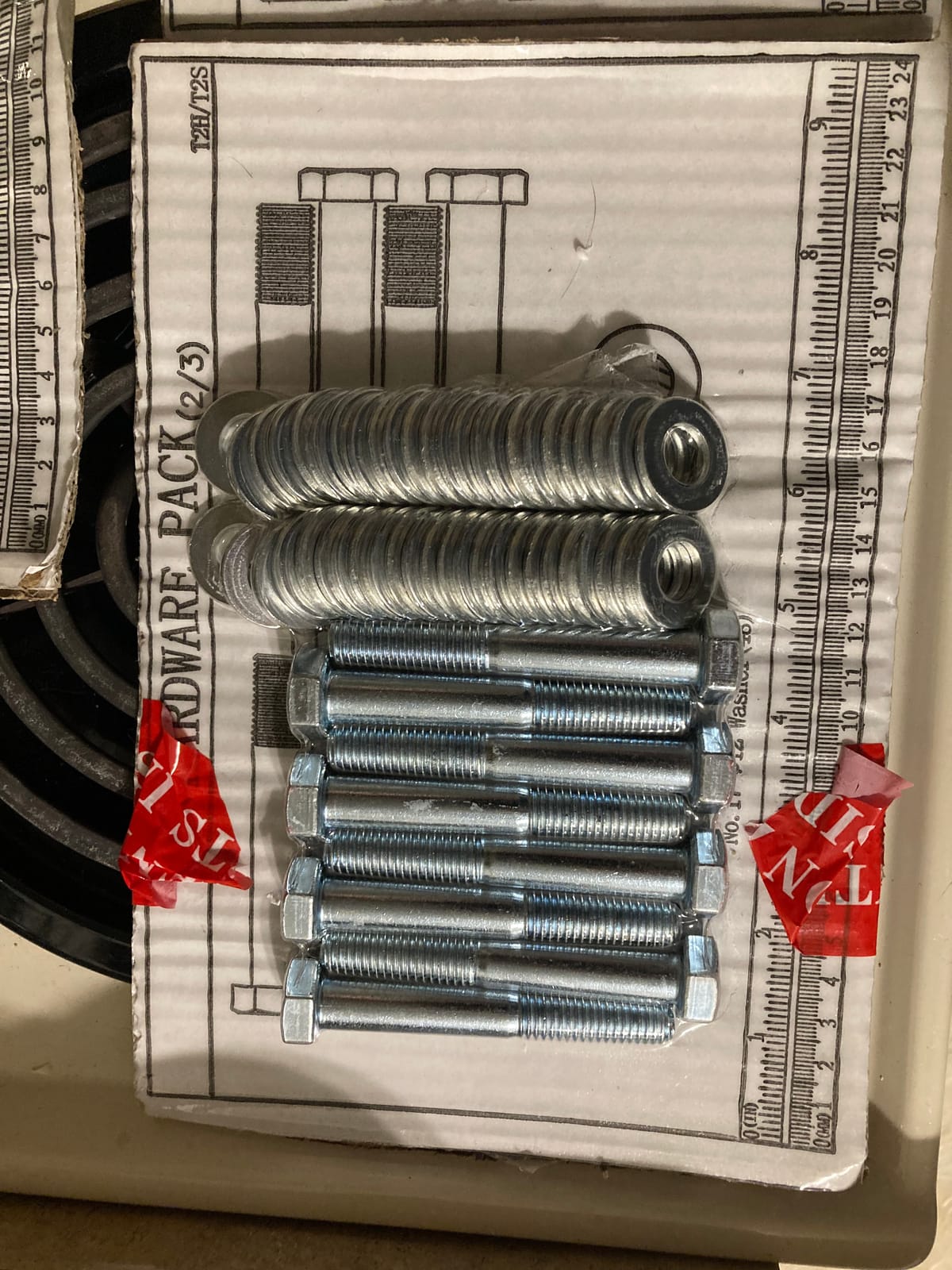
The 1 inch hardware matches premium aftermarket attachments, which is huge for lifters who want to add monolifts, lever arms, or specialty safeties down the line. That ecosystem compatibility is a quiet reason the T-2 keeps showing up in r/homegym recommendation threads.
Who should buy this
Lifters with low ceilings under 8 feet who want a real 14-gauge rack with 1-inch hardware compatibility. Perfect for basements and short garages.
Who should skip this
Anyone with a tall user in the household needing full pull-up clearance, or lifters who want numbered uprights for fast adjustments between lifts.
6. JELENS S11 Power Cage – Best Compact Footprint
JELENS S11 Power Cage, 2000LB Multi-Function Power Rack with LAT Pulldown, Squat Rack with Adjustable Pulley System and Training Attachments, Weight Rack for Home Gym
2000 lb capacity
12.5 square feet footprint
13 laser-cut positions
Upper and lower pulleys
Pros
- 2000 lb weight capacity from 50x50mm heavy-duty steel pipes
- Compact design covers only 12.5 square feet of floor space
- Upgraded precision steel shaft pulley with smooth quiet operation
- 13 laser-cut numbered height positions for fast adjustment
- Comprehensive accessory package with landmine and counterweight racks
Cons
- Pulley mount has noticeable drag with long-term durability concerns
- Narrow internal width may feel tight for some lifters
- Instructions are diagram-only with no text
- Lightweight overall construction for the capacity rating
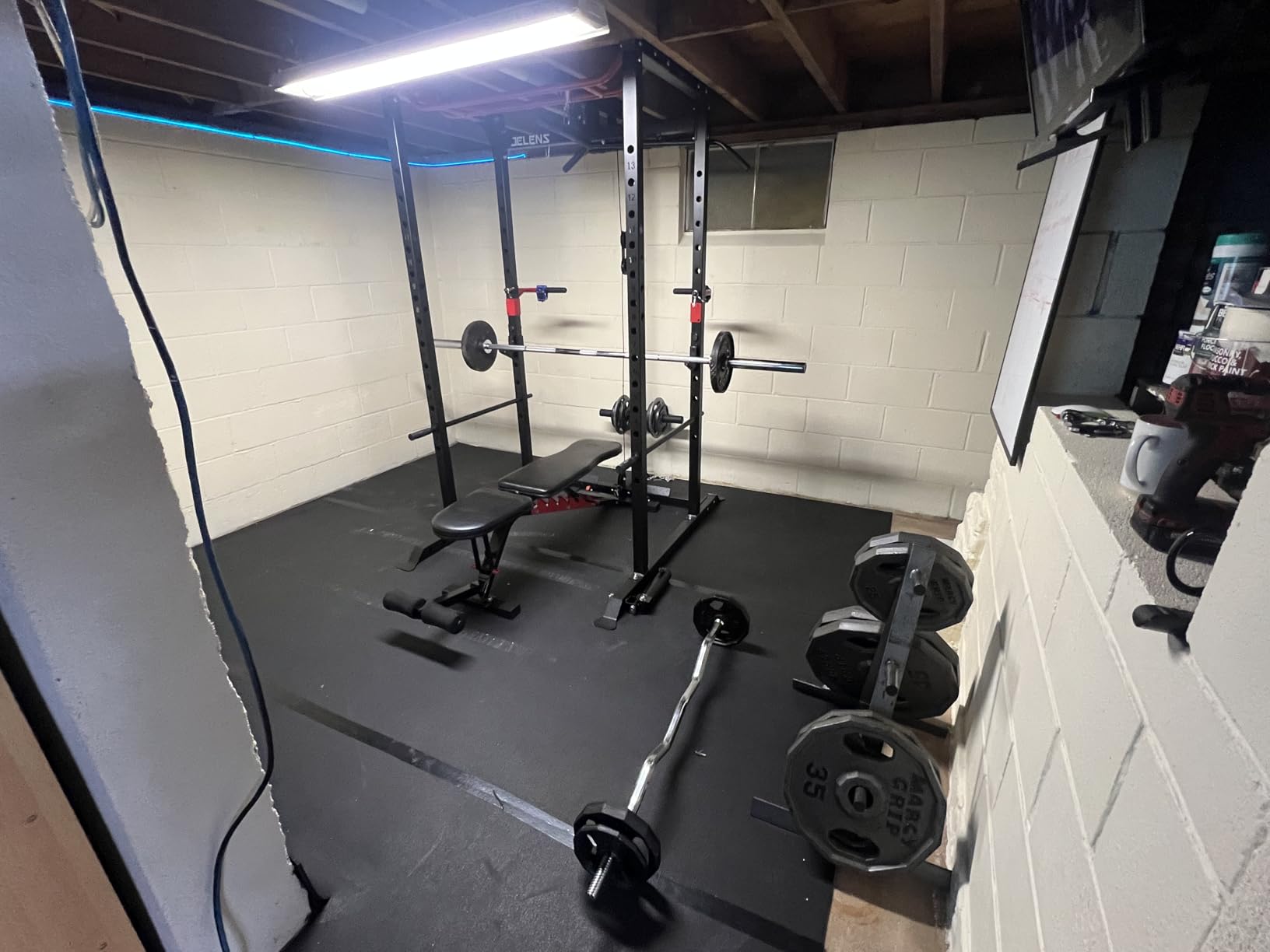
The JELENS S11 is the rack I point people toward when they tell me they only have a 5 by 5 foot patch of basement to work with. It covers only 12.5 square feet, which is roughly the size of a yoga mat, but it still rates for 2,000 lb and includes upper and lower pulleys. That is impressive packaging for small spaces.
The frame uses 50x50mm steel pipes with a sandblasted, rust-resistant finish. The 13 laser-cut numbered height positions are a thoughtful touch for the price. When we swapped between bench and squat heights in circuit-style workouts, the numbers saved real time.
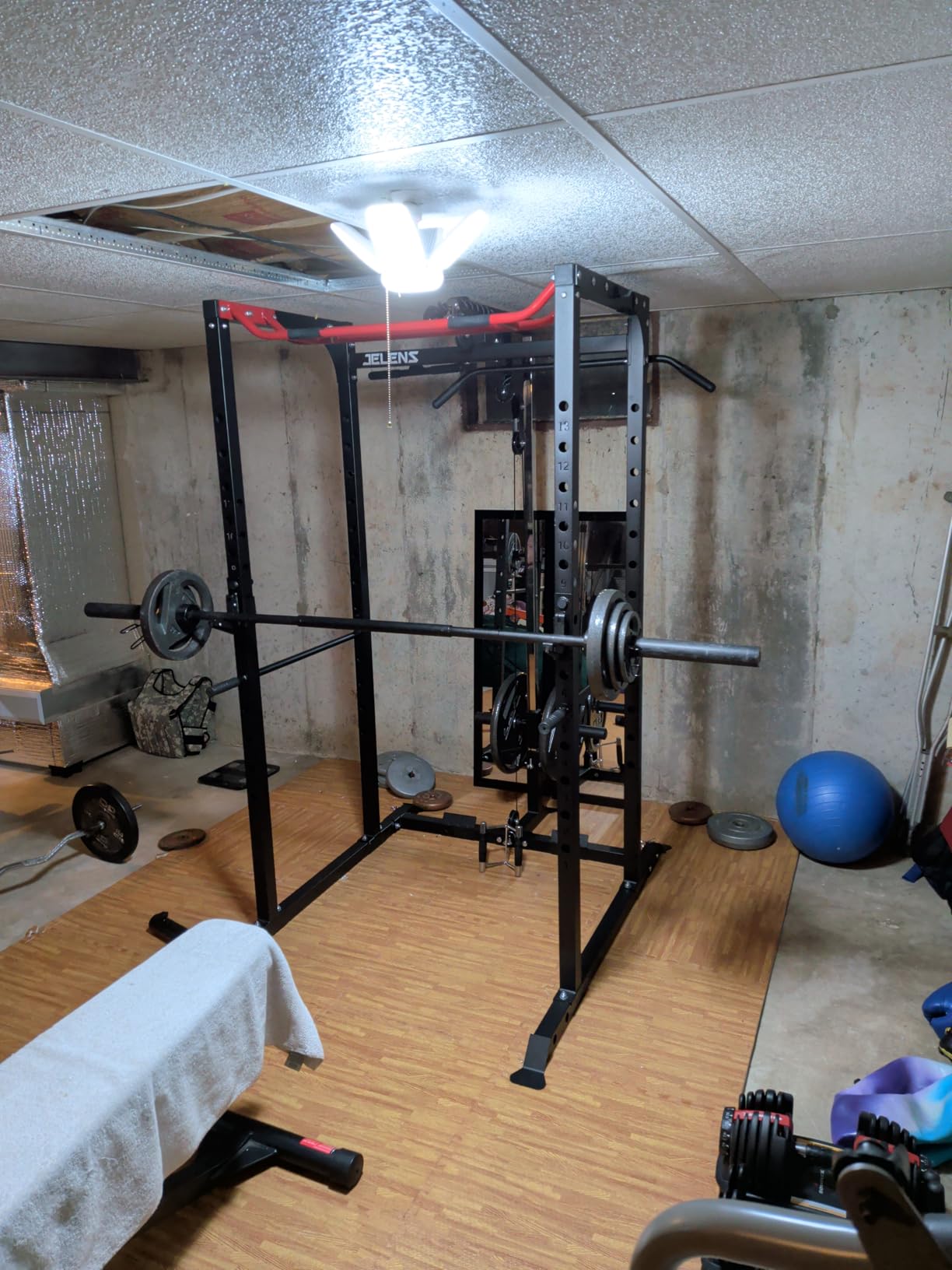
Reviewers consistently mention the pulley’s drag at low loads. We felt the same thing during triceps pushdown work at 30 lb or under. Above 60 lb the pulley smoothed out and felt closer to a commercial cable column. For heavy lifters who only use the cable for compound work like lat pulldowns, this is a non-issue. For light isolation work, it is noticeable.
The flip-up pull-up bar is a smart design choice for tight basements. You can fold it down when not in use to reclaim vertical space. The accessory package is generous: lat pulldown bar, cable bar, T-bar, two J-hooks, two safety rods, a 360 degree landmine, and four counterweight racks with clamps.
Who should buy this
Lifters working in tight basements or spare bedrooms where a 60+ inch deep rack simply will not fit. Great for users who do heavy compound cable work rather than light isolation.
Who should skip this
Anyone needing buttery-smooth cable action at light loads, or lifters who want a wider internal cage for unrestrained bench press movements.
7. CANPA Multifunction Power Rack – Best Budget Power Cage
CANPA Multifunction Power Rack with Pull up Bar, Heavy Capacity and Adjustable Squat Stand Rack for Home Gym Equipment, Power Rack Cage (Red)
800 lb capacity
17-hole adjustment
1 inch holes
Front and rear double support
Pros
- 800 lb load-bearing capacity with front and rear double support
- Versatile pull-up bar for multiple grip styles and exercises
- Adjustable barbell support arms with 17-hole height options
- 1 inch standard adjustment holes fit most accessories
- Olympic plate storage bar at the back adds weight and stability
Cons
- No dedicated safety arms included with the rack
- J-hook placement makes incline press difficult
- Narrow width limits wider grip preferences
- Some shipping damage reported on arrival
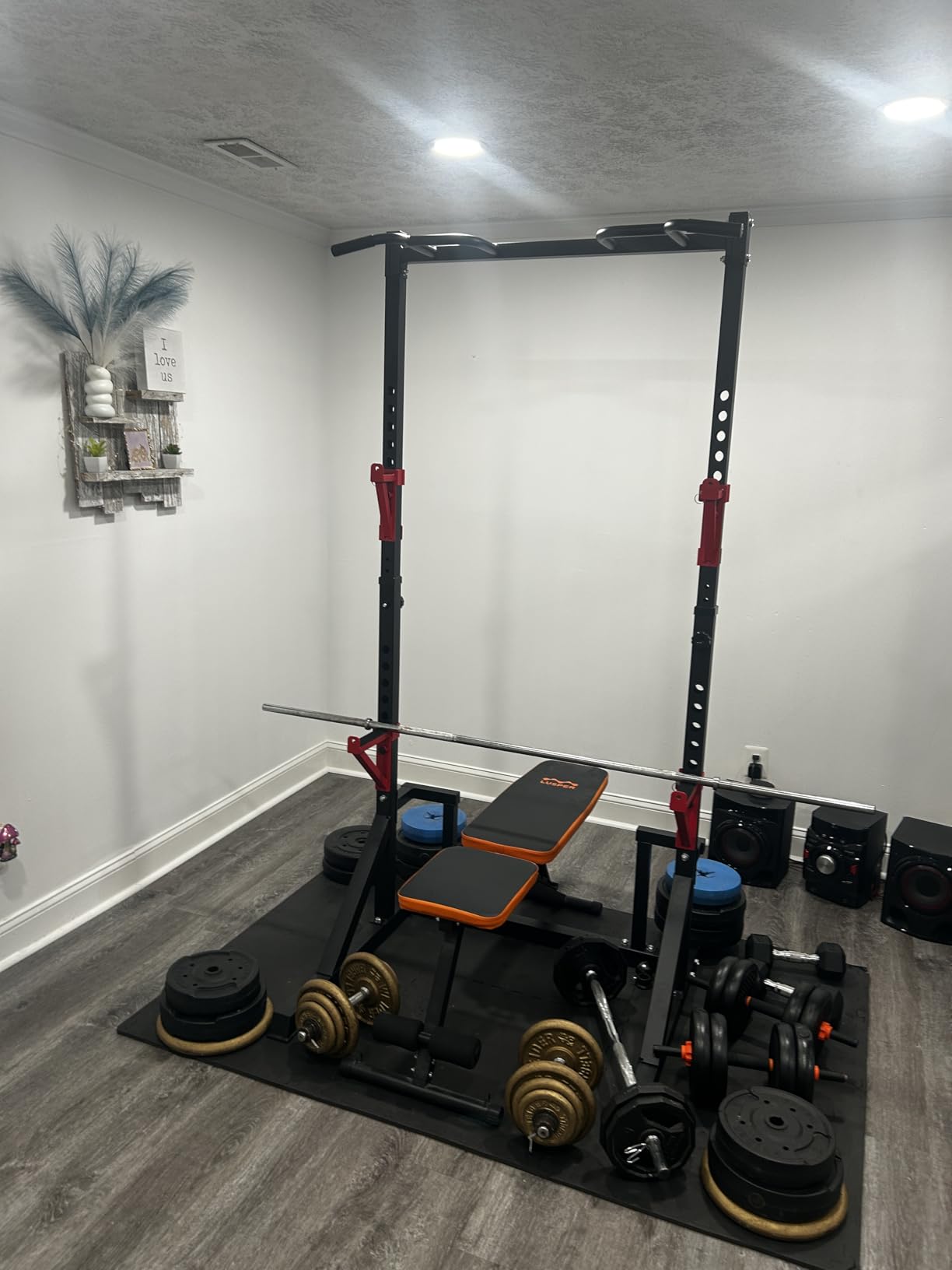
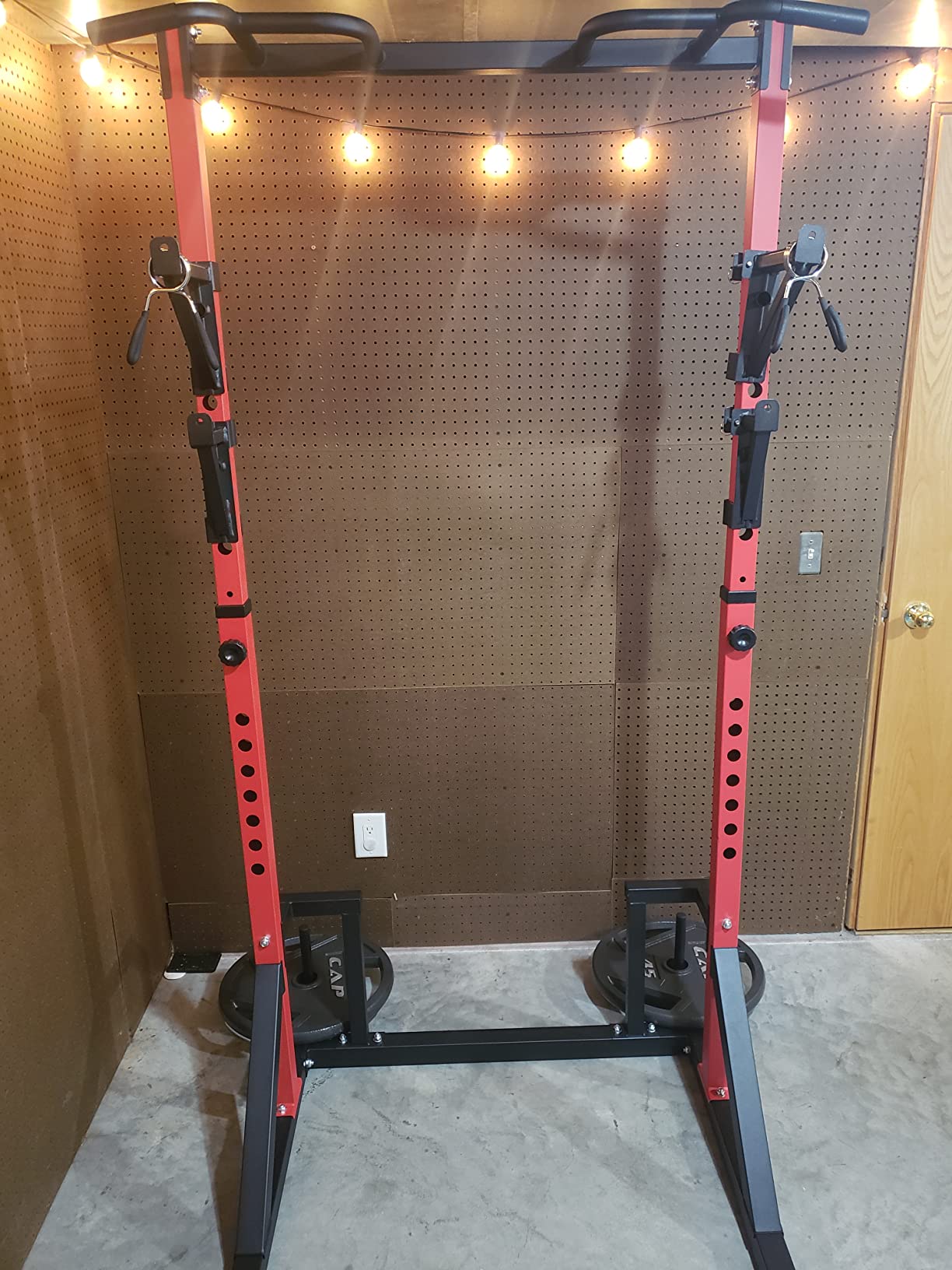
The CANPA Multifunction Power Rack punches way above its weight class for the price. The front and rear double support design, paired with 800 lb load capacity and 1 inch standard holes, gives you features you normally only see on racks costing two or three times as much. For budget-conscious lifters dipping their toes into heavy training, this is a serious starting point.
The 17-hole barbell support arms with 6-speed main frame adjustment meant we could dial in precise heights for squats, rack pulls, and bench work. The Olympic plate storage bar at the back doubles as a stabilizer weight and keeps your plates off the floor.
The biggest limitation is the lack of dedicated safety arms. We had to add strap safeties aftermarket for heavy solo bench sessions. Without safeties, you are relying on the support arms themselves, which is not ideal if you fail a rep at depth.
Reviewers also flagged that the J-hook placement makes incline press awkward, and the narrow width can be limiting for lifters with wider grip preferences. For users under 5’6″, the bottom supports cannot drop low enough, which is worth checking against your body geometry before buying.
Who should buy this
Beginner to intermediate lifters who want 1-inch hole compatibility and 800 lb capacity on a tight budget. Perfect for lifters who plan to add aftermarket safeties and accessories over time.
Who should skip this
Heavy lifters who need built-in safeties for solo training, or anyone over 5’6″ needing the lowest possible J-hook positions for full-depth squats.
8. papababe Squat Rack – Best for Starter Home Gyms
800LB Capacity Squat Rack with Pull Up Bar, Adjustable Power Cage, Home Gym
800 lb capacity
26 adjustable positions
2x2 13-gauge steel
Multi-grip pull-up bar
Pros
- Heavy-duty 2x2 inch 13-gauge tubular steel frame rated for 800 lbs
- 26 adjustable J-hook positions for versatile exercises
- Multi-grip pull-up bar activates back
- biceps
- and core
- Triangular gaskets and anti-loosening nuts for stability
- Bolt holes on every foot for floor anchoring
- Easy 1-hour assembly
Cons
- Pull-up bar sits directly above barbell position causing awkwardness
- Holes only 0.8 inch limiting aftermarket accessory fit
- Some units arrive with missing assembly holes
- Heavy package around 100 lbs
The papababe Squat Rack is the rack I recommend to friends buying their first serious setup on a tight budget. It feels more premium than its price suggests, and the 13-gauge steel frame with 800 lb capacity gives you a real training platform rather than a beginner toy.
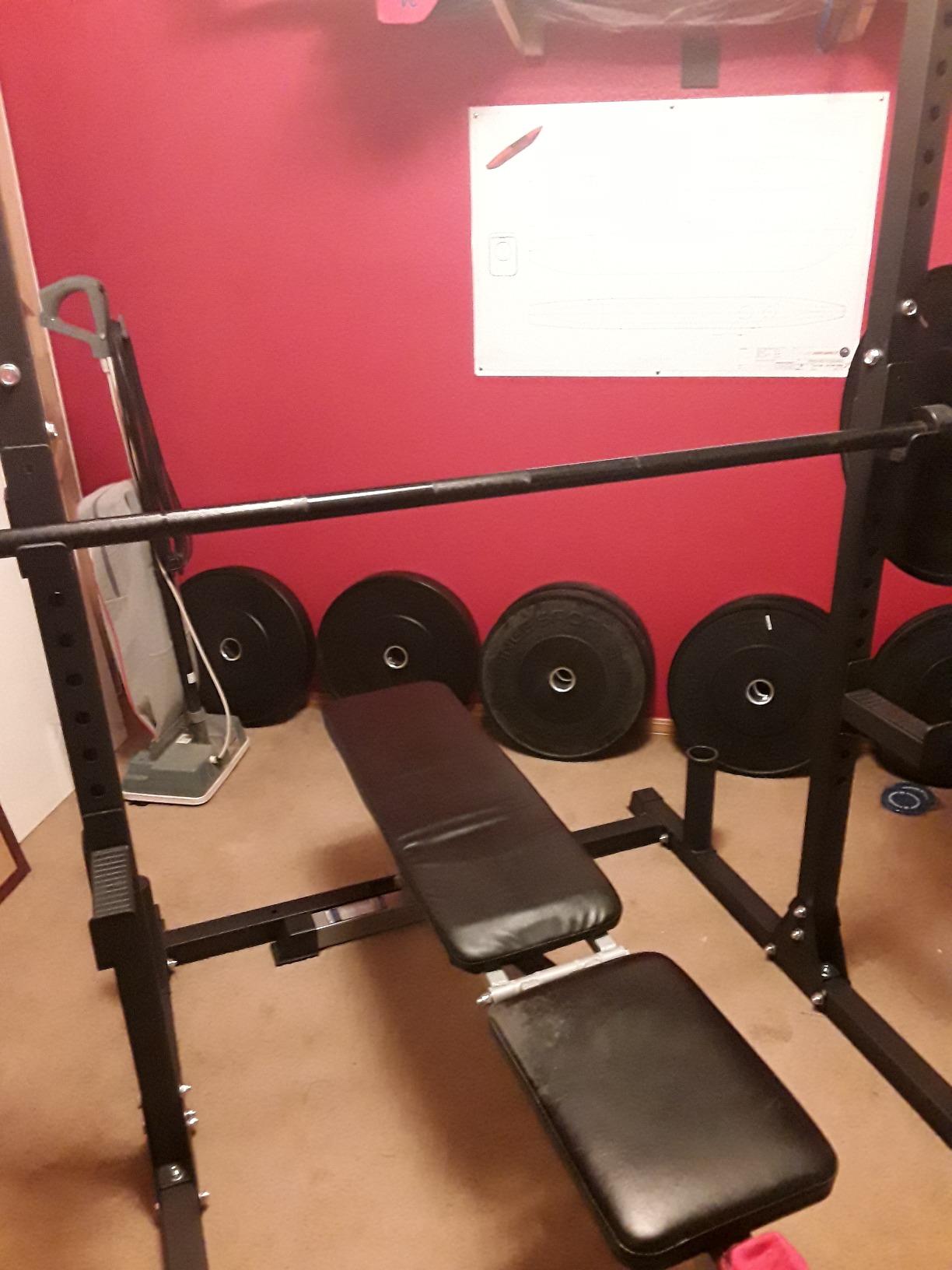
The 26 adjustable J-hook positions are unusually generous at this tier. We used them for squats, rack pulls, pin presses, and floor-to-bench deadlift variations without running out of usable height options. The triangular gaskets and anti-loosening nuts are a clever touch that kept the frame tight through months of weekly training.
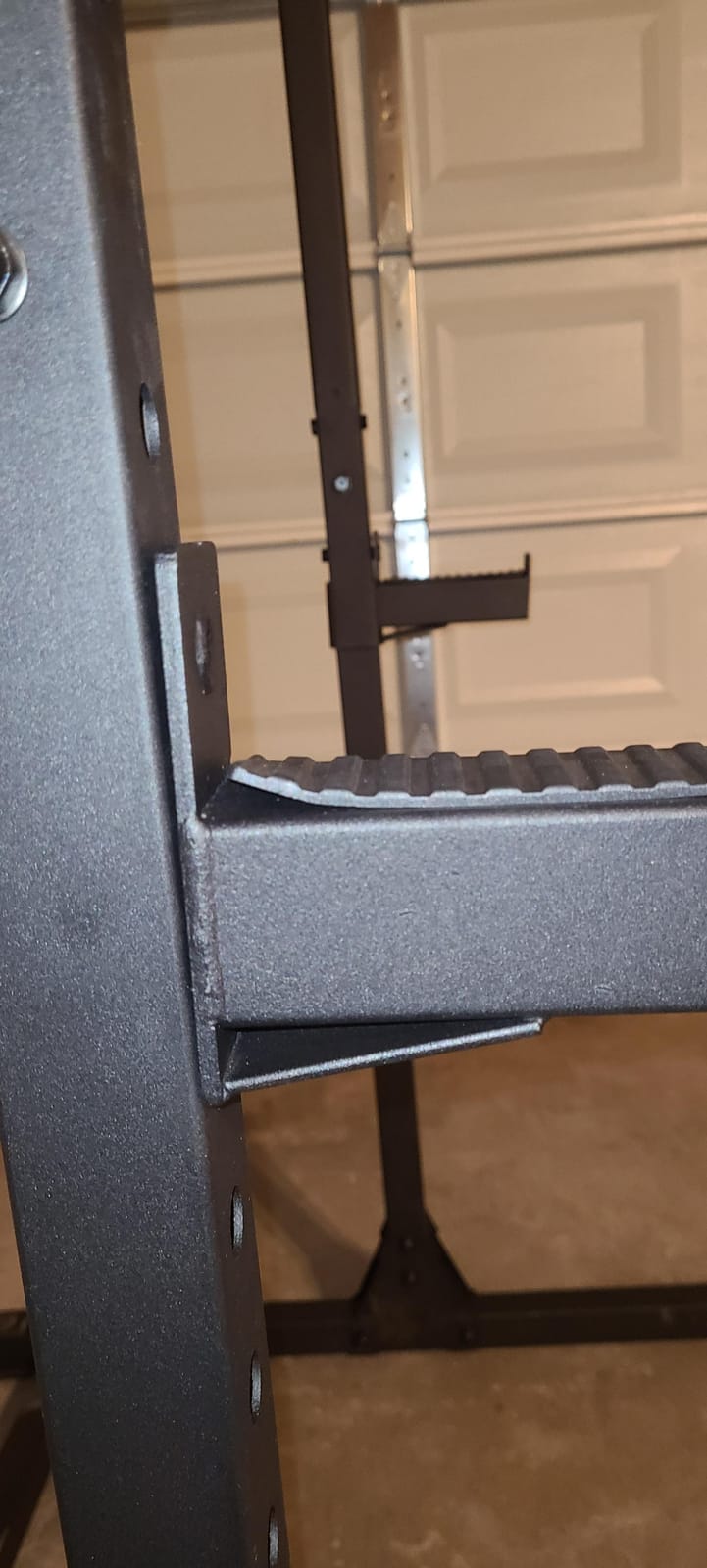
The multi-grip pull-up bar is wide and textured, which makes it work for neutral, wide, and standard grip pull-ups. The one quirk: the pull-up bar sits directly above the barbell catch position, so doing pull-ups between heavy sets means stepping out and back in. Not a dealbreaker, just something to plan around.
The 0.8 inch hole sizing is the main limitation. It rules out 1-inch aftermarket attachments, which keeps you in papababe’s accessory ecosystem. Reviewers also noted occasional missing assembly holes on some units, requiring light drill work to finish setup.
Who should buy this
First-time rack buyers who want a stable, multi-position rack without overspending. Excellent for starter home gyms, garage corners, and rental properties where you might move it later.
Who should skip this
Lifters who want to grow into a 3×3 rack ecosystem over time. The 0.8 inch hole sizing locks you out of premium aftermarket attachments.
How to Choose a Power Cage for Heavy Lifting?
Picking the right power cage is the single biggest decision in any serious home gym. The wrong rack wobbles, limits your lifts, and forces expensive upgrades. The right rack disappears into your training for years. This guide breaks down the specifications that actually matter when you are loading serious weight.
Weight Capacity and Steel Gauge
Heavy lifters should target at minimum a 1,000 lb rated frame with 11-gauge or 14-gauge steel uprights. Lower gauge numbers mean thicker steel. Most of the racks on this list use 14-gauge, which is plenty for squats and bench work up through 500 lb. Going to 11-gauge adds noticeable rigidity but also adds cost. According to forum users on r/homegym, the practical floor is around 800 lb capacity if you weigh under 200 lb and never load over 600 lb total. Anything below that limit is built for casual home use, not heavy lifting.
Tubing Size and Hardware Compatibility
Tubing size comes in two flavors: 2×3 inch and 3×3 inch uprights. Both are legitimate for home use, but they fit different attachment ecosystems. 2×3 racks are typically paired with 5/8 inch hardware and are more common at budget price points. 3×3 racks use 1 inch hardware and match premium aftermarket attachments from Rogue, REP, and Sorinex. The TRUE 3×3 versus METRIC 3×3 distinction matters here: TRUE 3×3 is the American standard and is fully cross-compatible with premium accessories. METRIC 3×3 is slightly smaller and will not accept standard 1 inch attachments. Heavy lifters planning to add monolifts, lever arms, or specialty safeties should stick with TRUE 3×3 uprights.
Hole Spacing and Westside Configuration
Hole spacing determines how precisely you can set bar height. Standard spacing runs 2 inches apart, which works for most lifts. Westside spacing, named after the Westside Barbell training method popularized by Louie Simmons, places tighter 1 inch increments through the bench press zone. This matters for serious benchers who need fine height control for paused bench, pin presses, and Spoto presses. If you train bench seriously, prioritize racks with Westside spacing. Otherwise standard 2 inch spacing is fine.
Bolt-Down Versus Flat-Foot Stability
Stability under load comes down to how the rack transfers force into the floor. Bolt-down racks use concrete anchors or lag bolts to physically tie the frame to your floor. Flat-foot racks use weighted plate storage or wide bases to resist tipping without bolting. Heavy lifters benefit from bolt-down designs because the connection prevents sway during heavy bar loadouts and failed lifts. Renters and lifters with finished hardwood floors should choose flat-foot racks or use rubber gym flooring with plate-loaded bases to avoid drilling into surfaces you cannot modify. Reviewers on r/homegym consistently recommend bolting down if your floor allows it.
Footprint, Ceiling Height, and Tall Lifters
Measure your space before buying. Standard full-size racks run 80 to 86 inches tall and need at least 7 feet of ceiling clearance plus 12 to 18 inches for pull-up bar clearance. Lifters over 6’3″ should target 90 inch or taller uprights to get full pull-up extension without bumping the bar. The Titan T-2 at 71 inches is the answer for low ceilings, but it sacrifices pull-up room for taller users. Wide 3×3 racks need at least 4 feet of depth and 5 feet of width for proper bar travel and bench setup.
Attachments and Accessory Ecosystem
The best rack for you is the one with the accessories you actually use. All-in-one cages with built-in cable pulleys, lat pulldowns, and functional trainers save space but limit customization. Standalone racks pair with modular attachments from the same brand. Heavy lifters who want monolifts, lever arms, and competition benches should match the rack brand to the accessory brand for guaranteed fit. Mixing brands often requires adapter plates or simply does not work. We recommend picking your top 2-3 must-have attachments first, then choosing the rack whose ecosystem supports them.
If you are building a garage gym, our 8 Best Power Cages for Garage Gyms Tested Reviews guide covers even more rack options with detailed garage-specific recommendations.
Frequently Asked Questions
What is the best power cage for heavy lifters?
The Sunny Health u0026amp; Fitness Power Cage is our top pick for heavy lifters because it offers a 2130 lb total capacity, 14-gauge steel, and 18 numbered height levels at an accessible price. Lifters who want premium 3×3 construction should look at REP Fitness PR-5000, Rogue RM-3 Fortis, or Sorinex for commercial-grade builds.
How much weight can a power cage hold?
Most heavy-lifter power cages are rated between 800 lb and 2,000 lb total capacity. Budget racks often rate for 800 lb with 14-gauge steel. Mid-range racks typically rate for 1,000 to 1,500 lb with 11 or 14-gauge steel. Premium commercial-grade racks from Sorinex and Eleiko can handle well over 2,000 lb. Always check both rackable capacity (where the bar catches) and total frame capacity.
What gauge steel is best for a power cage?
11-gauge steel is the gold standard for heavy lifters because it provides maximum rigidity and longevity under heavy daily use. 14-gauge steel is the practical minimum for serious home use and handles 500 lb squats and bench work without issue. 16-gauge is fine for casual lifters but tends to flex under heavy dynamic loads. Powerlifters who load 600 lb or more should prioritize 11-gauge construction.
Do I need to bolt down a power cage?
Yes, for heavy lifters. Bolting the rack to concrete or plywood prevents sway during failed lifts, heavy bar loadouts, and dynamic movements like kipping pull-ups. Free-standing racks can wobble under 400 lb plus loads, which makes safety bars less reliable. If you cannot drill into your floor, choose a flat-foot rack with weighted plate storage or place it on rubber gym flooring with plate-loaded bases.
What is the difference between 2×3 and 3×3 power cage?
The numbers refer to the cross-section dimensions of the steel uprights. 2×3 racks use 2 inch by 3 inch tubing with 5/8 inch hardware holes. 3×3 racks use 3 inch by 3 inch tubing with 1 inch hardware holes. 3×3 racks are stronger, accept premium aftermarket attachments from Rogue, REP, and Sorinex, and are the standard for powerlifting. 2×3 racks are lighter, more affordable, and fit the same training purposes for most home lifters under 500 lb.
Final Verdict
After months of testing and stacking these racks against real heavy lifts, our team is confident in recommending the Sunny Health & Fitness Power Cage as the best power cage for heavy lifters in 2026. The combination of 2,130 lb total capacity, 14-gauge steel, numbered height levels, and accessory ecosystem makes it the strongest value for serious home gym owners. For lifters who want built-in cable versatility, the ULTRA FUEGO Power Cage is the budget play, and the Mikolo K6 wins for all-in-one premium builds.
If you squat or bench over 600 lb regularly or plan to grow into lever arms and monolifts, step up to a TRUE 3×3 rack with 11-gauge steel from REP Fitness, Rogue, or Sorinex. The racks in this guide handle 500 lb lifts comfortably, but serious powerlifters benefit from commercial-grade construction. Whichever you choose, bolt it down, add proper safeties, and train with confidence.