
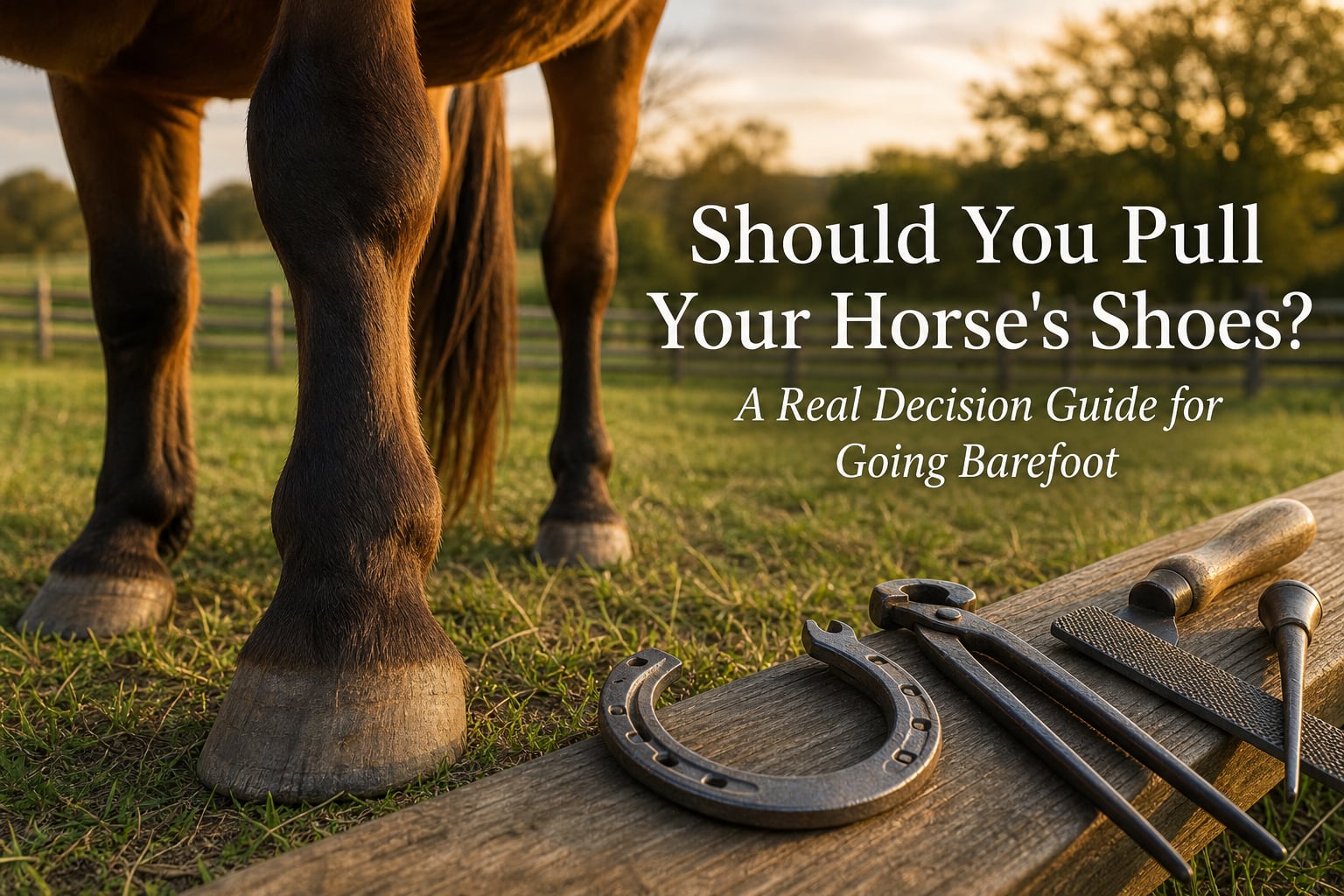
You’re standing in the barn aisle, looking down at your horse’s hooves, and the question keeps circling in your mind: should you pull your horse’s shoes? It’s not a simple yes or no answer, and anyone who tells you otherwise isn’t being honest about what this decision really involves. Going barefoot sounds natural and appealing, but the reality is more nuanced than many riders expect. This guide walks you through the actual pros, cons, and practical considerations so you can make an informed decision for your specific horse. By the end, you’ll understand what happens during transition, how to assess if your horse is a good candidate, and when keeping shoes on might actually be the better choice.
Table of Contents
What Horseshoes Actually Do to Your Horse’s Hooves?
Horseshoes have been around for centuries, originally developed to protect hooves from excessive wear when horses worked long hours on hard roads and cobblestones. But what many riders don’t fully understand is how fundamentally a metal shoe changes hoof function. A shod hoof cannot expand and contract the way a bare hoof does. Every time a barefoot horse’s foot hits the ground, the hoof capsule flexes, the digital cushion compresses, and blood pumps through the hoof. This natural movement is called the hoof mechanism, and it’s essential for circulation, shock absorption, and overall hoof health.
When a metal shoe is nailed on, it restricts that expansion. The hoof becomes more rigid, and the natural pumping action diminishes. Over time, this can lead to weaker hoof walls, contracted heels, and reduced sole depth. The frog, that V-shaped structure in the center of the hoof, often shrinks from reduced ground contact. None of this means shoes are inherently bad. For many horses, the benefits of protection and support outweigh these drawbacks. But understanding what happens mechanically helps explain why some horses thrive barefoot while others struggle.
Shoes also change how concussion travels up the leg. Without the natural shock absorption of an expanding hoof, more impact force transfers directly to the bones, joints, and soft tissues. For horses working on soft footing, this may not matter much. But for performance horses logging miles on hard ground, the cumulative effect can contribute to wear and tear over years. This is why many riders consider going barefoot for long-term soundness, not just cost savings.
Pros of Going Barefoot: What You Stand to Gain
The biggest advantage of going barefoot is improved circulation. When hooves expand and contract naturally, they pump blood more effectively. Many barefoot advocates report improved hoof quality over time, with thicker soles, wider frogs, and stronger hoof walls. This isn’t instant; it takes months or even years of proper trimming and management. But horses that successfully transition often end up with healthier feet than they ever had in shoes.
Proprioception improves too. That’s the horse’s ability to feel where his feet are and adjust accordingly. A bare hoof has direct ground contact, which helps the horse navigate uneven terrain with more awareness. Some riders describe their barefoot horses as more surefooted, especially on trails. The frog, which is essentially a shock-absorbing pad, becomes more developed and functional without a shoe blocking ground contact.
Cost savings are real, though not always immediate. Barefoot trims typically cost less than shoeing, and they’re often needed less frequently. Many barefoot horses go 5 to 7 weeks between trims, while shod horses need shoes reset every 4 to 6 weeks. Over a year, the difference adds up. Plus, you eliminate the risk of lost shoes, which can happen at the worst possible moment on a ride and may cause hoof damage when a shoe pulls off with part of the wall.
There’s also the issue of nail holes. Every time a shoe is reset, new holes get punched through the hoof wall. Over years of continuous shoeing, those holes weaken the structure. Some horses develop cracks that originate at old nail holes. Going barefoot eliminates this entirely, and the hoof wall can grow out strong and intact. For horses with sensitive feet or a history of hoof cracks, this alone might be reason enough to consider the switch.
Cons of Going Barefoot: Real Risks You Need to Know
The transition period is the biggest hurdle, and it’s where many barefoot attempts fail. When you pull shoes that have been on for years, the underlying hoof is often not prepared for ground contact. The sole may be thin, the frog underdeveloped, and the walls accustomed to being held rigid. The horse will likely be tender, especially on hard or rocky ground. This isn’t a sign of failure; it’s an expected part of the process. But it does mean you need a plan for managing discomfort while the hoof remodels.
Abscessing is common during transition. As circulation improves and the hoof capsule changes shape, pockets of infection or damaged tissue can work their way out through the sole. This looks alarming, and it’s certainly uncomfortable for the horse. But experienced barefoot practitioners consider it a normal part of the healing process. The hoof is essentially cleaning itself out. Still, it requires management, veterinary involvement in some cases, and patience from the owner.
Terrain matters more than many riders expect. If your horse lives on soft pasture and only rides on arenas, barefoot transition is relatively straightforward. But if you need to trail ride on rocky terrain regularly, you’ll likely need hoof boots for at least some time, possibly indefinitely. Some horses never develop the sole depth needed to handle sharp rocks comfortably. Others take a year or more to build up enough callous. During that time, you’re managing a horse that may be reluctant to move forward on certain ground.
Not every horse can go barefoot successfully. Horses with naturally thin soles, chronic hoof issues, or underlying health problems may never become comfortable without shoes. Age matters too; older horses that have been shod their entire lives have less adaptive capacity than young horses. Some disciplines demand more traction than a bare hoof can provide. And some individual horses, for reasons not fully understood, simply do better with shoes. Going into this with an open mind about the outcome is essential.
Pros of Keeping Shoes On: When Metal Makes Sense
Protection is the primary reason shoes exist. If your horse works on surfaces that would wear down a bare hoof faster than it can grow, shoes preserve hoof integrity. This includes hard roads, rocky trails, and arena footing with abrasive sand. For horses that need to perform consistently regardless of ground conditions, shoes provide predictable soundness. You don’t have to worry about whether your horse can handle the terrain on any given day.
Traction is another legitimate benefit. Bare hooves can slip on wet grass, slick arena footing, or steep terrain. For horses that need reliable grip for their job, whether that’s jumping, eventing, or working cattle, shoes with studs or specialized traction devices make sense. Some riders use a hybrid approach: barefoot most of the time but shod for competition season or specific events. This allows the hoof to develop naturally while still meeting performance demands when needed.
Corrective and therapeutic shoeing has its place. Horses with specific hoof imbalances, injuries, or medical conditions often benefit from specialized shoeing that a bare trim cannot replicate. A farrier can use shoes to redistribute weight, support damaged structures, or address gait abnormalities. For horses recovering from laminitis or managing navicular syndrome, therapeutic shoeing can be the difference between comfort and chronic pain. In these cases, going barefoot might actually be harmful rather than helpful.
Some horses simply do better shod. This isn’t a failure of the barefoot approach; it’s an acknowledgment that individual variation exists. A horse with naturally flat soles, poor hoof wall quality, or a history of foot soreness may need the extra support that shoes provide. Working with your farrier and veterinarian to assess your horse’s specific situation is more valuable than adhering to any ideology about what’s “natural.”
Cons of Keeping Shoes On: The Hidden Costs
Cost is the most obvious downside. Shoeing a horse every 5 to 6 weeks adds up to a significant expense over a year, and that’s assuming no lost shoes or emergency farrier visits. Reset appointments take time and scheduling. For riders with multiple horses or limited budgets, this is a real consideration. And the cost isn’t just financial; there’s a time commitment to regular farrier visits that barefoot horses may not require as frequently.
The hoof mechanism itself is compromised by shoes. That pumping action that circulates blood and absorbs concussion? It’s reduced when the hoof is held rigid. Over years, this contributes to weaker hoof structure, contracted heels, and reduced sole depth. Some farriers call this “shod foot syndrome,” where the hoof becomes dependent on the shoe for structural integrity. The longer a horse has been continuously shod, the more pronounced these changes tend to be.
Nail holes are a structural weakness. Every reset creates new holes, and over time, the hoof wall becomes a patchwork of compromised areas. This isn’t just cosmetic; cracks can start at old nail holes and spread upward, potentially requiring special shoeing or extended healing time. Horses that lose shoes repeatedly may have significant hoof wall damage from nails pulling through. For horses already prone to cracking or with thin walls, this accumulates into a real problem.
Lost shoes are more than an inconvenience. When a shoe pulls off, it often takes part of the hoof wall with it. The exposed nail holes can catch on fencing or stall fixtures. And a horse suddenly barefoot on one foot is unbalanced, potentially leading to strain on the opposite limb. If you’ve ever had a shoe come off the night before a big ride, you know the frustration. Barefoot horses don’t have this problem; they’re always ready to go.
Is Your Horse a Good Barefoot Candidate? Self-Assessment Checklist
Before you pull shoes, assess whether your horse has the basic foundation for a successful transition. Start with hoof quality. Look for adequate sole depth, which you can roughly gauge by pressing your thumb firmly into the sole near the toe. If there’s some give but not excessive sensitivity, that’s a good sign. A very thin sole will feel hard and flat, and your horse may react to firm pressure. Check frog health: a developed, wide frog that makes ground contact is ideal. A shriveled, narrow frog that sits high in the hoof capsule indicates prolonged shoeing effects.
Hoof wall quality matters too. You want walls that are solid, without excessive cracking, flaking, or separation at the white line. Horses with chronic white line disease, seedy toe, or recurrent abscesses may struggle more during transition. The good news is that many of these issues improve with proper barefoot management over time. But you need to be prepared for a potentially longer transition period and more intensive care in the beginning.
Consider your horse’s workload honestly. If you’re riding 5 days a week on varied terrain, including trails with rocks and hard-packed dirt, the demands on a transitioning hoof are significant. Arena-only horses with soft footing have an easier time. Horses in consistent work on abrasive ground need more conditioning time. Think about whether you can adjust your riding schedule during transition, using boots for harder days and allowing turnout on soft ground.
Terrain at home is often overlooked. A horse that lives on rocky pasture or dry, hard-packed paddocks will develop stronger bare feet faster than one standing in a deeply bedded stall on soft dirt. If your facilities don’t provide varied, somewhat challenging footing, you might need to add gravel pads or increase turnout on different surfaces. Conversely, if your horse lives in a swampy, soft environment, the transition may take longer because the hooves aren’t getting conditioned by ground contact.
Health history is critical. Horses with a history of laminitis, founder, or metabolic issues need careful veterinary evaluation before going barefoot. These horses may need shoes for therapeutic reasons, or they may benefit from a modified barefoot approach with boots and special management. Navicular syndrome cases fall into a similar category: some improve barefoot, others need therapeutic shoeing. Don’t skip the professional consultation if your horse has any significant health history.
Age factors in. Young horses, especially those under 10, tend to transition faster and more completely. Their hooves are still adaptable, and they haven’t spent decades in shoes. Older horses can certainly go barefoot successfully, but expect a longer timeline and more management. Horses that have been shod continuously for 15-plus years have established structural changes that take time to reverse. This doesn’t mean it’s impossible, but realistic expectations help.
Work with both your farrier and veterinarian as a team. A farrier experienced in barefoot transitions can evaluate your horse’s current hoof health and predict how the process might go. Some farriers are openly skeptical of barefoot; if yours falls into that category, consider finding someone with specific transition experience. Your veterinarian can take x-rays to assess sole depth and internal structures, giving you objective data. This collaborative approach gives you the best chance of success and catches problems early if they arise.
The Barefoot Transition Process: What Actually Happens Step by Step
Step 1 involves assessment. Before pulling shoes, get x-rays to check sole depth and rule out underlying issues. Have your farrier evaluate hoof balance, wall quality, and overall hoof health. Discuss your horse’s workload, facilities, and timeline honestly. If there are significant concerns, address them first. This might mean a period of therapeutic shoeing to improve hoof quality before attempting transition.
Step 2 is timing the pull strategically. If you live in a climate with harsh winters, pulling shoes in late fall gives your horse months of lighter work and easier footing during transition. If you have a heavy competition schedule, plan the pull for your off-season. Don’t start a transition right before a big event or during a period when your horse needs to be in consistent work. Give yourself a buffer of at least 3 months where you can adjust expectations.
Step 3 involves hoof boots. Most transitioning horses need boots for at least some riding, especially on hard or rocky ground. Work with your farrier to find a boot style that fits your horse’s hoof shape and stays on during work. Some horses need boots just for the first few weeks; others need them for months or indefinitely on certain terrain. Budget for boots as part of the transition cost, and have a backup pair in case one fails during a ride.
Step 4 focuses on environment management. Provide turnout on varied, somewhat challenging footing if possible. Deep, soft bedding in stalls helps during the most tender phase. Avoid long periods on wet, manure-heavy ground, which can soften hooves excessively. Movement is good; standing still all day in a stall doesn’t help circulation. If your horse is very sore, limited turnout on soft pasture is better than confinement, but avoid forcing movement on painful ground.
Step 5 establishes a regular trim schedule. Barefoot horses typically need trims every 5 to 7 weeks initially, sometimes more frequently. The farrier is shaping the hoof to develop correctly as it grows out from shod conformation. Skipping trims or extending the interval too long can set back progress. As the transition matures, some horses stabilize on a longer schedule, but expect close maintenance in the first year.
Timeline expectations vary widely. Some horses are comfortable within weeks, others need 6 months, and a few take a full year or more to fully transition. A rough rule of thumb is one month of transition for every year the horse was shod. But this is just an estimate; individual factors like hoof quality, environment, and genetics all play a role. Be patient and resist the urge to rush. Trying to force a faster timeline usually backfires.
Abscessing during transition is common, and while it’s stressful, it’s often part of the healing process. As circulation improves and the hoof capsule changes, old damage or infection pockets can work their way out. A sudden abscess doesn’t mean the transition is failing. It means the hoof is cleaning itself. Work with your veterinarian for proper treatment, and don’t panic. Most abscesses resolve with soaking, poultice, and sometimes veterinary intervention to open the drainage path.
When Shoes Are Genuinely Necessary
Some horses simply need shoes, and recognizing this prevents unnecessary suffering. Horses with thin soles that don’t improve over time may never be comfortable barefoot, even with the best management. If your horse has been in careful transition for 12 months and is still consistently sore on normal ground, shoes might be the right answer. This isn’t a failure; it’s responsible horse ownership.
Laminitis and founder cases need individualized care. Some laminitic horses do well barefoot with proper rehabilitation, but many benefit from therapeutic shoeing that supports the compromised hoof capsule. The decision depends on the severity of damage, rotation, and the horse’s overall health. Work closely with your veterinarian and a farrier experienced in laminitis cases. The wrong approach can cause permanent harm.
Navicular syndrome presents a similar challenge. Some navicular horses improve barefoot as the hoof mechanism restores and heel first landing becomes more achievable. Others need specialized shoeing to manage pain and support the navicular bone. X-rays, veterinary guidance, and honest assessment of your horse’s response to different approaches should guide the decision, not ideology.
Corrective shoeing for specific conditions, like club feet or significant hoof imbalances, sometimes provides benefits that barefoot management cannot replicate. A skilled farrier can use shoes to redistribute weight, encourage proper landing, and support structural development. For young horses with growing feet, temporary corrective shoeing might set them up for successful barefoot years later. For older horses with established issues, ongoing shoeing may be the kindest option.
Performance demands sometimes exceed what a bare hoof can deliver. If you’re competing at upper levels in disciplines that require consistent traction, protection, and soundness regardless of conditions, shoes might be necessary during competition season. Some riders successfully use a hybrid approach: barefoot for most of the year and shod only during their competitive season. This allows hoof development while meeting the demands of the sport.
The Hybrid Approach: Best of Both Worlds
You don’t have to commit to 100% barefoot or 100% shod. Many successful riders use a hybrid approach that adapts to their horse’s needs and their schedule. One common strategy is pulling shoes for the off-season, typically winter for many riders. This gives the horse several months of barefoot time to improve hoof quality, with lighter work expectations during that period. When competition or riding season ramps up, shoes go back on if needed.
Hoof boots have made this approach more practical than ever. You can keep a horse barefoot for daily riding and use boots only when you need extra protection for a specific trail, event, or challenging terrain. Modern boots stay on better than older designs, and many riders find this flexibility worth the small investment. Some horses eventually transition to full barefoot this way; others use boots indefinitely for harder days.
Seasonal strategies work well in many climates. If you live somewhere with harsh winters, pulling shoes in late fall when riding decreases is natural timing. The horse has months to adjust during a slower period. By spring, you can assess whether shoes are needed again or if the transition is progressing well enough to continue barefoot. This approach also saves money during months when the horse isn’t in heavy work.
Partial shoeing is another option. Some horses do fine with front shoes only, leaving the hind feet bare. This can provide needed traction and protection in front while still allowing some natural hoof function behind. Your farrier can help determine if this makes sense for your horse’s specific needs and workload. Every horse is different, and a combination approach might be the best compromise.
Frequently Asked Questions
Is it better to shod or barefoot a horse?
Neither is universally better. Going barefoot improves circulation and hoof mechanism but requires transition time and proper management. Shoes provide immediate protection and traction but compromise natural hoof function. The right choice depends on your individual horse’s hoof health, workload, terrain, and health history. Some horses thrive barefoot; others need shoes for comfort or performance.
What are the disadvantages of barefoot horses?
Disadvantages include transition discomfort that can last weeks to months, risk of abscessing during transition, limitations on rough or rocky terrain without boots, and the need for regular trimming and management. Some horses with thin soles, chronic foot issues, or certain health conditions may never be comfortable barefoot. Not every horse is a good candidate.
How do I help my horse transition to barefoot?
Start with veterinary assessment and x-rays. Time the shoe pull strategically during lighter work periods. Use properly fitted hoof boots for protection during riding. Provide turnout on varied, somewhat challenging footing. Maintain regular trims every 5 to 7 weeks. Be patient with the timeline, which can range from weeks to over a year depending on your horse’s history and hoof quality.
How long does it take a horse to transition to barefoot?
Transition time varies significantly. Some horses are comfortable within weeks, while others need 6 to 12 months or longer. A general guideline is one month of transition for every year the horse was continuously shod. Young horses and those with shorter shoeing histories tend to transition faster. Horses with thin soles, health issues, or limited turnout on varied ground may take longer.
How often do barefoot horses need the farrier?
Most barefoot horses need trims every 5 to 7 weeks initially during transition. As hooves stabilize and develop proper form, some horses extend to 6 to 8 week intervals. Individual variation exists based on hoof growth rate, environment, and workload. Regular trimming is essential during transition to shape the hoof correctly as it grows out from shod conformation.
Will my horse be sore after pulling shoes?
Most horses experience some tenderness after shoe removal, especially on hard or rocky ground. This is expected and not a sign of failure. The underlying hoof needs time to adapt and develop. Use hoof boots for riding during this period and provide soft turnout. Severe soreness that persists beyond a few weeks or worsens should be evaluated by your veterinarian. Some soreness is manageable; lameness is not.
Conclusion: Making the Right Decision for Your Horse
The question of whether you should pull your horse’s shoes comes down to individual assessment, honest evaluation of your situation, and realistic expectations. There’s no universal answer that fits every horse. Some will thrive barefoot, developing stronger, healthier hooves over time. Others need the protection and support that shoes provide. Many fall somewhere in between, benefiting from a hybrid approach that adapts to their needs.
Work with professionals who understand both sides of the equation. A farrier experienced in barefoot transitions can guide the process if you decide to proceed. Your veterinarian can provide objective assessment through x-rays and physical evaluation. Don’t let ideology override your horse’s comfort. If a barefoot transition isn’t working after reasonable time and effort, shoes are a valid and responsible choice. If your horse does well barefoot, you’ve gained a partner with stronger feet and potentially better long-term soundness.