
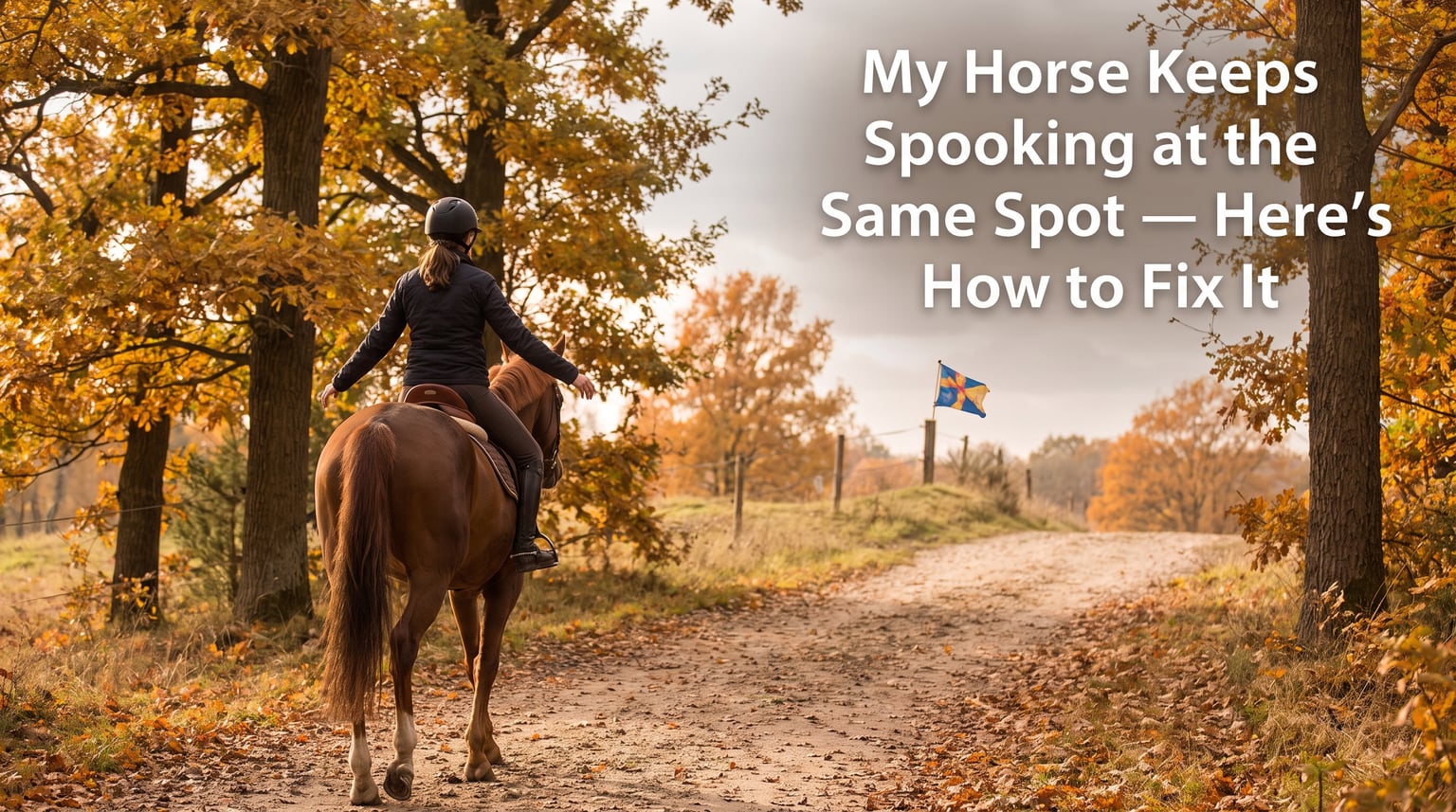
If your horse keeps spooking at the same spot every single ride, the problem usually isn’t bravery or stubbornness. In most cases, your horse has memorized that location as “dangerous” and is running a stored flight response before his brain has time to think. The good news: this is fixable. With the right mix of groundwork, desensitization, and rider patience, that spooky spot can become just another part of the arena or trail.
In this guide, I’ll walk you through what I do when a horse fixates on one location, why the behavior snowballs over time, and the exact step-by-step process I use to break the habit. I’ve worked with horses that spook at the same mailbox, the same puddle, the same shadow at the end of the arena, and even the same folding chair by the gate. The approach is always the same: understand why, then rebuild trust one quiet pass at a time.
Table of Contents
Why Horses Spook at the Same Spot: It’s Not Random
A horse that spooks at the same spot repeatedly is responding to a stored memory, not a fresh threat. Horses are prey animals with a flight-or-fight instinct wired into their nervous system. Their eyes are positioned on the sides of their head, giving them nearly 350 degrees of vision, but creating two significant blind spots directly in front of their nose and directly behind their tail.
Anything that appears suddenly in those blind spots, moves unexpectedly, or shifts in the wind can trigger a startle response. Once a horse spooks hard in one location, his brain files that spot under “danger zone.” Every time he approaches it after that, his sympathetic nervous system pre-loads the flight response. He’s literally bracing for the monster before he sees it.
Common culprits for one-spot spooking include:
- A specific shadow that moves with the sun at a particular time of day
- A flag, tarp, or piece of equipment that flaps in the wind
- A puddle, wet patch, or change in footing
- A reflection from a window, mirror, or piece of metal
- Something a horse actually spooked at once, then continued to remember
I keep a small journal of spook incidents for any horse I work with long-term. After about two weeks, a clear pattern usually shows up. One of my mares spooked at the exact same corner of the arena for three months. Turned out there was a metal roof panel that flashed reflection right at that spot every afternoon. Once we moved her ride time, the behavior dropped by half within a week.
The Psychology Behind Repeated Spooking at One Location
Every spook your horse has at that spot makes the next one more likely. This is classic conditioning. The horse’s brain releases a burst of adrenaline, he reacts, the “threat” passes, and he survives. From his perspective, the spook worked. His legs carried him away from danger, and he’s still here to tell the tale.
Add rider tension to the loop and the habit deepens. If you tense up, shorten the reins, hold your breath, or anticipate the spook every time you approach that corner, your horse reads that as confirmation that something is, in fact, wrong. He matches your energy. He gets more reactive. You get more nervous. The behavior compounds.
There’s also a learned attention component. Some horses figure out that a good spook ends the work session, returns them to the barn, or causes the rider to give them a moment of relief. This is what trainers call an “operant” spook, where the behavior is reinforced by the consequence, even if the consequence is unintentional.
The takeaway: a horse that spooks at the same spot isn’t being difficult. He’s running a deeply grooved neural pathway, and he’s been rewarded for it dozens of times, even if the reward was just survival and a soft moment afterward.
Early Warning Signs Your Horse Is About to Spook
Catching the spook before it happens is one of the most useful skills you can build. A spook rarely comes out of nowhere. There are usually 3 to 5 seconds of clear warning signs if you know what to look for.
- Ears: One or both ears lock forward and stop moving. The head raises slightly.
- Eyes: The eye on the “spooky side” widens visibly, showing more white.
- Nostrils: Short, sharp snorts or a sudden flare of the nostrils.
- Body: The back tightens, the stride shortens, and the horse feels like he’s gathering himself under you.
- Tail: A clamped tail or sudden swish is a strong sign of rising adrenaline.
When I notice two or more of these signs together, I redirect immediately. A small circle, a shoulder-in, a transition down to walk, anything that asks the brain to engage in a thinking task. The goal is to interrupt the pre-load before the flight response fires.
Riders often miss these signs because they’re focused ahead, scanning for whatever they assume is the spooky object. Try looking down at your horse’s ears and eyes instead. Your horse will tell you what’s coming before you can see it yourself.
Step-by-Step Desensitization Technique for the Same Spooky Spot
This is the core fix. The principle is simple: change the emotional association with that location from “danger” to “boring.” Repetition, paired with relaxation, does the heavy lifting. Here’s the exact sequence I use.
Step 1: Identify the Trigger and Control the Environment
Before you do anything, figure out exactly what is setting your horse off. Walk the area on foot. Look at it from your horse’s eye level. Note any movement, sound, smell, or reflection. Sometimes the trigger is obvious, sometimes it’s a plastic bag stuck in a bush 30 feet away.
If you can remove or reduce the trigger safely, do it. A flapping tarp tied down, a flag moved, a bucket relocated. You don’t need to desensitize your horse to every piece of debris in the world. You need to control what you can while you rebuild his confidence.
Step 2: Start on the Ground
Don’t mount up and head straight for the spooky spot. Begin with groundwork. Lead your horse past the spot at a comfortable distance on a loose line. The moment he sees it without reacting, click, treat, or verbally mark and walk on. You’re building a history of “see scary thing, nothing bad happens.”
Repeat this pass 8 to 10 times per session. Vary your distance. Sometimes walk closer, sometimes farther. The goal is for your horse to start ignoring the spot rather than tracking it with his eyes.
Step 3: Add Movement and Energy
Once your horse walks past calmly, add a working trot on the lead line. Circles, serpentines, and changes of direction near the spot keep his brain engaged. A thinking horse is a calm horse. A horse with nothing to do will find something to react to.
If he spooks on the line, simply stop, let him settle, and walk past again. No punishment. No big deal. The spook was information, not failure.
Step 4: Move to Lunging at the Spot
Lunging near the spooky spot gives your horse a job. Send him on a circle that crosses the spot repeatedly. The first few passes he’ll likely speed up, drop his inside shoulder, or try to cut the circle. Stay calm. Wait for one quiet pass and end on that.
Five good passes beats 50 dramatic ones. You are retraining the brain, not wearing him out.
Step 5: Mount Up and Repeat the Pattern
Only after groundwork and lunging are quiet do I get on. Ride the same pattern: walk past, trot past, add circles and transitions near the spot. Keep your hands soft, your seat quiet, and your breathing slow. Your horse is reading you as much as he’s reading the environment.
For most horses, this sequence takes 7 to 14 days of consistent work before the spot becomes a non-event. Some take longer. A horse that has spooked hard at a location for years may need a month or more of patient passes.
Groundwork Exercises That Build Confidence at Spooky Spots
Beyond desensitization, certain groundwork exercises actively build the kind of bold, thinking horse that doesn’t fixate on one location. I rotate these into my routine three to four times a week.
Target Walks
Lead your horse to a cone, stump, or specific rock. Ask him to touch it with his nose. Reward. Move to the next. This teaches him to investigate new things rather than flee from them. Horses that have done target work tend to look at spooky spots with curiosity rather than fear.
Sending Exercises
Send your horse forward through a narrow gap between you and a fence, over a tarp on the ground, or past a flag on a stick. The act of sending teaches him to commit forward even when something looks weird. Start small. A 4-foot gap is enough at first.
Obstacle Courses
Poles on the ground, a small bridge, a jump standard, a wobble board. Horses that have done obstacle work generalize confidence. They start believing that unfamiliar equals possible rather than unfamiliar equals dangerous.
Under Saddle: What to Do When Your Horse Spooks
Even with perfect groundwork, your horse will spook sometimes. The goal isn’t zero spooks. The goal is a quick recovery. Here’s what to do in the moment.
- Don’t punish the spook. Your horse didn’t choose to be afraid. He just had an adrenaline spike.
- Stay deep in your seat and breathe. A tense rider makes a tense horse.
- Redirect within 3 seconds. A small circle, a shoulder-in, a downward transition. Anything that asks for a thinking response.
- Reapproach the spot within the same session if it’s safe. Walking away confirms the spook was the right answer.
- End on a good pass, not a bad one. Even if you only get one quiet moment, that’s where you finish.
I learned the reapproach lesson the hard way with a draft cross I worked with years ago. Every time he spooked at the corner, I rode him past it once and called it a day. The spook got worse every week. The day I finally rode him back to the corner four times in a row, ended on a quiet walk-by, and quit, the behavior started dropping. He needed proof that the corner wasn’t a one-way ticket to a meltdown.
Common Mistakes That Make Spooking at the Same Spot Worse
Most riders I work with aren’t making spooky horses on purpose. They’re accidentally reinforcing the behavior in ways that feel reasonable at the time. Here are the mistakes I see most often.
Avoiding the Spot Entirely
If you take a different route every time, your horse learns that the spooky spot is a place that should be feared and avoided. The avoidance itself becomes the reward. He spooked, you escaped, the lesson was learned: spooks work.
Working the Horse Until Exhausted
Some traditional trainers run a horse “down” past the spooky object until he’s too tired to react. This works in the short term but damages trust. Your horse doesn’t learn the object is safe. He learns that his feelings don’t matter and his rider will push him through pain. Long-term, his spooking gets worse because the emotional charge is still there.
Predictable Patterns
If you always approach the spot from the same direction, at the same pace, in the same frame of mind, your horse learns the build-up. He starts pre-loading the spook long before you arrive. Mix your approach. Change direction. Vary your speed. Break the pattern.
Over-Tightening the Reins
A common instinct is to gather up the reins right before the spooky spot. This is the worst possible timing. Your horse feels the contact increase and reads it as “something is coming.” He’s already bracing before he sees the trigger.
Instead, ride with a soft, steady contact right up to and past the spot. The moment you pass it quietly, that’s your reward moment.
When to Seek Professional Help for a Spooky Horse
Most one-spot spooking can be resolved with consistent work. Some situations warrant a professional trainer, especially if any of the following apply.
- The spook has escalated into bolting, rearing, or bucking
- The horse has injured himself or the rider during a spook
- You’ve worked on it consistently for over 60 days with no improvement
- The horse has obvious vision issues (spooking on one side only, bumping into things)
- You feel unsafe riding alone
A good trainer will evaluate your horse’s whole picture: physical comfort, saddle fit, teeth, vision, and training history. Sometimes what looks like a behavior problem is actually a pain problem. A horse that can’t see well out of one eye will spook hard and consistently on his blind side. A horse with ulcers or a sore back will be generally more reactive, and one specific spot will get the worst of it.
Building Long-Term Confidence So the Spooky Spot Stays Quiet
Once you’ve worked through the specific spot, the work isn’t over. Confidence is a maintenance skill. I treat it like fitness. If you stop training it, it fades.
For long-term success, I keep three habits in my weekly routine. First, I expose my horse to new things on a regular basis. Trail rides in new locations, walks past new obstacles, visits to new arenas. Every new experience is a deposit in the confidence bank.
Second, I revisit the previously spooky spot about once a week for the first three months, then monthly after that. One quiet pass is enough. It keeps the neural pathway grooved in the right direction.
Third, I watch my own energy. Horses read intention and emotion through the reins, the seat, and even the breath. A rider who approaches the old spooky spot with quiet confidence and slow exhales will get a quieter horse than one who approaches it white-knuckled.
Can a spooky horse be fixed? Yes. Most spooking is a symptom of one of three things: lack of exposure, a stored fear memory, or a learned behavior that worked once. All three respond to patient, consistent work. The fix isn’t dramatic. It’s small, repeated, and calm. If you give the process enough time, your horse will walk past that same spot without so much as an ear flick.
Frequently Asked Questions
Can a spooky horse be fixed?
Yes, most spooky horses can be reliably fixed with consistent desensitization, groundwork, and rider calmness. Spooking is a learned or memorized response, not a permanent trait. With 7 to 14 days of patient work, most one-spot spooking drops significantly. Severely reactive horses may take longer and benefit from a professional trainer.
Why does my horse keep spooking at the same spot?
Your horse has memorized that location as a threat. After a single hard spook, his brain files the spot under danger and pre-loads the flight response every time he approaches it. The behavior compounds with each pass because rider tension, environment, and stored adrenaline all reinforce it.
How do I get my horse to stop spooking at one place?
Start by identifying the trigger. Then use a step-by-step desensitization plan: lead past calmly on a loose line, add trotting on the circle, lunge past repeatedly, and finally ride past with a soft contact. Always reapproach within the same session and end on a quiet pass.
How do you desensitize a very spooky horse?
Go slow. Begin at a distance your horse can handle, mark and reward any calm look at the object, and gradually decrease the distance over multiple sessions. Never punish the spook, keep sessions short, and end on success. Groundwork before riding is critical for very reactive horses.
What causes spookiness in horses?
Spookiness comes from a combination of prey-animal instinct, stored fear memories, vision limitations (two blind spots directly in front and behind), and learned behavior. Some horses are also more sensitive by temperament. Pain, saddle fit issues, ulcers, and partial vision loss can all increase reactivity.
Should I avoid the spooky spot or push through it?
Push through it, but smartly. Avoiding the spot confirms to your horse that the spook was justified. Instead, return to the spot the same day, repeat the approach in a controlled pattern, and finish on a calm pass. Never force a fight, but always reapproach so the lesson is clear.
How long does it take to fix a horse that spooks at the same spot?
Most horses show clear improvement within 7 to 14 days of consistent daily work. Horses with years of stored spook history may take 4 to 6 weeks. Maintenance passes once or twice a week are recommended for the first three months to lock in the new habit.
What is the best calmer for a spooky horse?
Calming supplements can support a training program but should not replace it. Magnesium, L-tryptophan, and B-vitamin blends are commonly used, though evidence is mixed. Always rule out pain, vision problems, and training gaps before relying on supplements. Consult your vet before adding anything to your horse’s diet.
Final Thoughts on Fixing a Horse That Spooks at the Same Spot
A horse that keeps spooking at the same spot is doing exactly what his wiring tells him to do. He’s not being difficult, and he’s not choosing to make your ride miserable. He’s running a stored fear response, and he needs your help rewriting it.
The fix is a pattern of small, calm, repeated wins. Identify the trigger, control what you can, do the groundwork, ride back to the spot, and end on a quiet pass. Keep your own energy soft. Avoid the common mistakes of avoiding the spot, tightening the reins, or pushing the horse until he’s exhausted. Give the process 7 to 14 days of consistent work, and most spooky spots become invisible.
If you’ve been riding through the same corner, past the same flag, or under the same tree for months wondering why your horse won’t settle, today is a good day to start changing the pattern. Pick one spot. Pick one session. Build one quiet pass. That’s the first step on the way to a horse that walks past everything like he’s seen it a thousand times, because he has.