
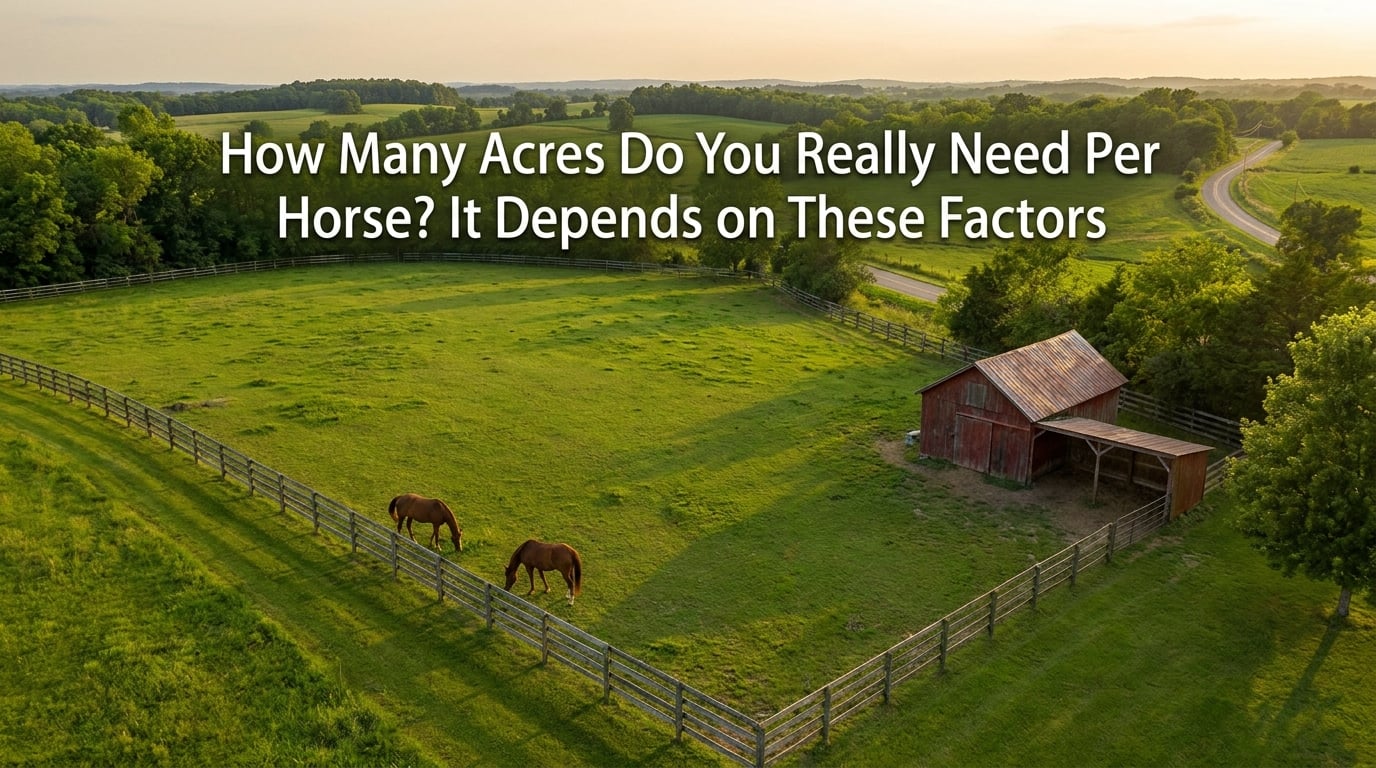
When horse owners ask me how many acres per horse they really need, my answer is always the same: it depends. The general rule of thumb is 1 to 2 acres per horse for full-time pasture, but I’ve seen properties thrive on less and fail on much more. The truth lives in your pasture quality, your climate, your management style, and how your horses use the land.
In this guide, I’ll walk you through the rule of thumb, the five key factors that change your answer, and what to do when you have less land than the “ideal.” I’ve pulled in research from university extension services, real horse owner experiences, and our team’s years of working with property owners to bring you answers that actually hold up in the real world.
Table of Contents
The Basic Rule of Thumb: 1-2 Acres Per Horse
The standard recommendation is 1 to 2 acres of land per horse for full-time pasture grazing, with at least 2 acres suggested for the first horse and 1 additional acre for each horse after that. This is the rule you’ll see quoted by most extension services, including Iowa State University Extension and Stable Management.
Here’s how the acreage range breaks down in plain terms:
- 1 acre per horse: Only works with excellent pasture management, supplemental feeding, and good grass cover. Best for properties in regions with long growing seasons.
- 1.5 acres per horse: A reasonable middle ground for many horse owners with decent pasture and supplemental hay when needed.
- 2 acres per horse: The most common recommendation. Gives enough forage for most of the year and room to rotate or rest sections of pasture.
- 2.5+ acres per horse: Ideal for dry climates, poor pasture, or properties where you want the land to do most of the work without heavy supplemental feeding.
If you only remember one number from this article, make it this: 2 acres for the first horse, then 1 acre for each additional horse. That formula gives you a solid starting point for any property.
The 5 Key Factors That Change How Many Acres Per Horse You Need
The 1-2 acre rule is a starting line, not a finish line. Several factors can push your actual needs above or below that range. Here are the five that matter most.
Factor 1: Pasture Quality and Grass Type
Not all acres are equal. An acre of lush, well-fertilized cool-season grass in Virginia produces far more forage than an acre of sparse native grass in West Texas. Pasture quality is probably the single biggest factor in your real-world acreage needs.
If your pasture is thick with orchardgrass, fescue, or timothy, you can support more horses per acre. If it’s mostly weeds, brush, or thin native grass, you’ll need significantly more land or you’ll be buying hay year-round.
Soil fertility matters too. A soil test costs around $20 and tells you exactly what your pasture can grow. Many horse owners I talk to are shocked to find their soil is missing key nutrients, which directly limits how much forage each acre can produce.
Factor 2: Climate and Geographic Location
Where you live changes everything. A horse in Florida with 12 months of growing season needs far less land than a horse in Alberta with 4 months of grass and 8 months of snow. Climate affects both how much grass grows and how long your pasture can support grazing each year.
In the southern United States, 1 acre per horse can work because warm-season grasses like Bermuda grow nearly year-round. In the northern plains or mountain west, you’ll want closer to 2.5 acres per horse, and you’ll be feeding hay for 6 to 8 months of the year regardless of property size.
Rainfall is another piece of the puzzle. Areas with less than 20 inches of annual rainfall simply won’t grow enough forage to support horses without heavy supplemental feeding. In those regions, more land helps, but managed grazing and hay supplementation matter more.
Factor 3: Horse Size, Age, and Activity Level
A 1,200-pound draft horse eats significantly more than a 600-pound mini horse. A hard-working performance horse burns more calories than a retired pasture pet. Your horse’s individual needs directly affect how much forage you need to produce per acre.
Easy keepers, older horses, and horses with metabolic issues may need restricted grazing, which actually changes how you calculate acreage. For these horses, a smaller pasture with dry lot access sometimes works better than a large pasture where they can overeat.
Mini horses are a special case. While they need less absolute acreage (some sources suggest 0.5 acres per mini), they still need room to move, exercise, and graze. They’re also prone to obesity, so managed grazing on smaller acreage is often better than unlimited access to a large pasture.
Factor 4: Management Practices
This is where you have the most control. How you manage your land can stretch your acreage or waste it entirely. Two properties of the exact same size can support very different herd sizes based on management alone.
Rotational grazing is the single most effective practice for increasing how many horses your land can support. By dividing your pasture into smaller paddocks and rotating horses between them, you can often support 1.5 to 2 times more horses per acre than continuous grazing allows.
Other management factors that change your acreage needs:
- Supplemental feeding: If you feed hay year-round, your acreage requirements drop dramatically.
- Manure management: Composting and spreading manure returns nutrients to the soil and improves pasture productivity.
- Mowing and dragging: Regular maintenance encourages even grass growth and prevents weeds from taking over.
- Reseeding and fertilization: Investing in your pasture’s productivity can effectively increase your carrying capacity.
Factor 5: Herd Size and the 1/2/3 Rule
Here’s where the math gets specific. The 1/2/3 rule is a simple formula horse owners use to calculate acreage:
- 1 acre: The minimum for a single horse with excellent management.
- 2 acres: The standard recommendation for one horse.
- 3 acres: Comfortable space for one horse, with room for facilities, sacrifice areas, and some buffer.
For multiple horses, the formula is 2 acres for the first horse plus 1 acre for each additional horse. So 3 horses would need about 4 acres total (2 + 1 + 1), 4 horses would need 5 acres, and so on. This formula assumes average pasture quality and standard management.
Many horse owners I know add an extra acre per horse if they live in a dry climate, have poor soil, or want the property to feel less crowded. That buffer makes a real difference in how the land holds up over time.
How Many Acres Per Horse: Quick Reference by Number of Horses
Here’s a quick reference table to help you estimate acreage needs based on herd size. These numbers assume average pasture quality, a temperate climate, and standard management practices.
| Number of Horses | Minimum Acres | Recommended Acres | Comfortable Acres |
|---|---|---|---|
| 1 horse | 1 acre | 2 acres | 3 acres |
| 2 horses | 2 acres | 3 acres | 4 acres |
| 3 horses | 3 acres | 4 acres | 5 acres |
| 4 horses | 4 acres | 5 acres | 6 acres |
| 5 horses | 5 acres | 6 acres | 8 acres |
| 6 horses | 6 acres | 7 acres | 9 acres |
| 8 horses | 8 acres | 10 acres | 12 acres |
| 10 horses | 10 acres | 12 acres | 15 acres |
For common scenarios I get asked about: 1 acre is generally not enough for 2 horses long-term unless you have excellent pasture and feed hay year-round. 3 acres is tight for 4 horses but workable with rotational grazing and supplemental feeding. 5 acres is comfortable for 4 horses with average management.
Signs Your Pasture Is Overgrazed
Whether you have too little land or just too many horses, overgrazing shows up in predictable ways. Watching for these signs helps you catch problems before they damage your pasture long-term.
- Bare patches of soil that don’t recover: A sure sign horses are grazing the same areas too intensively or too often.
- Weed invasion: Horses will eat preferred grasses down to the roots, leaving room for weeds like thistle, buttercup, and dock to move in.
- Soil compaction: If your pasture feels hard underfoot and water pools on the surface instead of soaking in, compaction is limiting grass growth.
- Horse body condition dropping: If your horses are losing weight despite being on pasture, the land isn’t producing enough forage to meet their needs.
- Mud and manure buildup: Heavy use areas around gates, water troughs, and shelter become muddy and unsanitary when there’s not enough land to absorb the traffic.
If you spot these signs, you have two choices: reduce stocking rate (fewer horses or more land) or invest in management improvements like rotational grazing, reseeding, and increased supplemental feeding. Both work, but they cost different amounts of time and money.
Making Small Acreage Work: Practical Tips
Not everyone has the “ideal” amount of land. Plenty of horse owners, including me when I started out, make smaller properties work with the right approach. If you have less acreage than recommended, here’s what actually helps.
The dry lot strategy is the most reliable approach for small properties. This means creating a smaller, high-traffic area (called a sacrifice lot) where horses spend part of their time, while preserving your pasture for rotational grazing during peak growth periods. A sacrifice lot with a run-in shed, water, and hay keeps your pasture from being destroyed during winter or drought.
Heavy rotational grazing is the second key. On a small property, dividing your pasture into 4 to 6 smaller paddocks and rotating horses every few days dramatically increases what your land can support. Electric tape or temporary fencing makes this affordable and easy to set up.
Year-round hay feeding is the reality for many small acreage owners. As one Reddit user with 2 acres told me, “We make it work but have to feed hay 6 months out of the year.” That’s normal and expected. Buying hay is cheaper than buying more land in most regions.
Real-world example: A 2-acre property in a temperate climate can comfortably support 1 horse with rotational grazing and supplemental hay. Two horses on 2 acres is possible but requires sacrifice lot rotation, careful pasture management, and hay feeding for at least half the year. Three horses on 2 acres is generally not recommended.
Mini Horses vs Full-Sized Horses: Acreage Differences
Mini horses and miniature donkeys have different acreage requirements than full-sized horses, but they still need adequate space. The common recommendation is 0.5 to 1 acre per mini horse, though some sources suggest a minimum of 0.25 acres for a single mini with access to pasture.
However, minis are prone to obesity, laminitis, and metabolic issues, so unlimited pasture access isn’t always ideal. Many mini owners use dry lots with measured grazing time to keep their horses healthy. The space needs shift from “how much forage can the land produce” to “how much room do they need to move and exercise.”
If you’re keeping minis on the same property as full-sized horses, keep in mind that minis can’t compete with bigger horses for resources. Separated turnout areas usually work better than mixing them in the same pasture.
Frequently Asked Questions About Horse Acreage Requirements
How many acres are recommended per horse?
The general recommendation is 1 to 2 acres per horse for full-time pasture grazing, with 2 acres for the first horse and 1 additional acre for each horse after that. The exact amount depends on pasture quality, climate, and management practices.
How many horses can I have on 1 acre?
One acre is generally enough for only one horse, and even then it requires excellent pasture management and supplemental feeding. Two horses on 1 acre is possible but not recommended for full-time pasture use, especially in regions with shorter growing seasons.
Is 1 acre enough for 2 horses?
One acre is tight for 2 horses and usually requires year-round hay feeding plus active rotational grazing. For most situations, 2 horses need at least 2 to 3 acres to maintain healthy pasture and avoid overgrazing.
Is 3 acres enough for 4 horses?
Three acres is on the low end for 4 horses but can work with rotational grazing, sacrifice lot use, and supplemental hay feeding. Four horses typically do better on 5 or more acres for sustainable pasture management.
What is the 1/2/3 rule for horses?
The 1/2/3 rule is a simple acreage guideline: 1 acre is the bare minimum, 2 acres is the standard recommendation, and 3 acres is comfortable space for a single horse with room for facilities and pasture rest.
What is the 20% rule with horses?
The 20% rule suggests that no more than 20% of available pasture should be grazed at any one time, allowing the remaining 80% to recover and regrow. This principle supports rotational grazing systems and long-term pasture health.
Final Thoughts on How Many Acres Per Horse You Really Need
The question of how many acres per horse you need doesn’t have a single number that fits every situation. The honest answer for 2026 is that 1 to 2 acres per horse is a reliable starting point, but your pasture quality, climate, horse type, and management style will push your real needs above or below that range.
If you’re shopping for property or expanding your herd, use the 2 + 1 formula (2 acres for the first horse, 1 acre for each additional) as your baseline, then adjust up for dry climates, poor soil, or retirement horses with low activity. If you’re working with less land than the formula suggests, focus on rotational grazing, sacrifice lots, and planned supplemental feeding rather than trying to push more horses onto less acreage.
The horse owners I see succeed long-term aren’t the ones with the most land. They’re the ones who match their management to what their land can actually support. Start with the rule of thumb, learn your property’s carrying capacity, and adjust as you go. Your horses and your pasture will both be healthier for it.