
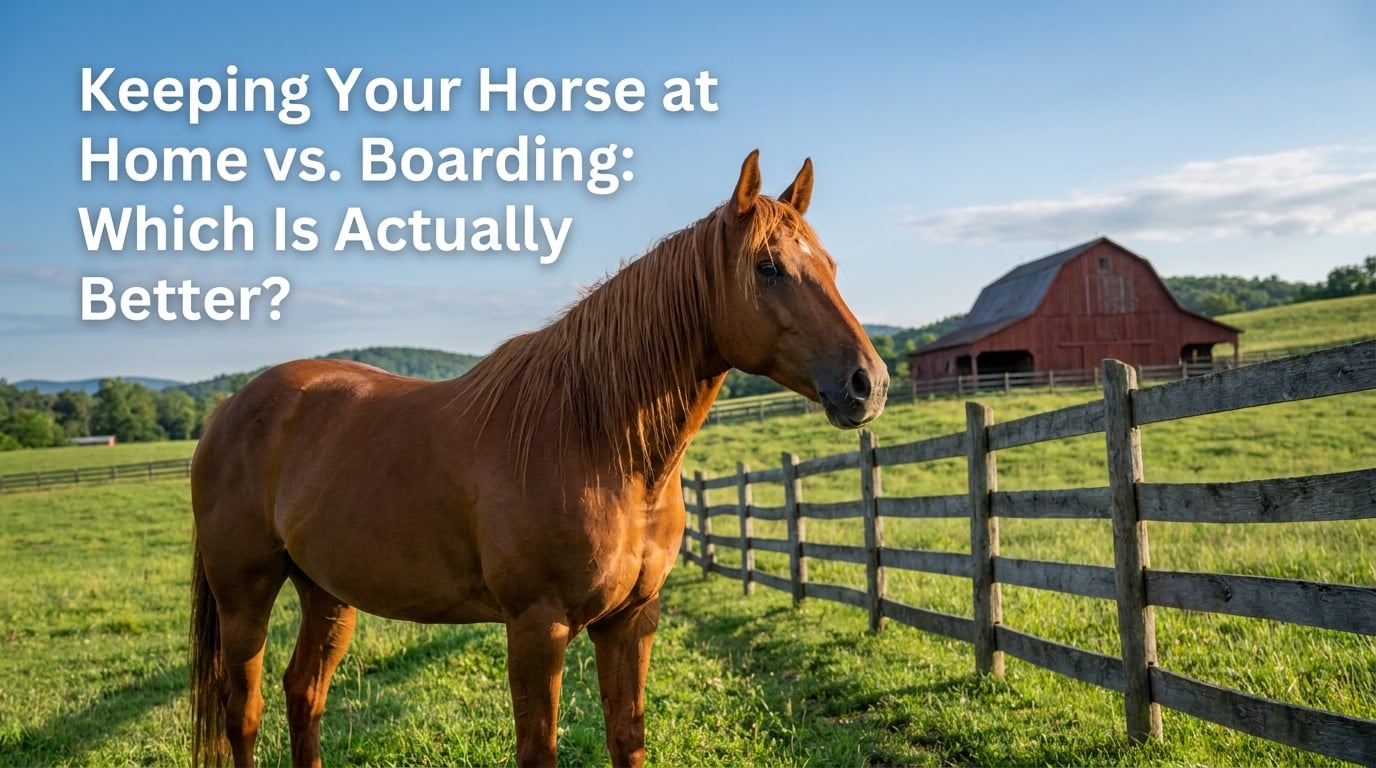
Every horse owner reaches the same crossroads at some point. You stand at the barn aisle, fork in hand, and wonder whether the grass really is greener on the other side. The horse boarding vs home keeping debate is one of the most discussed topics in equestrian communities, and for good reason. The choice you make affects your wallet, your schedule, your horse’s daily routine, and honestly, your entire lifestyle.
I have spent years talking with owners on both sides of this fence. Some would never go back to a boarding barn after experiencing the freedom of home keeping. Others tried keeping horses at home and ran back to boarding within six months. The truth is that neither option is universally better. What works depends entirely on your situation, budget, property, and personality.
This guide breaks down every factor you need to weigh. We will cover real cost comparisons, time commitments, land requirements, emergency planning, and the hidden challenges that forum threads and glossy barn websites rarely mention. By the end, you will have a clear framework for making the right call for your horse and your life.
Table of Contents
Quick Summary: Home vs Boarding at a Glance
Before we get into the details, here is a high-level snapshot of how home keeping and boarding compare across the factors that matter most to horse owners.
Monthly cost: Boarding typically runs $300 to $2,000+ per horse depending on region and service level. Home keeping costs $150 to $400 per horse monthly for feed, hay, farrier, and vet, but requires property investment upfront.
Time commitment: Boarding with full care means you show up and ride. Home keeping demands 1 to 3 hours daily for feeding, stall cleaning, turnout, and water management.
Control over care: Home keeping gives you total control. Boarding means trusting barn staff with feeding, supplements, and daily routines.
Facility access: Boarding barns often offer indoor arenas, trails, and lesson programs. Home keeping means building or doing without these amenities.
Travel flexibility: Boarding makes vacations easy. Home keeping requires arranging reliable horse sitters every time you leave.
Social aspect: Boarding offers community and riding partners. Home keeping offers privacy and solitude.
One Reddit user on r/Equestrian put it bluntly: keeping horses at home is so much more enjoyable than boarding, assuming you actually enjoy the care aspects. If daily chores sound like a burden rather than a pleasure, that tells you something important right there.
Boarding Barn Advantages
Boarding barns exist for a reason. For many owners, they solve problems that home keeping simply cannot address. Here is what you gain when you pay for a boarding facility.
Professional Care on Demand
The biggest advantage of boarding is access to experienced barn staff who handle daily care. Full board typically includes feeding, stall cleaning, turnout, blanketing, and holding for the farrier or vet. You do not need to worry about whether someone fed at 6 AM or if the water trough is frozen. The barn handles it.
For first-time horse owners or people with demanding careers, this peace of mind is invaluable. You can focus on riding and bonding with your horse instead of managing logistics.
Quality Facilities You Could Never Build Alone
Most boarding barns offer amenities that would cost hundreds of thousands of dollars to replicate at home. Indoor arenas, heated wash stalls, dedicated tack rooms, professionally built footing, and direct access to trail systems are standard at mid-to-upper-tier facilities.
If you live in a climate with harsh winters, an indoor arena alone can justify the boarding cost. Riding outside in January in many parts of the country is simply not safe or enjoyable.
Built-In Community and Support
Boarding barns provide something home keeping cannot match: a community of fellow riders. You get riding partners, people to trailer with, friends who notice when your horse looks off, and instructors who offer lessons on site. For many equestrians, the social aspect of the barn is a primary reason they stay in boarding.
The barn community also creates accountability. When others are watching, you are more likely to stick to your riding schedule and push yourself to improve.
Travel Without Guilt
When you board, you can leave town for a week and know your horse is cared for. No scrambling to find a reliable sitter, no anxious texts checking in, no guilt about burdening a friend. This flexibility is something home-keeping owners deeply miss.
Emergency Coverage
Boarding barns have staff on site or nearby. If your horse colics at 2 AM or a fence breaks during a storm, someone is there to handle it. This 24/7 safety net is a powerful advantage that many owners underestimate until they face an emergency alone at home.
Boarding Barn Disadvantages
Boarding is not all convenience and community. Forum discussions reveal consistent frustrations that boarders deal with regularly. Here are the downsides you should understand before committing.
Cost in High-Demand Areas
Boarding costs can exceed $2,000 per month in regions like Southern California, the Northeast, and parts of Florida. Even in more affordable areas, full board typically runs $500 to $800 monthly. Over a year, that is $6,000 to $10,000 per horse. For owners with multiple horses, the numbers climb fast.
One forum user on HorseForum.com noted that they saved money keeping three horses at home for less than the cost of boarding one at a decent facility. That kind of math makes home keeping very attractive for multi-horse households.
Lack of Control Over Daily Care
This is the number one complaint among boarders. You are trusting someone else to feed the right amounts, administer supplements correctly, monitor water intake, and notice subtle health changes. When care falls short, the consequences can be serious.
Common complaints from forums include supplements not being given, feed amounts inconsistent, blankets left on during warm days, and turnout schedules changed without notice. You are paying for care but have limited ability to verify quality day to day.
Barn Policies and Restrictions
Every boarding barn has rules. Some restrict which trainers you can use. Others limit riding hours, require specific bedding, mandate certain farriers, or prohibit certain supplements and treatments. You may love your body worker, but if the barn does not allow outside practitioners, you are stuck.
Some barns also restrict when you can visit, how many guests you can bring, or whether you can bring your dog. These policies are reasonable from the barn owner’s perspective but can feel suffocating when you are used to autonomy.
Barn Drama and Personality Conflicts
Put twenty passionate horse people in one facility and conflict is inevitable. Forum threads are filled with stories about stolen tack, gossip, judgment about training methods, and arguments over arena etiquette. Not every barn has drama, but enough do that it ranks as a top frustration.
For private individuals who just want to enjoy their horse without social complications, the boarding barn environment can feel draining.
Home Horsekeeping Advantages
Keeping your horse at home is a deeply rewarding experience for the right person. Here is what draws owners away from boarding and into their own backyards.
Significant Cost Savings, Especially for Multiple Horses
The financial case for home keeping gets stronger with every horse you add. Feed, hay, supplements, farrier, and vet care cost roughly the same whether you have one horse or five. The difference is that boarding charges a per-horse markup, while home keeping spreads your fixed property costs across your herd.
A single horse at home might save you $200 to $400 per month compared to boarding. Three horses at home could save $1,500 or more monthly. Over several years, those savings can pay for property improvements, a new truck, or a covered arena.
Total Control Over Every Detail
You decide what your horse eats, when they go out, how long they stay out, whether they wear a blanket, and who handles them. For owners with horses that have special dietary needs, metabolic conditions, or specific training requirements, this level of control is not a luxury. It is a necessity.
You also control the environment. No exposure to sick horses from other boarders. No shared water troughs. No random people feeding treats without permission. Your horse’s world is exactly what you make it.
Privacy and Peace
Many home-keeping owners cite privacy as their favorite benefit. One HorseForum.com member shared that being a very private person made home keeping the obvious choice. You ride when you want, wear what you want, and never worry about someone watching or judging.
There is also a profound peace that comes from looking out your kitchen window and seeing your horse grazing. That connection to your animal and the land is something boarding simply cannot replicate.
Flexible Schedule
No driving to the barn. No waiting for the arena. No coordinating with barn staff. Your horse is steps away, which means you can squeeze in a ride at dawn, do a quick check during lunch, or sit with your horse after dinner. The convenience of walking out your door cannot be overstated.
Deeper Bond With Your Horse
When you are the one feeding, grooming, turning out, and mucking stalls every day, you develop a relationship with your horse that goes beyond riding. You learn their moods, their habits, their preferences. You notice the slightest change in behavior because you are there for every interaction.
Home Horsekeeping Disadvantages
The romance of keeping horses at home meets reality quickly. Here are the challenges that catch new home-keepers off guard.
Time Commitment Is Massive
This is the most underestimated aspect of home horsekeeping. Daily chores include morning feeding, stall cleaning, water management, turnout management, evening feeding, and nightly checks. A realistic daily time breakdown looks like this:
Morning feed and stall check: 30 to 45 minutes per horse
Stall cleaning: 15 to 20 minutes per stall
Water trough cleaning and refilling: 15 to 30 minutes
Turnout and bring-in: 20 to 40 minutes depending on setup
Evening feed and final check: 20 to 30 minutes per horse
Hay and feed management: 30 minutes weekly, more during delivery days
For one horse, plan on 2 to 3 hours daily. For two or three horses, that time grows. And that is before you even tack up and ride. Weekends often become full work days for fence repair, pasture management, and facility maintenance.
Physical Demands Are Real
Carrying water buckets, hauling hay bales, mucking stalls in freezing weather, breaking ice from troughs, and wrestling with fencing takes a toll on your body. Forum users frequently mention that the physical demands of home horsekeeping were a shock. If you have any physical limitations, consider how you will manage heavy labor long-term.
Travel Becomes Complicated
Every vacation, business trip, and weekend away requires finding someone trustworthy to care for your horses. Reliable horse sitters are hard to find and expensive to retain. One forum member described the stress of travel planning as the single biggest drawback of home keeping.
You need someone who knows horses, understands colic signs, can handle emergencies, and is willing to commit to twice-daily visits. In rural areas, this person may not exist. Even when you find someone, you will pay $25 to $50 per visit, which adds up fast during a week-long trip.
Property and Facility Costs
The monthly savings of home keeping come with significant upfront investment. Fencing alone can cost $3,000 to $15,000 depending on materials and acreage. A run-in shelter runs $2,000 to $8,000. A proper barn with stalls can exceed $50,000. Tack storage, hay storage, water systems, and lighting all add to the bill.
Property maintenance also never ends. Fence posts rot, gates sag, roofs leak, and pastures need reseeding. Budget time and money for ongoing repairs.
Isolation From the Equestrian Community
If you thrive on riding with friends, taking lessons, and being part of a barn culture, home keeping can feel lonely. No one is there to hold a horse for the vet, spot you while you school a new exercise, or share the excitement when you nail a difficult movement.
You can offset this by hauling to nearby facilities for lessons or joining local riding clubs. But the spontaneous social connection of a boarding barn is gone.
Cost Comparison: Home vs Boarding
Let us get into the numbers. This is where the horse boarding vs home keeping decision gets concrete. I will break down realistic monthly costs for each option so you can see exactly what you are paying for.
Monthly Boarding Cost Ranges
Boarding costs vary enormously by region, facility quality, and service level. Here are realistic ranges across the United States for 2026:
Pasture board (self-care, no stall): $150 to $400 per month
Partial board (stall, some care): $250 to $600 per month
Full board (stall, feeding, turnout, basic care): $400 to $1,200 per month
Premium full board (arena access, blanketing, supplements, holding): $800 to $2,500 per month
Top-tier show barns (coaching, grooming, full service): $1,500 to $4,000+ per month
These costs do not include farrier, vet, dental, or insurance, which you pay regardless of where your horse lives.
Monthly Home Keeping Cost Breakdown
Home keeping costs are lower per horse but come with property overhead. Here is what to expect monthly for one horse on your own property:
Hay (2 to 4 bales monthly): $40 to $120 depending on region and hay type
Grain or concentrate feed: $30 to $60
Supplements: $20 to $80
Bedding (if using stalls): $40 to $100
Farrier (trim or shoes, averaged monthly): $50 to $150
Veterinary care (routine, averaged monthly): $30 to $60
Deworming and dental (averaged): $15 to $30
Electricity and water for barn: $20 to $60
Property insurance for equine liability: $15 to $40
That puts home keeping at roughly $260 to $700 per horse per month, with most owners landing around $300 to $450. Compare that to $500 to $1,200 for full board, and the savings are clear.
Break-Even Analysis for Property Purchase
No competitor covers this adequately, so let me walk through a realistic scenario. Say you board one horse at $800 per month and are considering buying a property to keep them at home.
Your monthly savings from home keeping might be $400 to $500 after accounting for your own feed and supply costs. That is $4,800 to $6,000 per year. If you needed to spend $20,000 on fencing, a shelter, and water systems to make your property horse-ready, the break-even point is roughly 3 to 4 years on improvements alone.
Add a second horse, and the savings double while the property investment stays the same. With two horses boarding at $800 each, you save $1,600 monthly or $19,200 annually. That same $20,000 improvement pays for itself in just over a year.
The catch is property purchase cost itself. If you are buying land specifically for horses, the mortgage, property taxes, and maintenance can dwarf boarding costs. Home keeping saves money when you already own suitable land or are buying property regardless of horses.
Regional Cost Variations
Where you live dramatically affects the math. Boarding in rural Texas might cost $350 for full board, while the same service in Los Angeles easily hits $1,200. Hay prices swing from $4 per bale in hay-producing states to $15 or more in drought-affected or import-dependent regions.
Before making any decision, call three boarding barns and two feed stores in your specific area. Local numbers always beat national averages.
Hidden Costs Both Sides Forget
Boarders often overlook the cost of gas driving to and from the barn. If your barn is 30 minutes away and you visit five times per week, that is roughly 260 hours of driving annually plus significant fuel costs. Home keepers sometimes forget to budget for tractor maintenance, lime for stalls, fly spray systems, and the inevitable vet emergency fund.
Land and Facility Requirements for Home Keeping
If you are leaning toward home keeping, you need to understand what your property must provide. Horses are not like dogs or cats. They require specific space, shelter, and infrastructure to stay healthy and safe.
Acreage: The Half-Acre Per Horse Guideline
The widely accepted guideline is a minimum of half an acre to one acre of turnout per horse, not including the space taken up by your house, driveway, and barn. This assumes you are also providing hay year-round, since most lots cannot sustain enough pasture for grazing alone.
For self-sustaining pasture without supplemental hay during growing season, you need 2 to 5 acres per horse depending on climate, soil quality, and rainfall. In arid regions like Nevada or Arizona, even 5 acres may not support one horse without significant irrigation.
The 1/2/3 Rule for Horse Property
A useful framework circulating in equestrian communities is the 1/2/3 rule for horse property evaluation. Plan for a minimum of 1 acre total per horse, 2 acres if you want decent pasture rotation, and 3 acres if you want self-sustaining grazing in most climates. This gives you room for a sacrifice area, rotation paddocks, and hay storage without overcrowding.
Fencing Specifications
Fencing is non-negotiable and must be horse-safe. The most recommended options include:
No-climb woven wire with a top board: The gold standard for horse fencing. Safe, durable, and visible. Costs $4 to $8 per linear foot installed.
Wood board fencing (3 to 4 boards): Attractive and visible but requires maintenance. Runs $5 to $12 per linear foot.
Electric fencing (tape or rope): Affordable and effective for interior divisions. Best used as a secondary fence, not a primary boundary.
Vinyl or PVC: Low maintenance and attractive but expensive at $10 to $20 per linear foot.
Never use barbed wire for horses. It causes devastating injuries. Check fences monthly for loose boards, sagging wire, or broken posts.
Shelter Requirements
Horses need protection from wind, rain, sun, and insects. A three-sided run-in shed facing away from prevailing winds is the minimum requirement. The standard guideline is 12 feet by 12 feet per horse minimum, with a 10 to 12 foot ceiling height.
If you live in an area with extreme weather, severe cold, or heavy insect populations, a fully enclosed barn with stalls may be necessary. Senior horses, thin-skinned breeds, and horses with health issues often need more protection than healthy, younger horses.
Water Access and Management
Each horse drinks 8 to 12 gallons of water daily, more in hot weather or during heavy work. You need a reliable water source, whether that is frost-free hydrants, automatic waterers, or troughs you fill manually. In cold climates, you will need heated troughs or bucket heaters to prevent freezing.
Clean water is critical. Troughs should be scrubbed weekly to prevent algae and bacteria buildup. Automatic waterers need monthly inspection to ensure they are functioning correctly.
Hay and Feed Storage
A single horse eats roughly 15 to 25 pounds of hay daily. That translates to 100 to 150 bales annually. You need dry, secure storage for at least a three-month supply, ideally more to buffer against price spikes and supply shortages. A 12 by 16 foot hay storage area handles approximately 200 square bales.
Emergency Care and Travel Planning
This is a topic almost no competitor addresses, and it is critical. When you keep horses at home, you are the first responder, the caretaker, and the vacation planner. Here is what you need to prepare.
Building Your Emergency Plan
Before bringing your horse home, establish a relationship with a local equine veterinarian. Know their emergency hours, after-hours policy, and typical response time. Have their number posted in the barn and saved in your phone. If your nearest equine vet is 45 minutes away, that matters during a colic emergency.
Keep a well-stocked first aid kit in your barn. Essentials include a digital thermometer, stethoscope, bandaging materials, antiseptic, wound ointment, electrolyte paste, and a flashlight with extra batteries. Know how to take your horse’s temperature, heart rate, and respiratory rate. These numbers help your vet assess severity over the phone.
Finding and Vetting Horse Sitters
Reliable horse sitters are worth their weight in gold. Start your search months before you need one. Good sources include local feed stores, equine veterinarians, farriers, and riding clubs. Ask for references and always have a sitter do a paid trial run before you leave town.
Prepare a detailed care sheet for your sitter that covers feed amounts and schedules, turnout routine, supplement administration, emergency contacts, and your horse’s normal behavior patterns. Leave your vet’s number, a credit card on file with the clinic, and written authorization for emergency treatment up to a dollar amount you specify.
Insurance Considerations
No competitor mentions insurance, but it matters. If you keep horses at home, look into equine liability insurance to protect yourself if someone is injured by your horse on your property. Major medical and mortality insurance on the horse itself is also worth considering, especially for valuable animals.
Your homeowners insurance may not cover equine-related liability automatically. Check with your agent and consider a separate policy or umbrella coverage. This is a small monthly cost that protects you from catastrophic financial loss.
Horse Boarding vs Home Keeping: Decision Checklist
Still unsure which path is right for you? Work through these questions honestly. Your answers will point you toward the better option.
Boarding Likely Wins If You…
Work full-time with an inflexible schedule and cannot commit to twice-daily barn chores
Own one horse and live in an area where land is expensive or unavailable
Value riding in an indoor arena during winter or extreme weather
Travel frequently for work or pleasure and need caretaking built in
Are new to horse ownership and want professional guidance and support
Thriving in a social barn environment energizes you
Ride competitively and need access to trainers, lessons, and show infrastructure
Home Keeping Likely Wins If You…
Own two or more horses and want to significantly reduce monthly costs
Already own suitable property or are buying property regardless of horses
Enjoy the daily care aspects of horsemanship, not just riding
Have a flexible schedule or work from home
Value privacy, autonomy, and control over every aspect of your horse’s care
Have a reliable network of horse-knowledgeable friends or family for backup
Are comfortable with physical labor in all weather conditions
Barn Sharing: The Middle Ground
If neither full boarding nor solo home keeping feels right, consider barn sharing. This arrangement involves two or more owners splitting the cost of leasing or purchasing a private property together. Each owner contributes to chores, expenses, and facility maintenance.
Barn sharing reduces costs compared to commercial boarding while distributing the workload that makes solo home keeping exhausting. It also provides built-in horse-sitting coverage, since your partner can cover when you travel and vice versa. The key is choosing partners whose standards and work ethic match your own. A written agreement covering expenses, schedules, and decision-making prevents most conflicts.
Frequently Asked Questions
Is it better to keep horses at home or stables?
Neither option is universally better. Boarding is better for owners who value convenience, facility access, professional care, and travel flexibility. Home keeping is better for multi-horse owners seeking cost savings, complete control over care, and a deeper daily bond with their horses. The right choice depends on your budget, schedule, property, and personal preferences.
What does it cost on average to board a horse?
Boarding costs vary widely by region and service level. Pasture board averages $150 to $400 per month, partial board runs $250 to $600, and full board typically costs $400 to $1,200 monthly. Premium full board with arena access and full service can reach $800 to $2,500 per month, while top show barns may charge $1,500 to $4,000 or more.
How much land do I need to keep a horse at home?
The minimum guideline is half an acre to one acre of turnout per horse, assuming you provide supplemental hay year-round. For decent pasture rotation, plan on two acres per horse. For self-sustaining grazing in most climates, you need three to five acres per horse. Always check local zoning laws, which may dictate minimum acreage requirements.
What are some common problems with horse boarding?
Common boarding problems include lack of control over daily care, inconsistent feeding or supplement administration, restrictive barn policies, high costs in demand areas, personality conflicts with other boarders, and limited choice of trainers or practitioners. Some boarders also report issues with turnout changes, blanketing mistakes, and delayed communication about health concerns.
Can I keep my horse on a small property?
Yes, you can keep a horse on a small property if you provide daily turnout or exercise, supplemental hay instead of relying on grazing, and adequate shelter. Even half an acre can work for one horse if you manage a sacrifice area, feed hay year-round, and ensure the horse gets regular exercise. The key is honest assessment of whether your space meets the horse’s physical and social needs.
Is keeping a horse at home worth the effort?
For the right person, absolutely. Home keeping saves significant money for multi-horse owners, provides total control over care, and creates a deeper bond with your horse. However, it requires 2 to 3 hours of daily labor, limits your travel flexibility, and demands physical work in all weather. If you genuinely enjoy the care aspects of horsemanship, home keeping is deeply rewarding. If daily chores feel like a burden, boarding is the better investment.
Making the Right Choice for You and Your Horse
The horse boarding vs home keeping decision comes down to a trade-off between convenience and control. Boarding buys you time, facility access, professional care, and travel freedom. Home keeping buys you cost savings, autonomy, privacy, and an unbreakable daily connection with your horse. Neither path is wrong.
Start by honestly assessing your budget, your schedule, your property situation, and your tolerance for physical labor. Talk to local boarding barns about their rates. Walk your property and evaluate what improvements it would need. Most importantly, think about what brings you joy in horse ownership. If mucking a stall at sunrise fills you with peace, home is calling. If the thought makes you dread getting out of bed, boarding is your answer.
Your horse will thrive in either environment when you choose the option that lets you show up as the best owner you can be. Make the decision with your eyes wide open, and you and your horse will both be happier for it.