
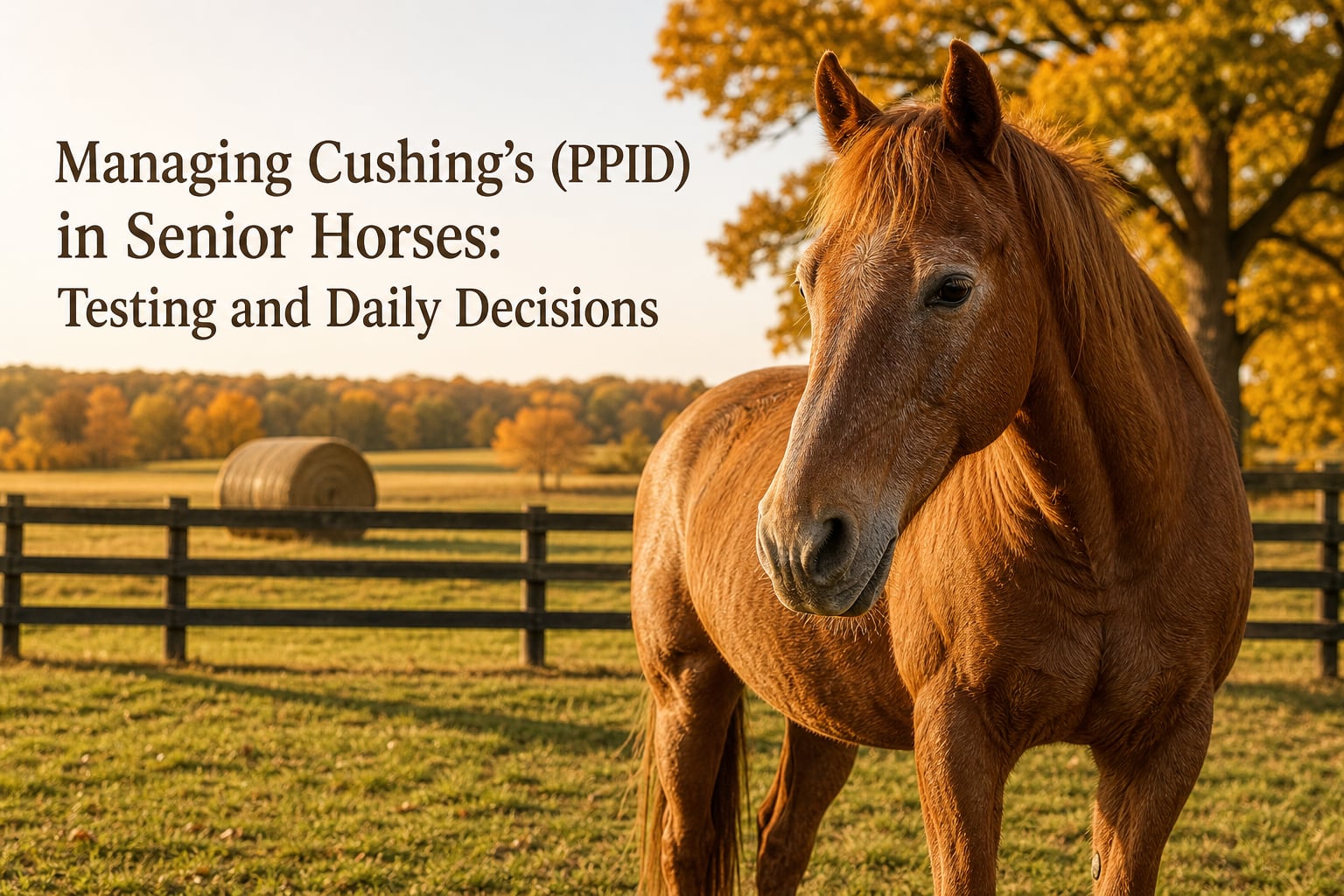
When my own gelding turned 18, I noticed his winter coat hung on well into May. I assumed he was just being stubborn about shedding. A year later, after a laminitis scare and a round of bloodwork, our vet handed me a diagnosis: PPID, also known as equine Cushing’s disease.
That moment taught me what every senior horse owner eventually learns. Cushing’s disease is not a single event you treat once. It is a slow, lifelong condition that asks you to make small, informed decisions every single day.
This guide to Managing Cushing’s PPID in Senior Horses pulls together what I have learned from my own vet, from equine endocrinologists, and from years of reading owner forums where people swap real-world experience. You will find clear answers about testing, the best time of year to test, how pergolide treatment works, and the daily choices that protect your horse’s quality of life.
Table of Contents
What Is PPID (Cushing’s Disease) in Senior Horses?
PPID stands for Pituitary Pars Intermedia Dysfunction. It is the most common endocrine disorder diagnosed in senior horses, and it is often simply called equine Cushing’s disease.
The condition develops when the dopamine-producing neurons in a horse’s hypothalamus slowly degenerate. Those neurons normally keep the pituitary gland’s intermediate lobe (the pars intermedia) in check. As dopamine levels fall, the pars intermedia enlarges and begins pumping out excessive adrenocorticotropic hormone, or ACTH.
High ACTH tells the adrenal glands to release more cortisol. Over time, that cortisol excess drives the visible clinical signs owners notice: a long, curly coat that will not shed, muscle wasting, laminitis risk, and a weakened immune system.
Research suggests PPID affects more than one in five horses over the age of 15, and the rate climbs higher in horses past 20. It is a disease of aging, and it does not go away once it starts. The goal of managing Cushing’s PPID in senior horses is not cure. It is slowing progression and keeping the horse comfortable.
Early Warning Signs Every Owner Should Know
Early PPID is subtle. Most owners do not catch it at the very first sign. Here is the order I watch for, and the order most equine vets discuss with their clients.
Delayed shedding or patchy coat. A horse that normally sheds by April is still holding a full coat in June. Some horses develop a slightly longer, curlier haircoat without obvious matting.
Subtle muscle loss over the topline. The saddle area looks softer, the hindquarters lose definition, and the horse may seem less willing to engage his back.
Regional fat deposits.
A cresty neck, fat pads behind the shoulders, or a puffed-out sheath in geldings are classic early clues, especially when paired with a hay-only diet.
Mild changes in drinking and urination. Stalls that stay wetter than usual, or water buckets that empty faster, can point to polyuria and polydipsia.
Recurring hoof abscesses or mild laminitic episodes. Any senior horse with sudden foot soreness deserves a PPID workup.
If your horse is showing two or more of these signs, ask your vet about baseline endocrine testing. Catching PPID early, before laminitis develops, is the single biggest factor in long-term quality of life.
Late-Stage and Advanced Symptoms
Advanced PPID is hard to miss. Horses often present with a thick, wavy haircoat that never sheds even in summer, severe muscle wasting over the back and hindquarters, and a pot-bellied appearance.
Other late-stage signs include chronic or recurrent laminitis, repeated infections (especially skin and hoof), dental disease and weight loss despite a good appetite, and an overall dull, lethargic demeanor.
Many forum owners describe this stage as the moment they first heard about Cushing’s from their vet. By then, the disease has usually been progressing silently for several years. That is why testing matters even when clinical signs feel mild.
How to Test for PPID in Horses: ACTH and TRH Stimulation?
There are two main blood tests your vet uses to diagnose and monitor PPID. Understanding the difference will help you make sense of the results.
Baseline ACTH Test
The first-line test measures resting ACTH in a single blood draw. Most labs give results within a few days, and your vet compares your horse’s value against seasonal reference ranges.
A baseline ACTH above the reference range strongly suggests PPID. Values that fall in a gray zone often trigger follow-up testing.
TRH Stimulation Test
The TRH stimulation test is more sensitive, especially in early or borderline cases. Your vet draws blood, administers an injection of thyrotropin-releasing hormone (TRH), then draws a second sample 10 minutes later.
In a healthy horse, ACTH rises only slightly. In a PPID horse, ACTH spikes significantly. This test is most useful when resting ACTH is inconclusive or when early disease is suspected in a horse with classic clinical signs.
Insulin Testing
Because PPID and insulin dysregulation often travel together, your vet will usually pull a baseline insulin and sometimes glucose at the same time. A high insulin reading is itself a red flag for laminitis risk, even when ACTH is borderline.
Ask your vet to interpret all three values together. A horse with mildly elevated ACTH but very high insulin may need treatment for both conditions at once.
Best Time of Year to Test a Horse for Cushing’s
Here is the question I hear most from fellow owners: When is the best time of year to test a horse for Cushing’s? The honest answer is that it depends on what you are testing for.
ACTH levels rise naturally in late summer and fall, even in horses without PPID. This seasonal surge peaks between August and October in the Northern Hemisphere. Labs adjust their reference ranges seasonally to account for this.
Testing in late fall (September to November) catches more cases. Because natural ACTH is high, mild PPID becomes easier to detect.
Testing in spring or early summer is better for early or borderline disease monitoring. ACTH values should be near baseline in healthy horses, so any elevation is more meaningful.
For TRH stimulation, seasonal ranges also apply, but the test is sensitive year-round. It is often the best option when clinical signs suggest PPID but resting ACTH is normal in spring.
Our team typically recommends testing in early fall for an initial diagnosis, because the seasonal bump improves sensitivity. After diagnosis, follow-up ACTH checks are usually done in the same season each year so values can be compared fairly.
Understanding Insulin Dysregulation and Laminitis Risk
PPID on its own is uncomfortable, but the laminitis risk is what makes it dangerous. Horses with PPID frequently develop insulin dysregulation, where cells respond less effectively to insulin and blood insulin levels climb.
High insulin damages the laminae that suspend the coffin bone inside the hoof. The result is laminitis, which can become founder in severe cases.
This is why vets test insulin alongside ACTH. It is also why diet and exercise matter so much in Managing Cushing’s PPID in senior horses. Controlling insulin is the most direct way to protect the feet.
FDA-Approved Treatment: Pergolide (Prascend) for PPID
Pergolide mesylate is the only FDA-approved medication for PPID in horses. It is sold under the brand name Prascend, and it works as a dopamine agonist that mimics the missing dopamine in the hypothalamus.
By restoring dopamine activity, pergolide tells the pars intermedia to slow down. ACTH levels usually drop within four to six weeks, and many horses show visible improvement within the first two months.
Starting Low: A Common Protocol
Most equine vets now recommend starting at a low dose, often 0.5 mg per day for a 1,000-pound horse, and titrating upward based on follow-up ACTH results and clinical response.
This start-low approach reduces the chance of appetite loss or temporary dullness, which some horses experience when starting pergolide. Side effects are usually mild and resolve within a week or two.
Compounded vs FDA-Approved
Many forum owners ask about cheaper compounded pergolide. Compounded products are not FDA-approved and have shown variability in potency in published studies. Prascend is the gold standard for consistency.
Talk with your vet about cost. For long-term management, predictable dosing and reliable absorption matter.
Daily Management Strategies for Horses with PPID
Daily management of a PPID horse is built around consistency. Your horse’s body is already working harder than it should to maintain normal hormone balance. Surprise changes stress the system.
A Practical Daily Checklist
Observe coat and shedding. Note any changes in shedding pattern. Many horses need a full body clip in summer once they are on pergolide, or sometimes before.
Check body condition score. Run your hands over ribs, topline, and tailhead weekly. Subtle weight loss often shows up here before the eyes catch it.
Monitor water intake and output. Sudden increases in drinking or urination can signal disease progression.
Watch the feet. Look for short strides, weight shifting, or heat in the hooves. Any change warrants a call to your vet and farrier.
Inspect for infections. PPID suppresses immunity. Treat small skin wounds and dental issues early.
Administer medication consistently. Same time, same dose, every day. If you miss one, do not double up.
Body Clipping
Hirsutism, the long, curly haircoat, can be severe. PPID horses that cannot shed properly overheat in warm months, which adds stress on top of the disease. A full body clip in spring is one of the simplest ways to improve comfort.
Exercise
Light, regular exercise supports insulin regulation and muscle maintenance. Turnout in a paddock or pasture is a great baseline, with riding or in-hand work added based on your horse’s soundness.
Nutrition Guidelines for the PPID Horse
Diet is the second pillar of Managing Cushing’s PPID in senior horses, right after medication. The principles are simple: low starch, low sugar, plenty of fiber.
Hay First
Forage should make up the bulk of the diet, ideally at 1.5 to 2 percent of body weight per day. Choose hay with a low non-structural carbohydrate (NSC) content, ideally under 12 percent. Soaking hay for 30 to 60 minutes in warm water can leach out additional sugars.
If you can, submit your hay for NSC analysis. Equine nutrition labs run this for a modest fee, and the results take the guesswork out of feeding.
Grain and Concentrates
Most PPID horses do not need grain. If your horse struggles to maintain weight, look first at senior feeds formulated for metabolic horses, which are typically low NSC and high fat. Avoid sweet feed, apples, carrots in large quantities, and molasses-based treats.
Supplements Worth Considering
Research has highlighted a few supplements that may support senior horses with PPID.
Vitamin E. An antioxidant shown to support older horses with Cushing’s disease. Deficiency is common in hay-only diets, especially in winter.
Omega-3 fatty acids. Support inflammatory balance and joint comfort.
Magnesium and chromium. Sometimes used to support insulin regulation, although evidence is mixed.
Adaptogenic herbs. Some owners report benefits, but always run these past your vet, since they can interact with medications.
Working With Your Veterinarian and Monitoring Progress
PPID management is a partnership. Your vet sets the testing schedule, interprets results, and adjusts medication. Your job is to share observations between visits.
Keep a simple journal. Jot down the date, dose, body condition, water intake, and any behavior or coat changes. When you retest, the trend in those notes is often as valuable as the lab values.
Most vets recommend a follow-up ACTH test 4 to 6 weeks after starting pergolide, then annually. If clinical signs return or worsen, additional testing may be needed sooner.
Prognosis and Quality of Life Decisions
How long will a horse live with Cushing’s disease? With proper management, many horses live five to ten years or more after diagnosis. The biggest threats are uncontrolled laminitis, severe infections, and falls related to muscle weakness.
Quality of life matters as much as length. Watch for chronic pain that does not respond to treatment, repeated hospitalizations, inability to maintain weight, or a horse that no longer finds joy in turnout or interaction. Those are signals to have an honest conversation with your vet about timing.
Frequently Asked Questions
What is the best feed for a senior horse with Cushing’s syndrome?
A diet centered on low-NSC hay (under 12 percent), with senior-friendly ration balancers or low-starch concentrates added only as needed for weight. Soak hay to reduce sugar content, avoid sweet feed and molasses-based treats, and prioritize consistent forage over grain.
What is the best time of year to test a horse for Cushing’s?
Early to mid-fall (September to November) offers the highest diagnostic sensitivity because natural ACTH levels rise seasonally. For monitoring or borderline cases, spring testing is also useful when ACTH should be at baseline.
Which vitamin has been shown to support older horses with Cushing’s disease?
Vitamin E, a fat-soluble antioxidant, has been highlighted in equine research as supportive for senior horses with PPID, especially those on hay-only diets with limited fresh grass access.
How long will a horse live with Cushing’s disease?
With proper management including pergolide, controlled diet, and regular monitoring, many horses live five to ten years or longer after diagnosis. Lifespan depends heavily on laminitis prevention and early treatment.
What are the first signs of Cushing’s disease in horses?
Delayed or patchy shedding, a longer-than-usual coat, mild muscle loss over the topline, regional fat deposits (crest, shoulders, sheath), increased drinking and urination, and recurrent hoof soreness or abscesses.
Does Cushing’s shorten a horse’s life?
Untreated or poorly controlled PPID can shorten lifespan through laminitis, infection, and chronic weight loss. Early diagnosis and consistent treatment significantly improve the outlook.
Can Cushing’s disease in horses be cured?
No. PPID is a progressive, lifelong condition. Treatment with pergolide and careful management slows progression and improves quality of life, but does not reverse the underlying neural degeneration.
Putting It All Together on Managing Cushing’s PPID in Senior Horses
Managing Cushing’s PPID in senior horses comes down to a handful of repeatable habits. Test early and at the right time of year. Start pergolide low and titrate based on results. Feed low-NSC hay and skip the grain unless your horse needs the calories. Body clip in spring, monitor feet and water intake, and partner closely with your vet.
None of those steps are glamorous. None of them feel like a cure. Together, they buy your horse years of comfortable life, and they let you make decisions from a place of knowledge rather than panic.
If you take one thing from this guide, let it be this: PPID is not the end of the road. It is the start of a more attentive chapter. With the right testing, the right medication, and a steady daily routine, your senior horse can keep meeting you at the gate for many seasons to come.