
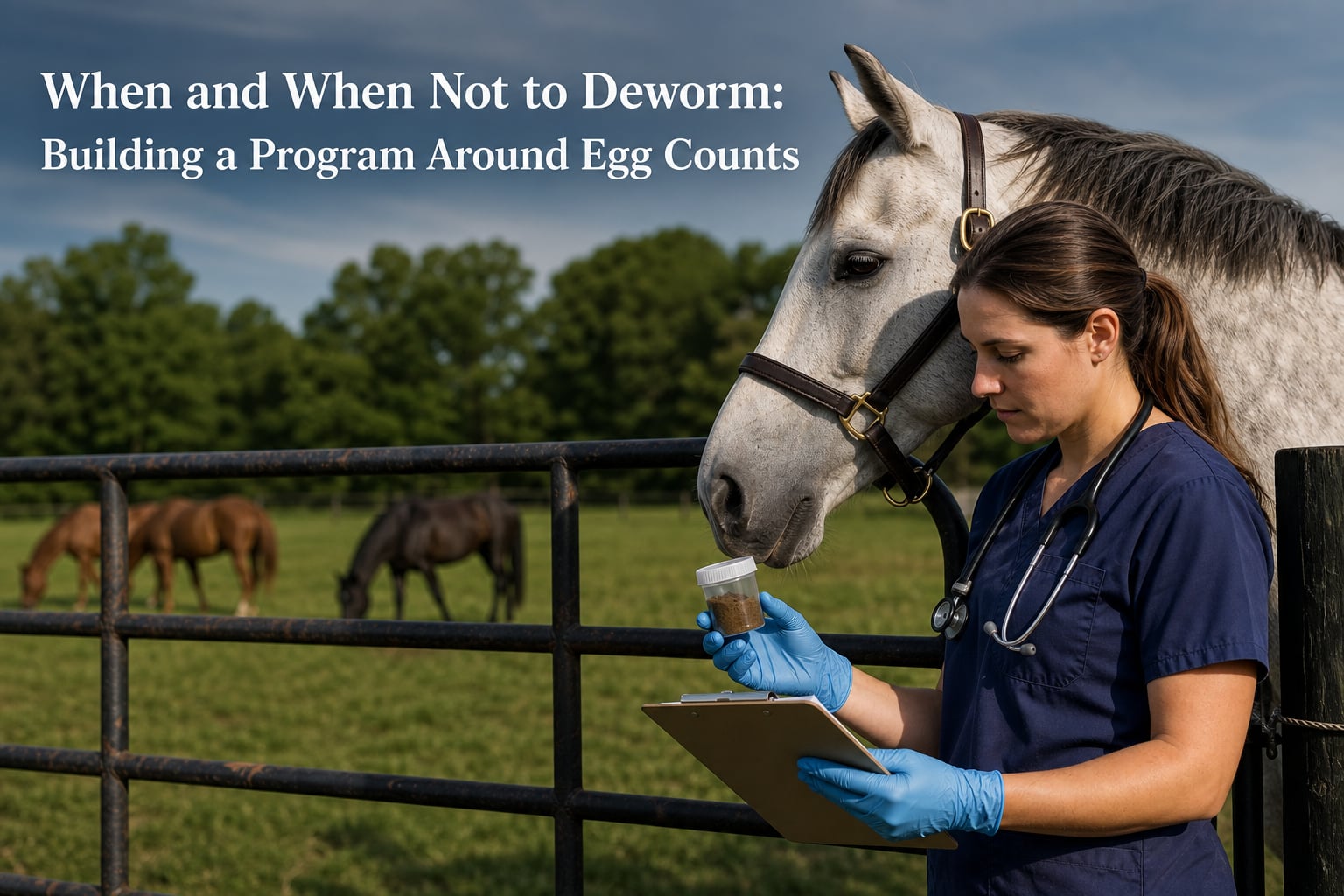
A horse deworming fecal egg count program replaces automatic calendar dosing with a simpler question: what does this horse, on this property, need right now? A fecal egg count (FEC) measures parasite eggs passed in manure, then gives you and your veterinarian a starting point for targeted deworming.
That distinction matters because treatment is not harmless just because it is familiar. Treating when it is not indicated adds drug pressure to the parasite population, which can select for anthelmintic resistance and leave fewer reliable treatment choices when a horse really needs one.
Egg counts are not a permission slip to ignore parasites, either. They are one piece of evidence alongside a horse’s age, condition, grazing history, clinical signs, pasture management, local parasite risk, and veterinary advice.
This guide explains when to test, how to collect a sample, what eggs per gram (EPG) means, and when a low result is a good reason to pause rather than deworm. It also covers the limits of the test, because a result of zero does not mean a horse has no parasites.
Quick answer: Test first when practical, classify the horse’s egg-shedding pattern over time, treat horses whose results and risk justify treatment, and recheck treatment performance with a fecal egg count reduction test when your veterinarian recommends it.
Table of Contents
A fecal egg count measures manure egg shedding, not every parasite in a horse
A fecal egg count is a laboratory examination of a manure sample. The technician mixes manure with a solution that lets certain parasite eggs float, then counts those eggs under a microscope and reports an estimate as eggs per gram, or EPG.
For adult horses, FEC programs chiefly help monitor strongyle-type egg shedding. Small strongyles, also called cyathostomins, are a major focus of modern equine parasite control because they are common and because resistance is a serious concern.
A result is a snapshot of egg output, not a full parasite census. Egg shedding can change with season, individual immunity, grazing exposure, the life stage of a parasite, and recent treatment, so a single test should start a record rather than end the discussion.
EPG is the reported number that sorts horses into practical shedding groups
EPG means eggs per gram of manure. A laboratory method has its own detection limit, so the reported figure is an estimate, not a precise count of every egg a horse passed that day.
For program planning, the commonly used categories in the research brief are under 200 EPG for a low shedder, 200 to 500 EPG for a moderate shedder, and over 500 EPG for a high shedder. Your veterinarian may adjust the interpretation for your region, the test method, and the horse in front of them.
FECs have limits that prevent a low number from becoming false reassurance
Standard manure egg counts do not reveal every important equine parasite or every life stage. Encysted small strongyle larvae, for example, are not reliably represented by an ordinary egg count, and a horse may carry immature parasites before those parasites are producing eggs.
Tapeworms and some other parasites also need separate consideration. A test result should therefore never overrule a veterinary examination when a horse has weight loss, diarrhea, colic signs, poor growth, a rough coat, anemia concerns, or another reason to suspect disease.
Definition: Anthelmintic resistance means parasites survive a drug that once killed them. Targeted deworming aims to reduce needless exposure while still treating horses and parasite burdens that call for treatment.
A horse deworming fecal egg count program follows a repeatable test-and-treat decision path
The useful alternative to rotational deworming is not “never deworm.” It is evidence-based parasite control: collect a meaningful sample, read the result in context, act with your veterinarian, and keep enough records to see patterns at the horse and herd level.
- Step 1: Build a baseline. Record each horse’s age, turnout group, grazing arrangement, prior treatment history if known, body condition, and any parasite-related health concerns. Test adult horses before making broad changes to a deworming schedule.
- Step 2: Collect fresh samples correctly. Take a sample from an identifiable horse, label it immediately, and get it to the chosen laboratory as directed. A poor sample can give a poor answer.
- Step 3: Read the EPG with the horse’s risk factors. Low, moderate, and high are starting categories, not stand-alone diagnoses. A young horse, a new arrival, or a horse with symptoms may need a different plan than a healthy adult with the same number.
- Step 4: Treat selectively when the result and risk support it. High shedders commonly need action; moderate shedders need a veterinarian-guided decision; many low-shedding adult horses can be monitored rather than automatically treated for strongyle egg shedding.
- Step 5: Record the decision. Write down the test date, EPG, laboratory method if reported, treatment decision, active ingredient if prescribed, and follow-up date. A simple spreadsheet or stable record works well.
- Step 6: Review the group, not only the individual. When several horses share pasture, look for a pattern in the turnout group. Multiple high counts point to exposure and manure-management questions, not merely one horse’s result.
This process answers a common worry from horse owners: why deworm at all if the count is low? The answer is that parasite control is broader than a single FEC, yet a low count can still be valuable evidence against treating an adult horse for strongyle egg shedding at that moment.
Records reveal repeat high shedders that deserve closer attention
Many adult horses have fairly repeatable shedding patterns when their management is stable. A horse that is repeatedly over 500 EPG is a likely high shedder and may contribute disproportionately to pasture contamination.
That does not make the horse “bad” or poorly cared for. It gives the owner and veterinarian a reason to monitor that individual more closely, check treatment effectiveness, and review pasture exposure without dosing every herd mate on the same date.
Fecal egg counts belong at planned times and after veterinary-advised intervals
Testing works best when it is scheduled around a purpose. A baseline test before a planned treatment decision is different from a follow-up test that checks whether a treatment worked, and the two should not be confused.
A baseline test is useful before changing a routine program
For an adult horse with no urgent clinical concern, collect a baseline fecal sample during a period of expected parasite transmission in your area and before administering a treatment intended to address egg-shedding strongyles. Local climate changes seasonal risk, so your veterinarian is the right source for the calendar that fits your property.
Owners sometimes test every horse on the same day, which can make herd review easier. Label samples carefully; manure from a shared field or stall floor cannot tell you which individual is shedding eggs.
Repeat surveillance testing tracks the pattern instead of guessing at it
Many programs use spring and fall surveillance to see whether an adult remains a low, moderate, or high shedder. Higher-risk horses and groups may need more frequent monitoring, while a consistent low shedder may need less frequent FEC surveillance under veterinary guidance.
New arrivals deserve separate thought. Their treatment and testing plan depends on their history, the receiving farm’s parasite-control policy, current health, and the risk of bringing resistant parasites onto the property.
Post-treatment timing must match the purpose of the test
A test taken too soon after treatment can be hard to interpret because eggs and parasite stages do not disappear from the manure timeline at the same instant. Research summarized in the SERP material notes that a second FEC 10 to 14 days after deworming can be used to evaluate anthelmintic effectiveness.
That check is called a fecal egg count reduction test, or FECRT, and it needs a pre-treatment count plus a planned post-treatment count. Do not pick a waiting period from a generic chart when a veterinarian has given you a different protocol for a specific drug, horse, or parasite concern.
Warning: Do not delay veterinary care while waiting for a manure test if a horse is ill, has colic signs, is losing condition, has persistent diarrhea, or is a young horse with a suspected parasite problem. A FEC is not an emergency test.
Fresh manure and clean handling produce a useful fecal egg count sample
How you collect a sample affects whether the laboratory can give you a useful result. Horse owners often focus on the container, but the most important point is getting a fresh, identifiable sample to the laboratory promptly and following its instructions.
- Step 1: Identify the horse before collection. Watch the horse defecate when possible, or collect from a clean stall only when you are certain whose manure it is.
- Step 2: Choose fresh material from the center of the pile. Avoid manure that has dried, been soaked by rain, mixed with bedding, or sat in sun. The inside is less exposed to heat and contamination.
- Step 3: Put the sample in a clean, sealed container or bag. Remove extra air if the laboratory asks for a bagged sample, then seal it so the sample does not dry out or contaminate other items.
- Step 4: Label it at once. Include the horse’s name or ID, collection date and time, and any laboratory form details. A sample without a firm identity has little management value.
- Step 5: Keep it cool, not frozen, unless the laboratory directs otherwise. Heat and delay can affect egg recovery. Protect the sample from direct sun and arrange delivery or mailing promptly according to the laboratory’s handling guidance.
- Step 6: Share the relevant history. Tell the veterinarian or laboratory about recent deworming, current illness, the horse’s age, and the reason for testing. Those details change how a result is read.
A mail-in service can be convenient, and a veterinary clinic may offer testing or direct you to a laboratory. The method matters: McMaster-style and centrifuge-based methods can have different sensitivity, which is another reason to compare a horse’s results over time using a consistent testing approach when possible.
EPG categories guide treatment decisions rather than replace veterinary judgment
For a practical adult-horse framework, under 200 EPG is commonly treated as low shedding, 200 to 500 EPG as moderate shedding, and over 500 EPG as high shedding. These bands help sort priorities, but they do not mean every horse in one band receives the same treatment on the same day.
A low count under 200 EPG usually supports monitoring rather than immediate routine treatment
A healthy adult horse with a low FEC is often a candidate for monitoring rather than an automatic strongyle treatment. This is the part of targeted deworming that feels unfamiliar to owners who have long used a fixed rotational schedule, but it is also where unnecessary drug exposure can be reduced.
Low does not equal no parasites. Consider the horse’s age, clinical signs, pasture risk, whether tapeworm or encysted small strongyle risk needs separate action, and any seasonal plan your veterinarian has set before deciding that no treatment is needed.
A moderate count from 200 to 500 EPG calls for a contextual decision
A moderate result deserves a conversation rather than a reflex. A veterinarian may weigh the horse’s prior counts, the time of year, pasture contamination, body condition, recent treatments, and whether the horse shares turnout with young or vulnerable animals.
If the same horse repeatedly falls in the moderate range, it is useful to document that consistency. If the number suddenly rises after a prior low pattern, review sample handling, turnout changes, herd changes, and treatment efficacy rather than assuming the reason.
A high count over 500 EPG makes prompt veterinary-guided action more likely
A horse over 500 EPG is commonly classed as a high shedder. This result raises concern because that horse may be adding more strongyle eggs to the environment, increasing exposure for pasture mates as well as itself.
Very high results, including the 2,000-plus EPG results that surprise some owners in forum discussions, should not lead to improvising multiple treatments. Contact your veterinarian promptly to make a safe, staged plan that accounts for the horse’s health, parasite risk, treatment history, and need for follow-up testing.
Practical rule: Treat the count as a management signal. A high EPG result points toward action and a review of treatment efficacy; a low EPG result points toward monitoring and a review of the parasite risks that FEC does not measure well.
Low egg shedding is often a reason not to deworm immediately
The clearest answer to “when not to deworm” is this: do not automatically administer a strongyle-directed treatment to every healthy adult horse with a low FEC just because the calendar says it is time. First ask whether there is a specific parasite risk that the FEC cannot answer and whether your veterinarian has recommended a seasonal treatment for that risk.
Skipping an unnecessary treatment is an active parasite-control decision, not neglect. It preserves useful drugs, gives you a clearer view of who is actually shedding eggs, and prevents a low-risk horse from receiving medication without a stated reason.
A zero FEC is not a claim that a horse is parasite-free
A zero result means the laboratory did not detect eggs in that sample at that method’s detection level. It does not rule out immature stages, parasites that do not reliably appear on a standard FEC, or egg shedding that happens at another time.
This point explains why FEC-based programs still contain veterinary-led seasonal and risk-based decisions. It also explains why copying another barn’s schedule is unreliable: climate, grazing density, pasture hygiene, age groups, and parasite history differ.
Young horses and unwell horses need a different threshold for concern
Foals, weanlings, yearlings, and young horses are not simply small adult horses in a parasite-control program. Parascaris and other age-linked concerns can matter more in young stock, and a veterinarian may recommend different testing or treatment steps than the adult-horse low/moderate/high strongyle framework.
A horse with clinical signs also needs a clinical assessment, even if the egg count is low. Parasites are only one possible cause of poor condition or digestive signs, and treating without diagnosis can postpone the care the horse actually needs.
Multiple high counts should trigger a pasture-and-herd review
If several horses in one turnout group return high FECs, look beyond the individual results. Review manure removal, stocking pressure, grazing rotation, the introduction of new horses, shared areas, and whether treatment performance has been verified.
It may be sensible to separate the immediate decisions: make a veterinarian-guided plan for the high shedders, then set a follow-up testing plan for the group. Treating all horses blindly can miss the reason the pasture is accumulating exposure and can add avoidable drug pressure to low shedders.
A fecal egg count reduction test checks whether a treatment still works on your property
An FECRT compares a horse’s egg count before treatment with a count taken afterward. It is not the same as a routine FEC, because the purpose is to assess drug efficacy rather than simply classify a horse as a low, moderate, or high shedder.
Start with a count high enough for a meaningful comparison, follow the veterinarian’s treatment protocol, and collect the post-treatment sample at the instructed time. The research material for this article identifies 10 to 14 days after deworming as a commonly cited follow-up window, while the exact protocol remains a veterinary decision.
A poor egg-count reduction needs investigation rather than guesswork
If eggs remain unexpectedly high after treatment, do not assume the answer is to repeat or rotate medication on your own. Sample timing, the original EPG, dosing accuracy, the product’s intended parasite coverage, reinfection risk, and resistance can all affect interpretation.
A veterinarian can help decide whether the result suggests reduced drug efficacy and whether more herd testing is warranted. This is especially useful when a property has a history of high shedders or when several horses show disappointing reductions.
Pasture hygiene and accurate records make targeted treatment more effective
Deworming alone cannot solve an exposure problem created by a heavily contaminated pasture. Parasite eggs leave the horse in manure, so routine manure removal and sensible grazing management reduce the contamination that horses encounter between tests.
Manure removal reduces the source of new pasture contamination
Regularly remove manure from paddocks and high-traffic turnout areas when your setup permits. The practical frequency depends on the property, weather, number of horses, and available labor, but the principle is direct: fewer manure piles left to develop means fewer parasite eggs entering the grazing environment.
Pasture rotation can help as part of a wider plan, yet moving horses without managing manure does not erase parasite risk. Discuss stocking density and grazing strategy with an equine veterinarian or local extension resource familiar with your region.
A one-page herd record makes decisions easier at the next test
Keep each horse’s test dates and EPG results together with turnout group, health notes, treatment decisions, and FECRT outcomes. Over several testing rounds, the record may show a stable low shedder, a repeat high shedder, a sudden change after a pasture move, or a herd-level pattern that needs attention.
This record also prevents a common mix-up: treating the entire group because no one can remember which horse had the high count. Clear identification supports selective therapy and lets your veterinarian advise from facts rather than memory.
A veterinarian turns a test result into a parasite control program
FEC results are most useful when a veterinarian can connect them to age, clinical condition, local seasonal risk, treatment history, and the parasites a standard count may miss. Ask your veterinarian which horses to test, when to collect, when a low count should still lead to action, and when an FECRT makes sense.
Horse-owner discussions often show understandable confusion around zero counts, testing delays after treatment, and surprising high EPG results. A written veterinarian-approved plan removes much of that uncertainty while leaving room to respond when a horse’s health or management changes.
The most common egg-count questions have clear but context-dependent answers
When should fecal egg counts be done?
Fecal egg counts should be done for a defined purpose: before a planned strongyle-treatment decision, during scheduled surveillance for adult horses, or before and after treatment when a veterinarian recommends an FECRT. Many programs use spring and fall surveillance, but local climate, age, grazing management, recent treatment, and health status can change the right timing. Do not test immediately after deworming unless the purpose and timing are part of a veterinary-directed reduction test.
What is a normal fecal egg count for a horse?
For adult-horse program planning, under 200 eggs per gram is commonly considered low shedding, 200 to 500 EPG moderate shedding, and over 500 EPG high shedding. These are management categories rather than universal diagnoses. A laboratory method, the horse’s age, clinical signs, regional parasite risk, and treatment history all affect what the number means for an individual horse.
How do you do a horse fecal egg count?
Collect fresh manure from a positively identified horse, preferably from the clean center of a newly passed pile. Put it in a clean sealed container or bag, label it with the horse name and collection details, keep it cool rather than frozen unless the laboratory says otherwise, and deliver or mail it promptly under the laboratory’s instructions. Share recent deworming and health history so the result can be interpreted correctly.
Should I deworm if a fecal egg count is low?
A healthy adult horse with a low fecal egg count often does not need an automatic strongyle-directed treatment at that moment, but the decision should be veterinary-guided. A low count does not rule out immature parasites, tapeworm risk, or parasites that a standard FEC does not show well. Age, symptoms, season, pasture conditions, and the farm’s program still matter.
Can deworming increase egg production?
Deworming is intended to reduce parasite burdens, not increase egg production. If a later fecal egg count is high, possible explanations include test timing, reinfection from contaminated pasture, a change in the horse’s shedding pattern, or reduced treatment efficacy. A properly planned FECRT, interpreted by a veterinarian, is the way to investigate whether a treatment produced the expected egg-count reduction.
A focused egg-count program makes deworming decisions clearer
When and when not to deworm becomes less confusing when you build a horse deworming fecal egg count program around records instead of a rotating calendar. Start with a fresh, identified sample; interpret its EPG alongside the horse’s age and health; treat only for a stated reason; and follow up when efficacy is in question.
A low count often supports monitoring, while a high count calls for prompt veterinary-guided action and a look at herd exposure. Keep in mind that a zero FEC is not a parasite-free certificate, so seasonal risk and parasites outside the standard test still belong in the plan.
The next practical step is to ask your veterinarian for a property-specific testing calendar and a simple record sheet for every horse. That gives you a program that can protect the horse, reduce avoidable treatment, and preserve useful anthelmintics for the situations where they are needed.