
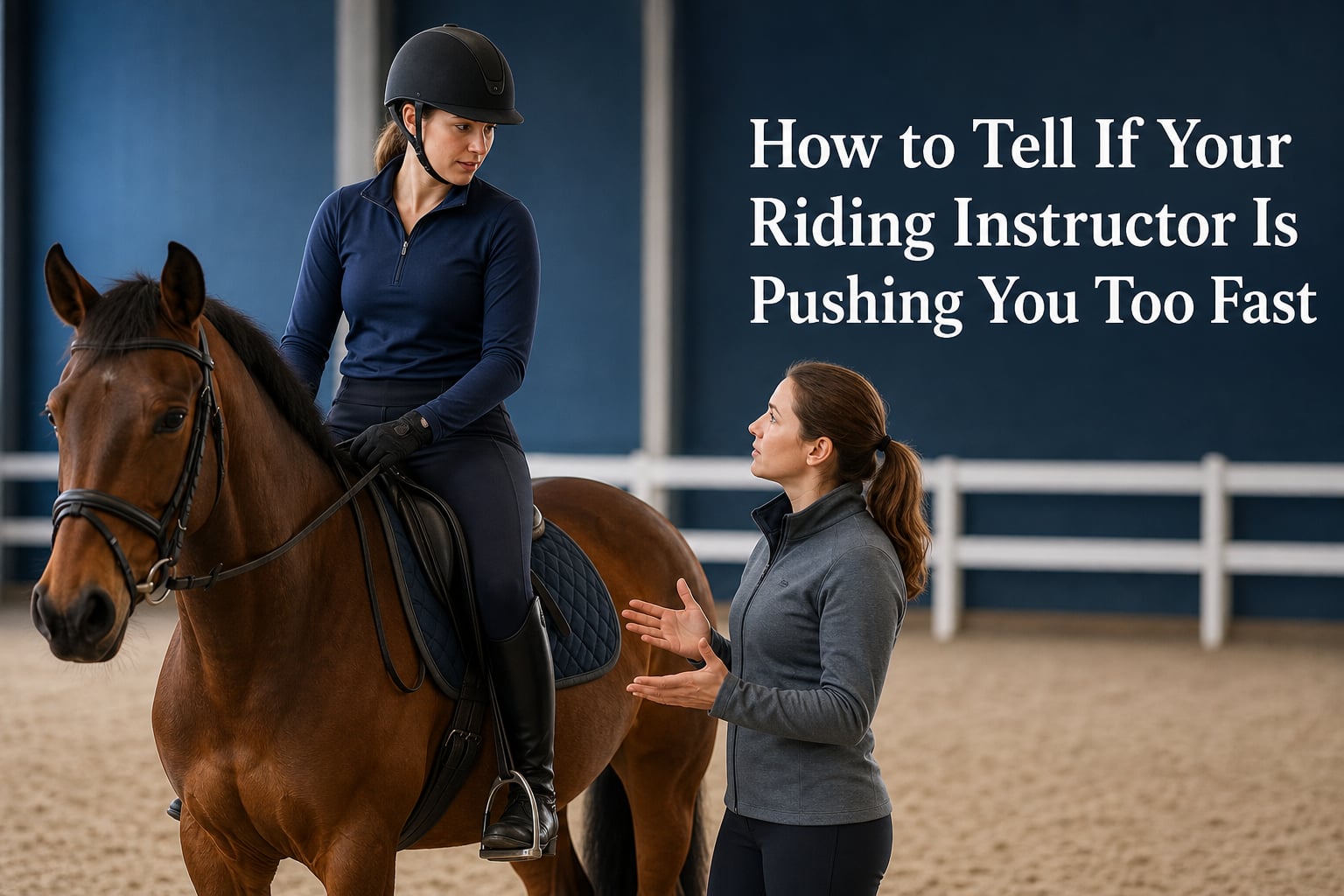
How to Tell If Your Riding Instructor Is Pushing You Too Fast comes down to one question: are you being asked to try a new skill with a clear safety plan, enough preparation, and room to say no? Good riding instruction includes challenge, but it does not make you feel trapped, ignored, or regularly unsafe.
Learning to ride can feel awkward. Your legs may ache after a first rising trot, and a new canter can make your stomach flip. Those feelings alone do not prove that a lesson pace is wrong; the pattern around them does.
An instructor is moving too quickly when they add demands before you have a workable foundation, cannot explain why the next step fits your skills, or dismiss your need for help. In riding language, a horse or rider in that position is often called overfaced: asked to do more than they can reasonably understand or manage at that moment.
That matters because horse riding is shared risk. A rider who freezes, grips, loses balance, or stops listening to instructions can frighten a lesson horse, while a worried horse can make an already overwhelmed rider feel even less secure.
Table of Contents
Yes, your instructor may be pushing too fast when these ten signs keep appearing
One difficult exercise is not a verdict on a teacher. Look for repeated signs across several lessons, especially when you have explained what is happening and the response stays the same.
- You are introduced to several new tasks before one basic task feels understandable. For example, being told to steer, rise, change diagonal, hold a jumping position, and cope with a faster gait in the same short lesson gives a beginner very little time to process.
- You do not know the purpose of the exercise. An instructor need not lecture through every minute, but they should be able to say what you are practising and what “good enough for today” looks like.
- You are pushed forward after saying that you are scared, confused, hurt, or not ready. Coaching sometimes includes calm encouragement; it should not turn a stated boundary into something to mock or brush aside.
- You lose skills you could do before because every lesson feels like survival. A rider who can walk, halt, steer, and ride a few balanced strides at trot may suddenly feel unable to do any of them when the task pile becomes too large.
- Your instructor gives only criticism, then adds difficulty. Useful feedback identifies one change, gives you a chance to try it, and recognizes a genuine improvement.
- You receive no mounted or ground-level support for a risky first attempt. The amount of help depends on the exercise and horse, but first canters, poles, or jumps should never feel like a surprise test.
- You dread lessons more often than you look forward to them. Nerves before a new skill are common; ongoing anxiety, shame, or a sick feeling before nearly every lesson is a red flag in riding lessons.
- You are compared to another rider rather than taught at your own pace. Age, fitness, past experience, the horse, lesson length, and how often you ride all change the learning curve.
- You cannot ask for a break, explanation, or easier version without a negative reaction. A rider needs enough agency to say, “Can we walk for a minute?” or “Could you show me that again?”
- The horse is also showing strain or resistance in a lesson pattern. Repeated stopping, rushing, pinned ears, sourness around the arena, or unusual fatigue deserve attention rather than simply escalating the demand.
A few of these can happen in an otherwise sound program, particularly during a busy group lesson. The concern grows when they form a pattern and when an instructor does not adapt after you bring them up.
How to Tell If Your Riding Instructor Is Pushing You Too Fast starts by separating challenge from overload
A suitable challenge asks you to work near the edge of what you can already do, not beyond your ability to stay present. You may make mistakes, need several tries, and feel pleasantly tired afterward, but you should still understand the instructions and have a way to return to walk, halt, or another known exercise.
Appropriate progress feels demanding but still understandable
In a good lesson, the instructor builds from fundamentals first. Before asking for a longer trot, for instance, they may check that you can steer a reliable line, keep your lower leg reasonably steady, use the reins without pulling for balance, and regain control if the horse speeds up.
The next step is explained in plain language. A coach might say, “We will trot only to the next letter, then walk. Keep your eyes up and hold the mane if you need it.” That is very different from sending a nervous beginner around the arena with an instruction they cannot yet decode.
Too-fast progress feels like a test you were not taught to take
Too-fast instruction piles a new gait, new position, new steering pattern, and new expectation into one moment. A rider may be told they are capable, yet receive no smaller steps that would let them discover how to be capable.
Forum conversations often describe this exact problem: an early lesson goes smoothly, then a later one introduces posting and a jumping position with little saddle time or explanation. The rider leaves feeling humiliated and defeated, not because they failed an ordinary learning task, but because the task was too broad for their current experience.
Progression has no universal lesson-by-lesson schedule
There is no honest rule that says every beginner should post after a certain number of lessons or canter by a fixed date. Someone who rides once a week on a steady horse may need much more repetition than a rider with past experience who rides several times each week.
Weather, arena footing, the horse’s temperament, physical strength, confidence, and whether you are learning English riding or western riding all matter. A responsible instructor uses those facts to adjust the lesson structure rather than treating a calendar as proof that you should be ready.
Your body and emotions give useful information about lesson pace
Physical discomfort does not always mean danger. Riding uses unfamiliar muscles, and the work of learning a sitting trot or two-point can leave you tired. Pain that is sharp, increasing, connected to an injury, or makes it hard to use your body safely is different from normal exertion and should be reported immediately.
Physical overload shows up as loss of control, not just sore muscles
Watch for hands that lock on the reins, legs that clamp without you intending to, breath-holding, dizziness, or fatigue so strong that you cannot follow a simple direction. These are signs to slow the exercise down, not character flaws to power through.
Repeated falls, near-falls, or being placed on a horse whose movement you cannot manage are also serious horseback riding instructor warning signs. Ask to return to a calmer horse, a lead-line exercise, or work at walk while you rebuild a basic skill.
Emotional overload shows up as persistent dread or shame
Feeling overwhelmed in riding lessons can look quiet. You may make excuses to miss class, cry in the car afterward, rehearse being criticized before you arrive, or stop asking questions because you expect to be called dramatic.
Those emotions deserve respect. Riders in community discussions have described looking to a trainer for reassurance only to be told to “get over” themselves, and that response can turn a temporary fear into lasting anxiety around horses.
Notice the difference between being proud after a hard lesson and feeling smaller after one. Constructive coaching can be direct, yet you should come away knowing what went better, what one thing to practise next, and why the instructor believes you can get there.
Your voice matters even when you are a beginner
Beginners sometimes assume they have no standing to question a professional. You do not need to diagnose a training program or prove your concern before asking for clarification; you only need to describe your experience accurately.
Try keeping a short note after each lesson: what you worked on, the moments you felt settled, the moments you became confused, what the horse did, and what response you got when you asked for help. Two or three entries can make a vague feeling easier to discuss calmly.
Your horse may also be telling you that the pace or workload needs attention
A horse’s behavior is communication, but it is not a neat diagnosis. Stopping at a fence, rushing, swishing a tail, pinning ears, or resisting a transition can arise from pain, tack fit, training, fear, fatigue, or confusion; no instructor should assume it is simply defiance.
Overwork often looks like a change from the horse’s usual way of going
Possible symptoms of an overworked horse include unusual tiredness, slower recovery after ordinary effort, reluctance to go forward, shortened stride, repeated stumbling, irritability during grooming or tacking up, and a sudden loss of willingness at work. Any acute lameness, heat, swelling, breathing concern, or marked behavior change calls for stopping work and contacting the horse’s owner or manager, with veterinary advice when appropriate.
In a lesson setting, a novice rider cannot always know the horse’s baseline. You can still notice whether the same horse repeatedly carries back-to-back difficult lessons, gets no walking breaks, or is asked to repeat an exercise after showing escalating distress.
Resistance is a reason to investigate, not a cue to punish harder
A horse who stops may be confused, tired, worried, sore, or simply unable to understand the question. A safe instructor assesses the situation, changes the exercise, checks equipment and footing, or gets qualified help instead of making a nervous rider force the issue.
The same principle applies to a rider. When a rider freezes at a canter transition or a small jump, returning to groundwork, flat work, poles, or a few quiet walk-trot transitions is teaching, not failure.
The 20% rule is a training guideline, not permission to ignore warning signs
In horseback riding, the “20% rule” commonly refers to changing a horse’s workload gradually rather than making a large sudden increase, often described as no more than roughly 20% at a time. It is a broad planning idea, not a medical formula and not a replacement for observing the individual horse.
For a lesson rider, the useful takeaway is simple: duration, intensity, complexity, and frequency should not all rise at once. If your instructor adds a faster gait or a new technical demand, the rest of the lesson should stay manageable enough for both you and the horse to learn.
You can address a too-fast lesson pace with a specific, calm plan
Start outside the moment of fear if you can. A brief conversation before or after a lesson is usually more productive than trying to explain yourself while a horse is moving and everyone is under pressure.
Step 1: Name the pattern and the goal
Use observations rather than labels. “I want to learn to canter, but in the last two lessons I lost track of the instructions once we added the full arena. I need a smaller step so I can keep my balance and understand the cue.”
This wording does not accuse the instructor of being bad. It asks them to connect your riding goals with a lesson pace that lets you learn safely.
Step 2: Ask five questions that reveal the teaching plan
- What skills do you want me to have before we move to the next gait or exercise?
- What is the one thing I should focus on during this lesson?
- Can we break this into a shorter exercise, a demonstration, or ground lessons first?
- What should I do if I feel unbalanced or the horse becomes quicker than I can manage?
- How will we know that I am ready to progress?
A thoughtful instructor might answer differently depending on your discipline and horse, but they should welcome the questions. If you consistently get vague answers, ridicule, or pressure to ignore fear, you have useful information about instructor not listening in riding lessons.
Step 3: Request a concrete reset for the next lesson
Ask for one or two changes you can see: a quieter horse, private rather than group instruction for a session, more time at walk and trot, a lunge lesson, a lead-line introduction, or a clear stop point after a few successful attempts. A reset is not a retreat from your goals; it gives your brain and body the repetition needed to meet them.
For example, you might say, “For the next two lessons, can we work on a balanced rising trot and steering before we add poles? I would like to feel consistent there first.” The request is specific, time-limited, and easy for a good teacher to discuss.
Step 4: Judge the response, not only the promise
A good response includes listening, a practical adjustment, and follow-through. Your instructor may explain a safety reason for their original plan, but they should still adapt the task, discuss options, or refer you to a program better suited to your needs.
A poor response makes you responsible for the instructor’s reaction. Dismissing fear as weakness, laughing at mistakes, refusing all modifications, or punishing a horse or rider for confusion are riding instructor red flags even when the person has impressive credentials or competitive results.
Step 5: Change instructors when safety and respect do not improve
Consider a new instructor if you have clearly raised the concern, given a reasonable chance for change, and still feel routinely unsafe, belittled, or unable to learn. You do not need permission to choose a teaching style that supports your student confidence and treats the horse fairly.
When leaving, keep the message brief: “Thank you for the lessons. I have decided to look for a program with a slower, fundamentals-focused pace that better matches my current goals.” You do not owe a debate or a detailed defense of your decision.
The answers below help you decide what a safe next step looks like
What is the 20% rule in horseback riding?
The 20% rule is a broad guideline for gradually changing a horse’s workload rather than making a large sudden increase. It is not a medical rule or a reason to overlook fatigue, pain, behavior changes, fitness, footing, or heat.
What are signs a horse does not like you?
A horse may show discomfort through pinned ears, tail swishing, moving away, tension, or reluctance to be caught or handled, but these behaviors do not prove that the horse dislikes a person. Consider pain, tack, training history, environment, and the horse’s usual behavior before drawing conclusions.
What are the symptoms of an overworked horse?
Possible signs include unusual fatigue, slow recovery, reluctance to move forward, shortened stride, stumbling, irritability, and a sudden change in willingness to work. Stop work and alert the owner or manager about concerning changes; veterinary advice may be needed for lameness, swelling, heat, breathing problems, or marked distress.
What should I do if I feel overwhelmed in riding lessons?
Tell the instructor outside the pressured moment, describe the exact exercise that feels too fast, and ask for a smaller step or more support. If the instructor dismisses you or the lesson remains unsafe after a clear conversation, seek another qualified instructor or program.
A better riding lesson challenges you while keeping learning and safety intact
How to Tell If Your Riding Instructor Is Pushing You Too Fast is not about avoiding every uncomfortable moment. It is about recognizing whether each new demand has preparation, explanation, meaningful choice, and a safe path back to basics.
Speak up with one specific example, ask for a smaller step, and watch what changes. The right instructor will take your concern seriously and help you build the skills that make riding feel more capable, not less.