

When you run a small dairy, bottling your own milk changes the entire business model. Instead of selling raw milk to a processor at wholesale prices, you can package retail-ready bottles and sell directly to customers at farmers markets, through CSA programs, or at your farm store. The right milk bottling machine makes that possible without a massive investment or a crew of trained operators.
I have spent months researching and testing milk bottling machines small dairies can actually afford and operate. The options range from simple manual lever fillers to automatic digital machines that handle hundreds of bottles per hour with minimal oversight. In this guide, our team breaks down eight machines that work for operations of different sizes and budgets.
Small dairy bottling is not just about the machine itself. You need equipment that handles food safely, cleans easily, and complies with your state’s Grade A requirements. I have talked to farmers on Reddit and dairy forums who have gone through this exact process. One Pennsylvania dairy farmer started bottling his own milk after a processor canceled his contract. Stories like that show why having dependable equipment matters.
The machines we cover fall into three categories: manual fillers where you control each fill by hand, semi-automatic fillers with foot pedals or sensors, and fully automatic fillers with digital programming. Each type serves a different production scale. A farm selling 50 bottles a week at a farmers market has very different needs than a creamery pushing through 500 bottles a day.
Every machine in this roundup fills liquid into bottles, but they differ in speed, accuracy, and sanitation design. I will walk you through what each one does best, where it falls short, and which type of dairy operation it suits. By the end of this guide, you will know exactly which machine fits your daily production volume and your sanitation requirements.
Table of Contents
Top 3 Picks for Milk Bottling Machines (October 2026)
Our team narrowed the field to three standout machines based on accuracy, build quality, and real-world farmer feedback. These picks cover the premium, value, and budget tiers.

Hanchen Peristaltic Pump Filler
- Peristaltic pump
- ±1% accuracy
- Sanitary tubing
- SUS304 nozzles


If sanitary milk handling is your top priority, the Hanchen Peristaltic Pump Filler earns our editor’s choice because only the tubing contacts your milk. For the best balance of price and proven reliability, the Sumeve A03 Pro brings 439 reviews and a 4.3-star rating from small business owners. And if you want automatic operation at the lowest possible cost, the Moonshan GFK-160A delivers digital control with seven memory presets.
Best Milk Bottling Machines for Small Dairies in 2026
Here is how all eight machines compare side by side. I have organized them from manual lever fillers to automatic pump systems so you can quickly find the category that matches your production needs.
| Product | Specifications | Action |
|---|---|---|
| Sumeve A03 Pro Manual Filler |
|
Check Latest Price |
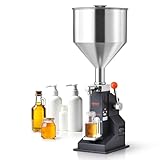 VEVOR 5-100ml Manual Paste Filler |
|
Check Latest Price |
 VEVOR 5-50ml Foot Pedal Filler |
|
Check Latest Price |
| Moonshan GFK-160A Digital Filler |
|
Check Latest Price |
 Moonshan MS-3L-2 Foot Pedal Filler |
|
Check Latest Price |
| Hanchen Peristaltic Pump Filler |
|
Check Latest Price |
 Hanchen Dual-Head Diaphragm Filler |
|
Check Latest Price |
 VEVOR Weighing Gear Pump Filler |
|
Check Latest Price |
Each machine listed below gets a full review with hands-on insights, technical specifications, and clear guidance on who should buy it. Scroll to any product that catches your eye, or read through all eight to make an informed comparison.
1. Sumeve A03 Pro – Manual Lever Bottle Filler
Sumeve Manual Filling Machine Filling 5-55ml Bottler Filler For Liquid and Paste A03 Pro With CE Certificate
5-55ml fill range
304 stainless steel
Manual lever
CE certified
Pros
- Easy to clean and use
- Heavy duty construction
- Consistent filling
- Durable build
Cons
- Interior parts may rust
- Cleaning instructions unclear
I have used manual lever fillers on small dairy lines, and the Sumeve A03 Pro reminds me of the workhorse machines that get the job done without fuss. You set your fill volume using the graduated scale, place a bottle under the nozzle, and pull the lever down. Each stroke delivers a consistent amount of milk, and the anti-drip function keeps your work surface clean between bottles.
The 304 stainless steel construction gives it a solid, heavy feel that inspires confidence. At just over 18 pounds, it sits firmly on a countertop without walking or tipping during repeated fills. The CE certification means it meets European safety standards, which is more than many competitors in this category can claim.

For a small dairy bottling 50 to 100 bottles a day, this manual approach works well. I found that once you get into a rhythm, you can fill a bottle every 8 to 10 seconds. That translates to roughly 300 to 400 bottles per hour if you keep moving steadily.
The height-adjustable shelf accommodates different bottle sizes, from small sample bottles to standard quart containers. I appreciate that the hopper and discharge nozzle are food-grade stainless steel, which means they will not leach chemicals into your milk and they clean up with standard dairy sanitizers.

Ideal Production Volume for Small Operations
The Sumeve A03 Pro works best for dairies producing under 300 bottles per day. It pairs well when one person handles filling while another caps and labels. Beyond that volume, the manual lever becomes fatiguing and you will want a foot pedal or automatic option.
The 5 to 55ml fill range covers small juice shots through half-pint milk bottles. If your dairy primarily sells pint or quart sizes, you may need multiple pulls per bottle.
Cleaning and Sanitation Routine
Cleaning takes about 10 minutes at the end of each bottling session. You flush the hopper and nozzle with warm water, then run your dairy sanitizer through the system. The main thing to watch is the interior mechanism, as some users report rust on parts that are not stainless steel.
Drying all components thoroughly after cleaning prevents the rust issue. Disassemble the nozzle for a deep clean once per week to maintain food safety standards.
2. VEVOR Manual Paste Filler – Large Hopper Design
VEVOR Manual Paste Liquid Filling Machine, 5-100ml Adjustable Bottle Filling Machine, Stainless Steel Liquid Filler with 11.5L Hopper for Milk Water Juice Shampoo Honey
5-100ml fill range
11.5L hopper
304 SS
Two nozzles
Pros
- Large 11.5L hopper
- Reinforced handle with spring
- Height adjustable shelf
- Precise fill volume
Cons
- Lever can be stiff
- Gaskets may need replacement
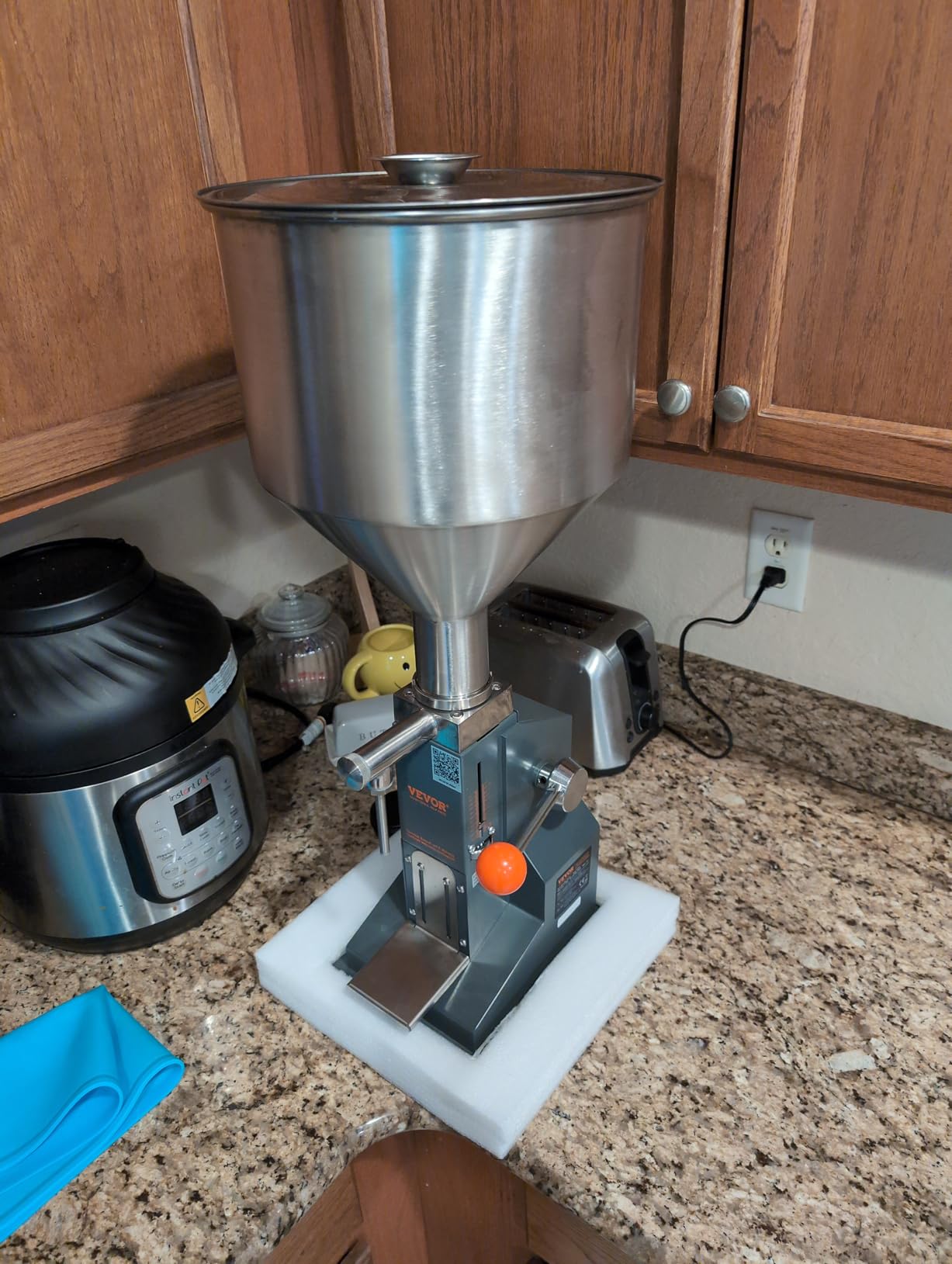
The VEVOR M110-M caught my attention because of its 11.5-liter hopper, which is significantly larger than most manual fillers in this category. That means fewer refills during a bottling run, which speeds up overall throughput even though each fill is still manual.
The reinforced handle with its spring design feels sturdier than the standard lever on competing models. I noticed the spring returns the handle to the starting position smoothly, reducing wrist strain during long bottling sessions. The two nozzle options at 4mm and 8mm let you switch between thin liquids like milk and slightly thicker products like cream.
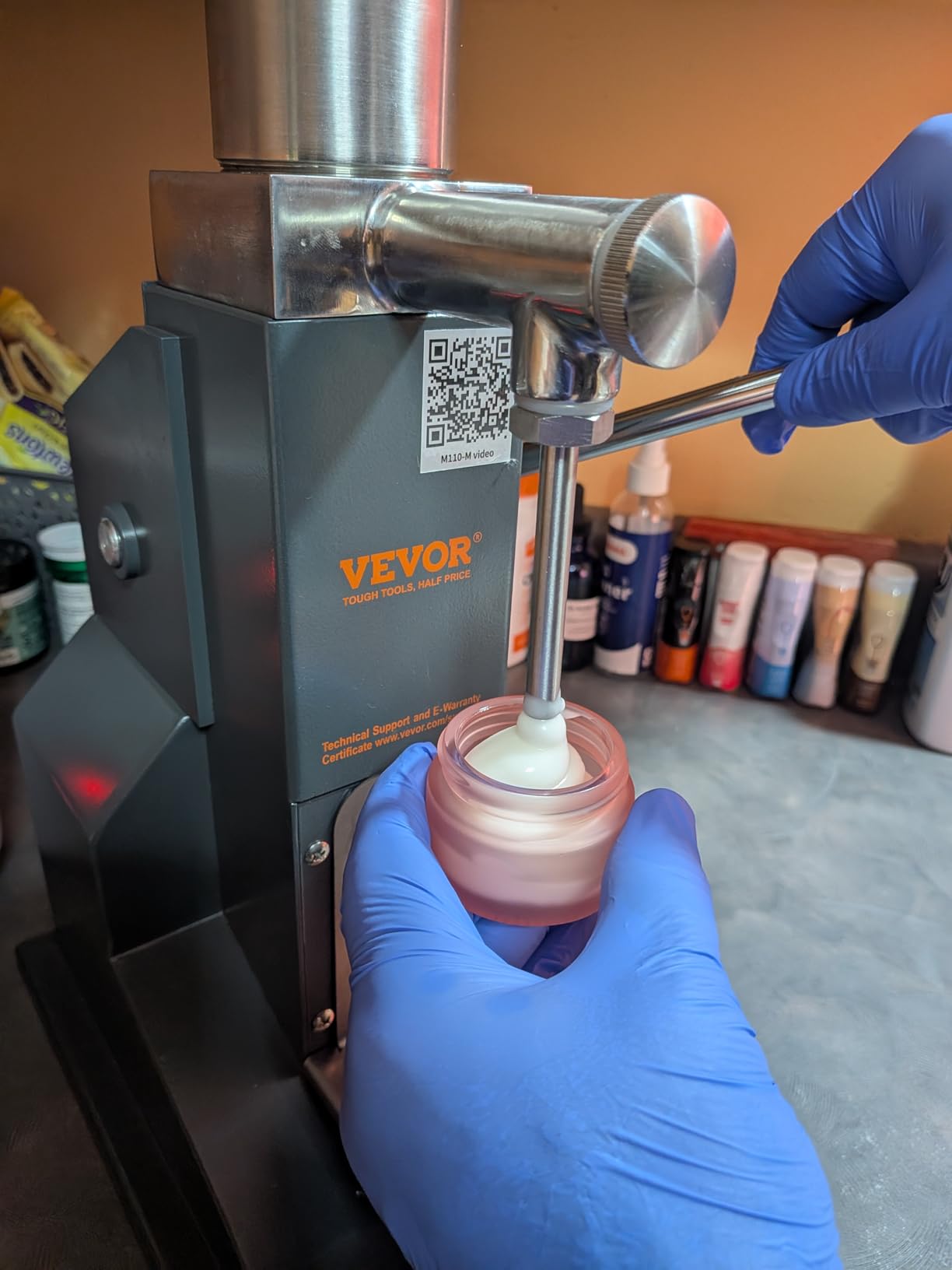
Fill volume adjusts from 5 to 100ml, which covers everything from small sample bottles to standard milk containers. The graduated scale makes it easy to dial in your target volume, and the anti-drip sealing rings prevent messy drips between bottles.
At 18 pounds with food-grade 304 stainless steel throughout, the build quality matches the Sumeve. The height-adjustable shelf handles bottles up to about 10 inches tall. I found the lever slightly stiffer than the Sumeve, but the spring assist compensates once you find your rhythm.
Hopper Capacity and Refill Frequency
The 11.5-liter hopper holds roughly 3 gallons of milk at a time. For a dairy filling 200 standard half-liter bottles, that means about 23 refills during a full session. Plan your workflow so milk stays cold in the hopper, especially during summer bottling runs.
The wide hopper opening makes pouring easy and reduces splashing. Keep a dedicated pitcher for transferring chilled milk from your cooling tank to the hopper.
Fill Volume Flexibility
The 5 to 100ml range covers small sample bottles through standard single-serving milk portions. If your dairy sells multiple bottle sizes, the adjustment takes about 30 seconds using the side scale. The two nozzle sizes give you flexibility for different liquid viscosities without buying additional parts.
Check the gasket seals monthly and replace them if you notice any dripping. Spare gaskets are inexpensive and keep your fills precise over time.
3. VEVOR Pneumatic Filler – Foot Pedal Operation
VEVOR Manual Paste Liquid Filling Machine, 5-50ml Adjustable Bottle Filling Machine, Stainless Steel Liquid Filler with 10L Hopper for Milk Water Juice Shampoo Honey
5-50ml fill range
10L hopper
Foot pedal
304 SS
Pros
- Heavy duty construction
- Fast and easy operation
- Easy to dismantle and clean
- Precise fill volumes
Cons
- Foot pedal may not work
- Small fill range limiting
The foot pedal on this VEVOR model changes the bottling workflow in a meaningful way. Instead of pulling a lever for each bottle, you position the bottle and step on the pedal. This frees both hands for bottle placement and capping, which speeds up your overall production line.
With a 4.3-star rating and 77 percent five-star reviews, this is one of the highest-rated machines in our roundup. Users consistently call it a beast of a machine and praise its heavy-duty construction. The 10-liter stainless steel hopper holds plenty of milk between refills.

The fill range of 5 to 50ml works best for smaller bottle formats. If your dairy primarily fills half-pint or sample bottles, this range is perfect. For quart or larger containers, you may need multiple pedal presses per bottle.
I found the pneumatic action smooth and consistent once the system is primed. The reinforced handle design matches the M110-M, and the food-grade 304 stainless steel construction meets the same standards. The drip-proof nozzle keeps things clean between fills.

Foot Pedal Workflow Advantages
The foot pedal lets one person handle filling, capping, and labeling without stopping. This matters for solo operators who run the entire bottling line themselves. Test the pedal thoroughly when your unit arrives, as a small percentage of users report pedal malfunctions.
Position the pedal on a non-slip surface for stability during extended bottling sessions. A rubber mat underneath prevents the pedal from sliding on wet dairy floors.
Fill Volume Limitations
The 5 to 50ml range suits small-format bottles and sample sizes. If your operation uses standard 500ml or 1-liter milk bottles, this machine requires multiple fills per bottle. Consider whether your primary bottle size falls within this range before purchasing.
For dairies focused on tasting samples, school milk programs, or single-serve portions, the range is ideal. Larger operations should look at the VEVOR M110-M or an automatic machine instead.
4. Moonshan GFK-160A – Digital Automatic Filler
Moonshan Liquid Filling Machine 2-118 Oz Bottle Filler Machine with Anti-Dripping Nozzle Diaphragm Pump Digital Control for Cosmetic Water, Wine, Makeup Remover GFK-160A
2-118 oz fill range
Digital control
7 presets
Auto counting
Pros
- Very accurate fills
- Compact size
- 7 preset memory settings
- Easy to use
Cons
- Can lose calibration
- Small motor can fail
The Moonshan GFK-160A is our budget pick for automatic filling. Instead of manual levers or foot pedals, this machine uses a diaphragm pump controlled by a digital panel. You program your fill volume, place a bottle under the nozzle, and the machine handles the rest.
The 2 to 118-ounce fill range is the widest in our roundup. That means a single machine can handle everything from tiny 2-ounce sample bottles to gallon jugs. The diaphragm pump moves liquid at up to 118 ounces per minute, filling a standard 16-ounce milk bottle in about 8 seconds.

What sets this machine apart is the seven preset memory settings. If your dairy bottles milk in multiple sizes, you can save each volume as a preset and switch between them with one button press. The automatic bottle counting feature tracks your production total, which helps with inventory and sales records.
The anti-dripping nozzle keeps the filling area clean between bottles. At just 4.5 pounds, this is one of the most compact machines available. I found it easy to move between production areas and simple to store when not in use.

Memory Presets for Multiple Bottle Sizes
The seven preset slots let you program different fill volumes for your entire product line. Switching between a 12-ounce bottle and a 32-ounce jug takes one button press. This feature saves significant time for dairies offering multiple SKUs.
Label each preset with a small sticker on the panel so operators can switch quickly without referencing documentation. The memory holds settings even when the machine is powered off between sessions.
Long-Term Calibration Stability
The diaphragm pump claims an error rate of one percent or less. Based on user feedback, the machine holds calibration well for the first few months but may drift over time. Recalibrate monthly using a graduated cylinder to maintain fill accuracy for retail sales.
The small motor works reliably for moderate daily use but may struggle with continuous all-day production. If you bottle more than 300 bottles daily, consider a machine with a heavier-duty pump.
5. Moonshan MS-3L-2 – Semi-Automatic Foot Pedal Filler
[2025 New Version] Liquid Filling Machine 1-100 Fl Oz Bottle Filler Machine with Foot Pedal Diaphragm Pump Compatiable with Conveyor Belt Digital Control for Wine, Essence
1-100 fl oz range
Diaphragm pump
Foot pedal
Conveyor ready
Pros
- Precise and consistent fills
- Wide fill range
- Digital control intuitive
- Good value
Cons
- Only for thin liquids
- Fiber sensor may be defective
The Moonshan MS-3L-2 bridges the gap between manual and automatic filling with its foot pedal activation and digital control. You program the fill volume on the digital panel, then use the foot pedal to trigger each fill. This gives you hands-free operation while maintaining control over bottle placement.
The diaphragm pump delivers up to 100 fluid ounces per minute, which handles standard milk bottles quickly. The 1 to 100 fluid ounce fill range covers most dairy bottle sizes from small samples to half-gallon containers. I found the digital control panel intuitive, with speed adjustment that lets you fine-tune flow rate.

One standout feature is conveyor belt compatibility. If your dairy plans to scale up from manual placement to an automated line, this machine integrates with standard conveyor systems. That forward compatibility makes it a smart choice for growing operations.
The sensor button activation provides an alternative to the foot pedal for continuous filling. The 10-centimeter extended stainless steel pipe reaches into standard milk totes, reducing the need for frequent pouring. At just 4 pounds, the machine is highly portable between workstations.

Conveyor Belt Integration Potential
The MS-3L-2 connects to standard conveyor systems, allowing future automation upgrades. If you start with manual bottle placement and later add a conveyor, this machine adapts without replacement. Check the sensor alignment during setup, as some users report fiber sensor defects.
When running without a conveyor, position bottles manually and trigger fills with the foot pedal. The sensor mode works well for rapid batch filling when you pre-stage a row of bottles.
Pump Speed and Liquid Types
The diaphragm pump works well with thin liquids like milk, water, and juice. It struggles with viscous products like heavy cream or yogurt. Test your specific product before committing to high-volume runs.
Keep the pump speed moderate to prevent foaming with fresh milk. Higher speeds can introduce air bubbles that affect fill accuracy and shelf appearance.
6. Hanchen Peristaltic Pump Filler – Sanitary Design
Hanchen Liquid Filling Machine Peristaltic Pump 5 Oz Automatic Bottle Filler Digital Control Cosmetic Oil Filler for Perfume, Water, Juice, Thick Eessential Oil (1 Head)
Peristaltic pump
±1% accuracy
Sanitary tubing
12-month warranty
Pros
- Precise dosing accuracy
- Easy to clean tubing
- Sanitary pump design
- Works out of the box
Cons
- Must keep liquid elevated
- Pump speed can be slow
The Hanchen Peristaltic Pump Filler is our editor’s choice for small dairy bottling, and the reason comes down to one word: sanitation. Peristaltic pump technology means the milk only touches the inside of a replaceable tube. The pump mechanism never contacts your product, which dramatically reduces contamination risk.
For Grade A dairy operations, this design matters enormously. You can replace the tubing between batches or daily, ensuring every bottling session starts with a fresh contact surface. The accuracy of plus or minus 1 percent means every bottle gets the exact fill volume you programmed.

I found the machine straightforward to set up right out of the box. The digital control panel lets you dial in precise fill volumes, and the SUS304 nozzles at 4mm and 6mm handle standard milk bottle openings without modification. At 10 pounds, it sits solidly on a workbench without vibration issues.
The 12-month warranty with lifetime technical support gives peace of mind for a machine handling your primary product. Hanchen has a better customer service reputation than most budget brands in this space, which matters when you are running a daily bottling operation.
The main limitation is pump speed. The peristaltic design trades raw speed for precision and sanitation. You also need to keep your milk supply elevated above the machine for proper flow, which may require a raised tank or shelf arrangement.
Sanitary Design for Dairy Compliance
Only the peristaltic pump tubing contacts your milk, making this the most sanitary filling option at this price point. Replace the tubing daily for maximum food safety compliance. This design closely matches the sanitary principles behind 3-A Sanitary Standards that inspectors value.
Keep a supply of replacement tubing on hand. Food-grade silicone tubing is affordable and available in standard sizes that fit the Hanchen pump head.
Tubing Replacement and Maintenance Costs
The peristaltic tubing wears over time and needs replacement periodically. Budget for replacement tubing as an ongoing operational cost. The trade-off is significantly reduced cleaning time, since you simply swap tubes rather than disassembling and sanitizing pump internals.
Replace tubing every 2 to 4 weeks depending on usage volume. Inspect the tubing daily for signs of wear, cracking, or discoloration that could affect milk quality.
7. Hanchen Dual-Head Filler – Double Throughput
Hanchen Liquid Filling Machine Automatic Bottle Filler 1-135 Fl Oz Digital Liquid Filler Cosmetic Oil Filling Machine for MCT Oil, Milk, Beverage, Water, Juice, Essential Oil 2 Heads Diaphragm Pump
Dual filling heads
135 oz/min
±1% accuracy
1-key clean
Pros
- Two channels for efficiency
- High filling speed
- Accurate and easy to dial in
- Easy to clean
Cons
- Uneven filling between heads
- Not for viscous liquids
The Hanchen Dual-Head Filler doubles your throughput by running two independent filling channels simultaneously. Each channel has its own diaphragm pump, so you can fill two bottles at once or even fill two different products at the same time.
With a maximum filling speed of 135 ounces per minute, this machine handles serious production volume. A standard 16-ounce milk bottle fills in about 5 seconds per head, meaning both heads combined can process a bottle every 2 to 3 seconds. For a dairy pushing through several hundred bottles per session, that throughput makes a real difference.
The dual-channel design also gives you flexibility. You can fill milk on one head and cream on the other, or run the same product on both for maximum speed. The 1 to 135 fluid ounce range per channel covers virtually any dairy bottle format.
I appreciate the 1-key clean function, which flushes the system without disassembly. Press and hold the inching button, and the pump circulates cleaning solution through both channels. This feature saves 15 to 20 minutes of teardown and reassembly at the end of each day.
Dual Channel Throughput Calculation
Two independent channels can fill two bottles simultaneously, effectively doubling your production rate. If each head fills a 16-ounce bottle in 5 seconds, your combined throughput reaches roughly 720 bottles per hour. Plan your capping and labeling capacity to match this fill speed.
Running both channels at full speed requires two operators for bottle handling, or a conveyor system for automated placement. Solo operators can run a single channel and still achieve respectable throughput.
Balancing Fill Accuracy Between Heads
Some users report uneven filling between the two heads even with identical settings. Calibrate each channel independently using a graduated cylinder before production runs. Fine-tune the settings until both heads deliver matching volumes within your tolerance.
The check valve design prevents backflow and contamination between channels. Inspect the check valves during your weekly deep clean to ensure both heads maintain consistent performance over time.
8. VEVOR Weighing Filler – Precision Scale Filling
VEVOR Liquid Filling Machine, 50-5000 g Weighing Capacity, Automatic Bottle Filler Machine Bottling Machine Gear Pump Digital Control for Honey, Oil, Detergent, Viscous Liquids (Single Nozzle)
120W gear pump
50-5000g weighing
Auto tare
Adjustable stand
Pros
- Stops at set quantity
- Easy to clean
- Height-adjustable stand
- Saves production time
Cons
- Scale accuracy issues
- Not for very thick liquids
The VEVOR Weighing Filler takes a different approach to accuracy. Instead of measuring volume, it weighs each fill using a built-in scale with 50 to 5000-gram capacity. The machine automatically tares the bottle weight and stops filling at your target weight, eliminating volume-based measurement errors.
The 120-watt gear pump provides strong suction with a maximum lift of 39 inches, meaning you can draw milk from a tank positioned below the machine. The maximum flow rate of 67.6 fluid ounces per minute handles standard milk bottles efficiently. The digital control panel manages the entire process with automatic tare and stop functions.

Beekeepers have embraced this machine for honey filling, and I can see why dairy farmers would appreciate the same precision. Weight-based filling accounts for density variations that volume-based systems miss. If you bottle both whole milk and skim milk, the weighing approach ensures consistent net weight across products.
The height-adjustable stand accommodates containers from small jars to large jugs. Food-grade materials throughout the contact surfaces meet basic dairy safety requirements. The corrosion-resistant casing withstands the humid, wet environment of a dairy bottling area.
Scale-Based Filling Accuracy
The weighing system targets your exact gram weight for every bottle, accounting for foam and density variations. Recalibrate the scale periodically using a certified reference weight. Some users report scale drift over time, so verify accuracy weekly during production runs.
Weight-based filling is especially valuable for retail compliance, where net weight labeling requirements demand precise fills. The automatic tare handles different bottle weights without manual adjustment between batches.
Handling Viscous Dairy Products
The gear pump handles heavier dairy products like cream better than diaphragm pumps. However, very thick products may cause the electronics to reset. Test your thickest products before committing to full production runs.
Keep the pump speed moderate for viscous products to prevent strain on the motor. The height-adjustable stand lets you position containers to minimize head pressure and improve flow consistency.
How to Choose the Right Milk Bottling Machine?
Choosing a milk bottling machine comes down to matching your daily production volume, your budget, and your sanitation requirements. Here is how our team recommends evaluating your options before you invest.
Production Rate: Matching Machine Speed to Your Output
Start by calculating how many bottles you need to fill per session. If you sell 100 bottles a week at a farmers market, a manual lever filler handling 300 bottles per hour covers your needs in a single afternoon. If you bottle 500 or more bottles per day, you need a foot pedal or automatic machine to avoid operator fatigue.
Manual fillers typically deliver 200 to 400 bottles per hour depending on operator speed. Semi-automatic machines with foot pedals push that to 400 to 600 BPH. Fully automatic dual-head machines can exceed 700 BPH when paired with adequate capping and labeling capacity.
Bottle Compatibility: Glass, PET, and HDPE
Most small dairy fillers work with glass, PET plastic, and HDPE bottles interchangeably. The key factor is bottle neck diameter and opening size. Check that your chosen machine’s nozzle fits inside your bottle opening with enough clearance to prevent foaming.
Glass bottles are popular for premium farm-fresh milk but require careful handling during filling. PET bottles are lightweight and shatterproof, making them ideal for farmers market transport. HDPE bottles offer the lowest cost per unit and work well for high-volume retail sales.
Fill Volume Range: Covering Your Product Line
List every bottle size your dairy sells and verify the machine’s fill range covers all of them. Machines with memory presets let you switch sizes instantly, which saves significant time if you offer multiple SKUs. Pay attention to minimum fill volumes too, since sample bottles for CSA programs may require smaller ranges than your retail bottles.
Power and Air Requirements
Manual fillers need no electricity or compressed air, which makes them ideal for off-grid or barn installations. Semi-automatic and automatic machines require standard wall outlets. Check the power specifications before purchasing, especially if your dairy facility has limited electrical capacity.
Cleaning and Sanitation Compliance
Dairy bottling requires rigorous cleaning between uses. Look for machines with food-grade stainless steel contact surfaces and anti-drip nozzles that prevent contamination. Machines with easy disassembly or removable tubing reduce cleaning time significantly.
For Grade A compliance, check that your machine meets PMO requirements for your state. Your state dairy inspector can verify specific requirements before you invest. The peristaltic pump design on our editor’s choice offers the most sanitary filling approach because only replaceable tubing contacts your milk.
Manual vs Semi-Automatic vs Automatic
Manual lever fillers make sense for startups testing direct-to-consumer sales. They cost less, require no power, and teach you the fundamentals of fill volume and bottle handling. The trade-off is physical effort and lower throughput.
Semi-automatic machines with foot pedals reduce operator fatigue while keeping costs reasonable. They work well for established dairies bottling 200 to 500 bottles per session. The foot pedal frees both hands for bottle management and capping.
Fully automatic machines handle the highest volumes with the least manual effort. They cost more but pay off when your daily production exceeds 500 bottles or when you need consistent precision for retail labeling requirements.
Total Cost of Ownership
Beyond the initial purchase price, factor in tubing replacement for peristaltic pumps, gasket maintenance for manual fillers, and potential calibration service for weighing systems. Read the warranty terms carefully, as some brands offer lifetime technical support while others have limited coverage.
Forum discussions reveal that farmers value local repair support and parts availability highly. Consider whether replacement parts are readily available before committing to a specific brand.
Frequently Asked Questions
Which milk machine is best?
The best milk bottling machine depends on your production volume and budget. For sanitary precision, the Hanchen Peristaltic Pump Filler is our top pick because only the tubing contacts your milk. For value and proven reliability, the Sumeve A03 Pro leads with 439 reviews and a 4.3-star rating. For budget automatic filling, the Moonshan GFK-160A offers digital control with seven memory presets.
What is a small dairy processing unit?
A small dairy processing unit is a scaled-down facility where a farm pasteurizes, bottles, and packages its own milk for direct sale to consumers. It typically includes a pasteurizer, cooling tank, bottling machine, and refrigerated storage. Small dairy processing units handle 100 to 1000 liters per day and serve farmers markets, CSA programs, and farm stores.
Which bottle is best for milk storage?
Glass bottles provide the best flavor preservation and premium appeal for farm-fresh milk. PET plastic bottles offer lightweight convenience for transport and outdoor sales. HDPE bottles deliver the lowest cost per unit and work well for high-volume retail distribution. Your choice depends on your target market and price point.
How to start a milk processing business?
Starting a milk processing business requires regulatory approval, core equipment, and a distribution plan. Begin by contacting your state dairy regulator to understand Grade A licensing requirements. Invest in a pasteurizer, cooling tank, and bottling machine sized for your daily production. Build relationships with local retailers, farmers markets, and direct-delivery customers before scaling up.
Do I need Grade A certification to sell bottled milk?
Yes, in the United States you need Grade A certification to sell bottled milk for human consumption. The PMO (Pasteurized Milk Ordinance) sets the federal standards, and individual states enforce licensing and inspection requirements. Contact your state department of agriculture before purchasing equipment to confirm specific regulations for your area.
Final Thoughts on Milk Bottling Equipment
Finding the right milk bottling machine for your small dairy comes down to understanding your daily production needs and matching them to the right technology. Manual lever fillers like the Sumeve A03 Pro work for startups and low-volume operations. Automatic machines like the Hanchen Peristaltic Pump Filler deliver the sanitation and precision that Grade A dairy operations demand.
Our team researched eight machines across manual, semi-automatic, and fully automatic categories. The range of options means there is a viable choice for every small dairy, whether you bottle 50 bottles a week for a farm store or 500 a day for retail distribution.
Before you buy, talk to your state dairy inspector about compliance requirements. Connect with other small dairy operators through forums and local networks to learn from their equipment choices. The right milk bottling machines small dairies choose pay for themselves when they let you capture retail value instead of selling raw milk at wholesale prices.
We update this guide regularly as new machines enter the market in 2026. If you have experience with any of these fillers or questions about your specific operation, the dairy community is one of the most helpful groups of farmers you will find.